Linkedin Prospecting
B2B Lead Generation Strategies That Actually Work in 2026
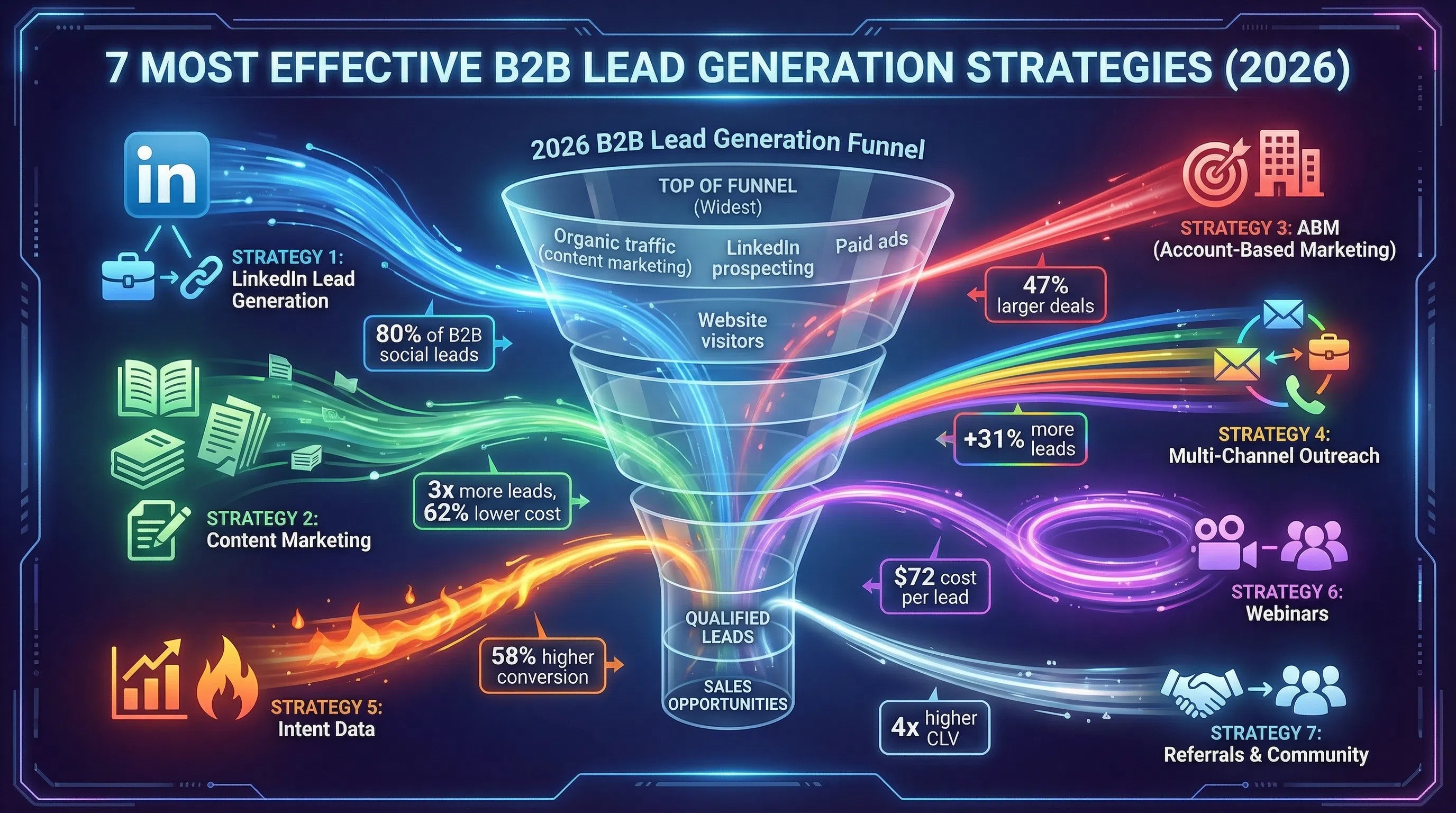
LinkedIn drives 80% of B2B social leads. Content marketing delivers 3x more leads at 62% lower cost. Multi-channel increases leads 31%. Discover the 7 proven strategies with benchmarks and implementation frameworks.
LeadSpark AI Team
14 min read
B2B lead generation has fundamentally changed. The tactics that dominated for decades—cold calling, trade shows, and generic email blasts—no longer deliver the ROI needed to sustain growth in competitive markets.
In 2026, successful B2B lead generation isn't about volume. It's about quality, precision, and building relationships before asking for the meeting.
According to the latest research, today's buyers complete 67% of their research before ever talking to sales. LinkedIn drives 80% of all social media leads in B2B. Multi-channel campaigns generate 31% more leads than single-channel approaches. And AI-powered personalization is on track to handle 30% of outbound marketing from large companies by year-end.
In this guide, we'll break down the 7 B2B lead generation strategies that actually work in 2026, complete with benchmarks, implementation frameworks, and real-world results.
The Shift from Quantity to Quality
Before diving into specific strategies, understand this fundamental shift:
Old approach (pre-2024): Cast the widest net possible. Send thousands of cold emails, make hundreds of cold calls, attend every trade show, and hope 1-2% convert.
New approach (2026): Identify ideal prospects, provide value before asking, build multi-touch relationships, and convert 10-30% of engaged leads.
The numbers tell the story:
- Average B2B conversion rate: 2.6% overall (visitor to customer)
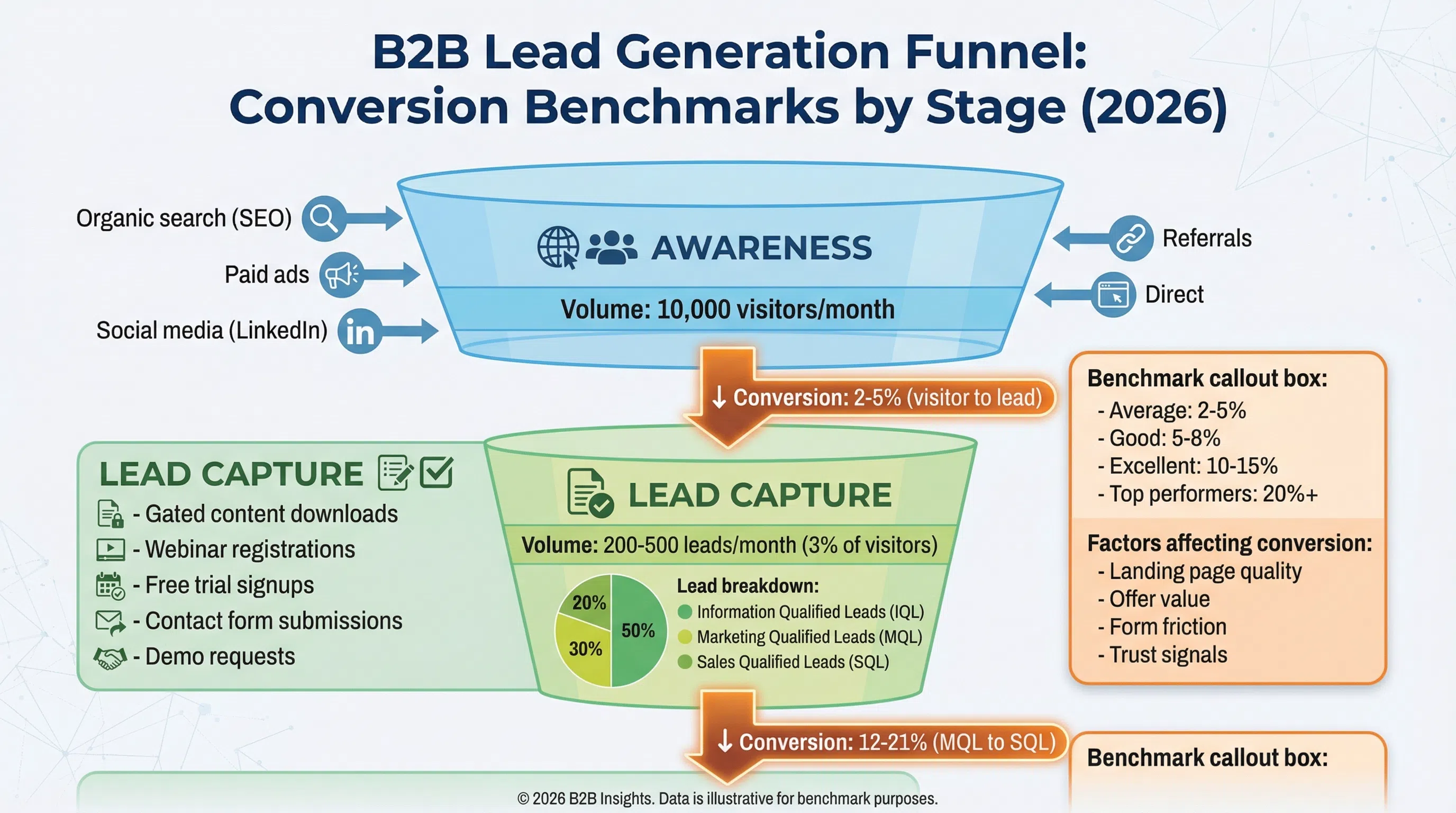
- Website visitor-to-lead: 2-5% average
- MQL to SQL conversion: 12-21% average, 40% for top performers
- Lead-to-customer: 10-20% for well-qualified leads
The companies winning in 2026 focus on moving prospects through each stage efficiently rather than just increasing top-of-funnel volume.
Strategy #1: LinkedIn Lead Generation
LinkedIn isn't just another channel—it's the dominant force in B2B lead generation for 2026.
Why LinkedIn Dominates
The data:
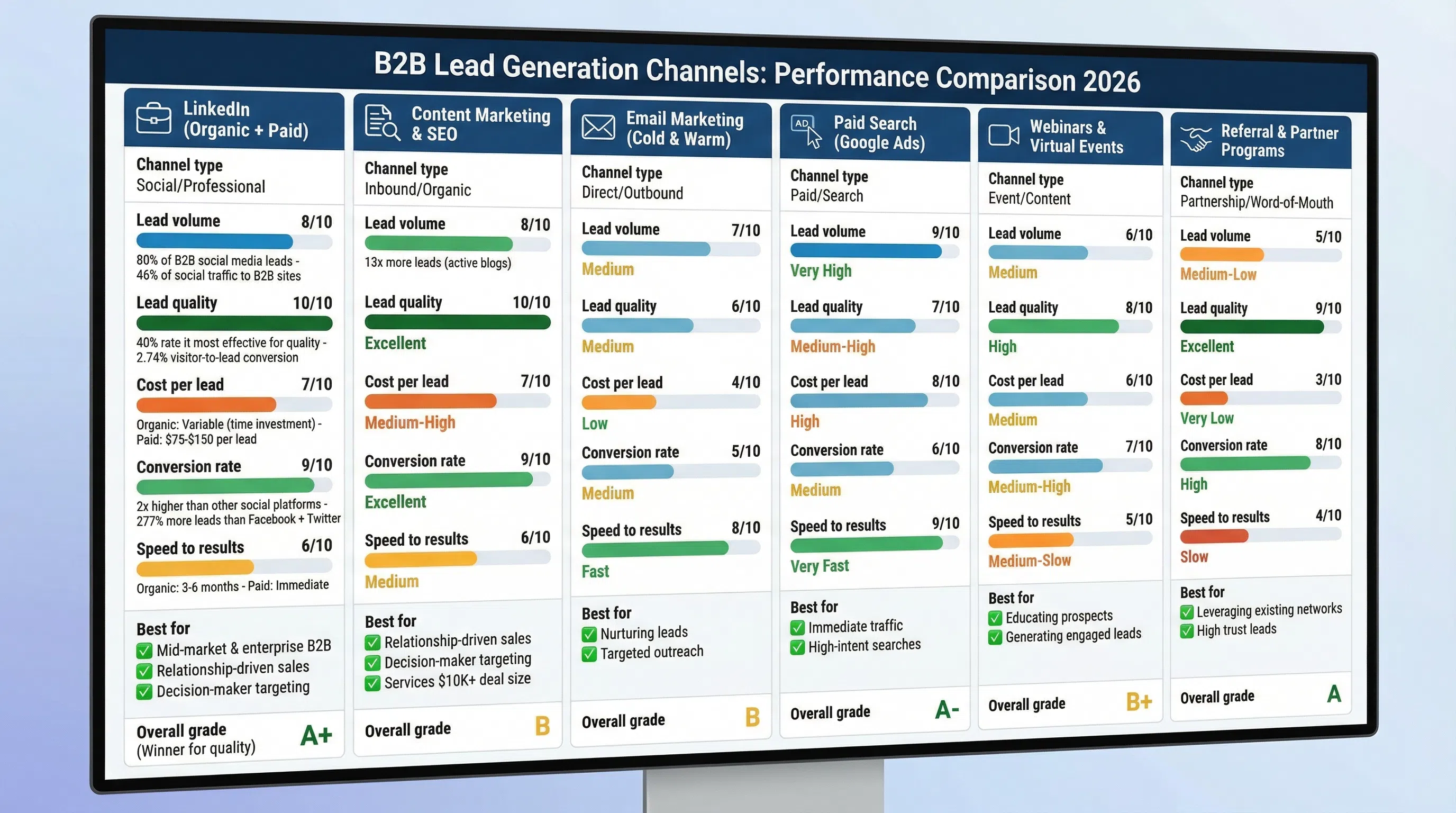
- 80% of B2B social media leads come from LinkedIn
- 89% of B2B marketers use LinkedIn for lead generation
- 40% rate LinkedIn as the most effective channel for high-quality leads
- 277% more leads than Facebook and Twitter combined
- 46% of social traffic to B2B websites comes from LinkedIn
- 2.74% visitor-to-lead conversion rate (nearly 3x higher than Facebook)
LinkedIn works because decision-makers actually use the platform. Your prospects aren't scrolling Instagram or TikTok during work hours—they're on LinkedIn.
How to Implement LinkedIn Lead Generation
Option 1: Organic LinkedIn Prospecting
- Optimize your profile: Professional headshot, compelling headline, achievement-focused summary
- Post valuable content: Share insights 3-5x per week (industry trends, lessons learned, data analysis)
- Engage strategically: Comment on prospects' posts before reaching out
- Send personalized connection requests: Reference specific posts, mutual connections, or shared interests
- Nurture with value-first messages: Provide insights before asking for meetings
Results: 20-30 qualified connections per week, 10-15% response rate on messages
Option 2: LinkedIn Ads (Paid)
- Create sponsored content: Target specific job titles, companies, industries
- Use Lead Gen Forms: Pre-filled forms reduce friction (6-10% conversion rate)
- Run InMail campaigns: Direct outreach to non-connections
- Retarget website visitors: Bring engaged visitors back to content offers
Results: $53-$150 cost per lead (varies by industry), 2x higher conversion than other social platforms
Option 3: AI-Powered LinkedIn Personalization
- Use AI to analyze prospects: Tools like LeadSpark AI analyze profiles and recent posts
- Generate contextual messages: Reference specific posts, company news, shared interests
- Scale personalization: Reach 500-1,000 prospects per week with 70-90% response rates
- Coordinate with email: Multi-channel sequences for maximum impact
Results: 70-90% response rates, 20+ hours saved per week per SDR
Best For
- Mid-market and enterprise B2B sales
- Services with $10K+ deal sizes
- Complex sales requiring relationship building
- Targeting specific job titles or industries
Strategy #2: Content Marketing & Thought Leadership
Content marketing produces 3x more leads at 62% lower cost compared with traditional outbound channels. But only if done strategically.
Why Content Marketing Works
The data:
- 67% of buyer research happens before contacting sales
- 13x more leads for companies that blog actively
- 70-20-10 rule: 70% educational, 20% engagement, 10% promotional content converts best
- $31-$72 cost per lead (SEO, email, webinars) vs $150+ for paid ads
Modern buyers want to research independently. When your content answers their questions, you're positioned as the trusted expert when they're ready to buy.
How to Implement Content Marketing
Step 1: Identify Content Topics
Research what your ideal customers are searching for:
- Use tools like Ahrefs, SEMrush to find keyword opportunities
- Analyze competitor content that ranks well
- Survey existing customers about pre-purchase research
- Monitor LinkedIn conversations and questions
Step 2: Create Pillar Content
Develop comprehensive guides (2,500-4,000 words) on core topics:
- "Complete Guide to [Problem Your Product Solves]"
- "[Your Industry] Benchmark Report 2026"
- "How to Choose [Your Product Category]"
Step 3: Distribute Strategically
- Publish on your website (SEO value)
- Share on LinkedIn with key insights (social reach)
- Send to email list with exclusive sections (nurture leads)
- Repurpose into LinkedIn posts, Twitter threads, webinars
Step 4: Gate Strategically
Gate only your highest-value content:
- Industry reports and original research
- Comprehensive templates and frameworks
- Video courses or webinar recordings
Leave educational content ungated to build audience and SEO value.
Best For
- Complex B2B products requiring education
- Industries with long sales cycles (6+ months)
- Building brand authority and thought leadership
- Companies with content creation capabilities
Strategy #3: Account-Based Marketing (ABM)
ABM flips traditional lead generation by targeting specific high-value accounts with personalized campaigns.
Why ABM Works
The data:
- 47% larger deal sizes with ABM vs traditional approaches
- 68% higher close rates for ABM accounts
- 91% increase in average deal size for companies using ABM
- ROI: 87% of marketers report ABM outperforms other marketing investments
ABM works because it aligns sales and marketing around shared target accounts and coordinates personalized outreach across multiple stakeholders.
How to Implement ABM
Step 1: Identify Target Accounts
Select 50-200 high-value accounts based on:
- Ideal customer profile fit (industry, size, tech stack)
- Revenue potential ($50K+ ARR minimum for ABM)
- Strategic value (brand name, case study potential, referral network)
- Buying signals (hiring, funding, technology changes)
Step 2: Research and Map Stakeholders
For each target account, identify:
- Economic buyer (budget authority)
- Technical buyer (evaluates solution)
- Champion (internal advocate)
- Influencers (provide input)
Step 3: Develop Account-Specific Campaigns
Create personalized assets for each account:
- Custom landing pages with account name
- Industry-specific case studies
- Personalized video messages
- Account-specific pain point content
Step 4: Coordinate Multi-Channel Outreach
Surround target accounts with coordinated messaging:
- LinkedIn ads targeting account employees
- Personalized LinkedIn outreach to stakeholders
- Direct mail (physical packages for top-tier accounts)
- Email sequences with account-specific insights
- Retargeting ads with custom messaging
Step 5: Measure Account Engagement
Track engagement across all touchpoints:
- Website visits from target accounts
- Content downloads by stakeholder
- LinkedIn profile views and post engagement
- Email opens and clicks
- Ad impressions and clicks
Best For
- Enterprise sales with $100K+ deal sizes
- Complex sales with 5-10 stakeholders
- Industries with small total addressable markets
- Sales teams with strong alignment between sales and marketing
Strategy #4: Multi-Channel Outreach Campaigns
Multi-channel campaigns see 31% uplift in leads compared to single-channel approaches. When done right, they combine the scale of email with the engagement of LinkedIn and the personal touch of phone calls.
Why Multi-Channel Works
The data:
- 287% higher purchase rates for campaigns using 3+ channels
- 494% increase in order rates when using multiple channels
- 40% higher response rates when combining email and LinkedIn vs email alone
- Optimal channel count: 3-4 channels (email + LinkedIn + phone/SMS)
Multiple touchpoints across different platforms create familiarity, build trust, and reach prospects in their preferred channels.
How to Implement Multi-Channel Campaigns
The Winning Sequence (14 days):
Day 1: Personalized cold email (primary value proposition)
Day 2: LinkedIn profile view (subtle awareness)
Day 3: LinkedIn connection request (personalized note)
Day 4: Phone call + voicemail (personal touch)
Day 7: Follow-up email (different angle, new value prop)
Day 10: LinkedIn message or InMail (contextual, post-based)
Day 14: Final email or call (breakup message)
Key Principles:
- Different message per channel: Don't repeat the same message on email and LinkedIn
- Space touchpoints 2-4 days: Avoid overwhelming prospects
- Provide value each time: Share insights, not just "checking in"
- Track channel attribution: Know which channel drives responses
Tools to Coordinate Multi-Channel:
- Email: Instantly.ai, Smartlead, Outreach, SalesLoft
- LinkedIn: LeadSpark AI (AI personalization), Expandi, Meet Alfred
- Phone: Apollo, Aircall, Gong
- Orchestration: HubSpot, Reply.io, Groove
Best For
- Mid-market B2B sales ($10K-$100K deals)
- Sales cycles of 2-6 months
- When competing for attention in crowded markets
- Teams with capacity for coordinated outreach
Strategy #5: Intent Data & Buyer Signal Tracking
Intent data identifies prospects actively researching solutions like yours, allowing you to reach them at the perfect moment.
Why Intent Data Works
The data:
- 58% higher conversion rates when contacting prospects showing intent signals
- 3-5x more likely to respond when timing aligns with active research
- 22% shorter sales cycles when engaging intent-qualified leads
- 41% higher win rates for intent-driven outreach
Intent data works because you're reaching prospects when they're actually looking for solutions, not interrupting them randomly.
Types of Intent Signals
First-Party Intent (Your Data):
- Website visits to pricing or product pages
- Content downloads (especially bottom-funnel content)
- Email engagement (clicks on specific topics)
- Product demo requests or trial signups
- LinkedIn profile views of your company page
Third-Party Intent (External Data):
- Researching competitors on review sites (G2, Capterra)
- Reading industry content about your product category
- Searching for solution-related keywords
- Attending relevant webinars or events
- Engaging with industry thought leaders
Technographic Intent:
- Using complementary tools in your ecosystem
- Technology stack changes (hiring for specific skills)
- Funding announcements or rapid hiring
- Contract renewals approaching with competitors
How to Implement Intent-Based Lead Generation
Step 1: Set Up First-Party Tracking
- Install website tracking for key page visits
- Create lead scoring model (points for high-intent actions)
- Set up alerts for hot leads (pricing page + case study + demo request)
- Track email engagement by topic
Step 2: Leverage Third-Party Intent Data
Use platforms like:
- Bombora: Intent topics being researched
- G2: Competitor research activity
- Clearbit: Technographic and company data
- Leadfeeder/Leadinfo: Website visitor identification
Step 3: Create Intent-Specific Outreach
When prospects show intent signals:
- High intent (pricing + demo request): Call within 5 minutes, email same day
- Medium intent (content download): Email sequence starting next day
- Low intent (blog reads): Add to nurture campaign, retarget with ads
Step 4: Personalize Based on Intent
Reference the specific signal in your outreach:
- "Saw you checked out our pricing page—happy to answer questions"
- "I noticed you downloaded our ROI calculator. Here's how [similar company] achieved 3x ROI"
- "You've been researching [competitor]. Here's how we compare on [specific feature]"
Best For
- B2B SaaS with measurable product interest
- Competitive markets where timing matters
- Sales teams that can respond quickly to signals
- Companies with marketing automation and CRM infrastructure
Strategy #6: Webinars & Virtual Events
Webinars remain one of the most cost-effective B2B lead generation tactics when executed strategically.
Why Webinars Work
The data:
- $72 average cost per lead (among lowest for B2B channels)
- 20-40% conversion rate from registrant to attendee
- 30-50% of attendees become qualified leads
- 2-3x longer engagement than most content formats (45-60 minutes)
Webinars work because they provide deep value, demonstrate expertise live, and create a committed audience (attendees invest 45-60 minutes of their time).
How to Implement Webinar Lead Generation
Step 1: Choose Strategic Topics
Successful webinar topics:
- Industry benchmark reports ("2026 [Industry] Benchmark Data")
- Tactical how-to guides ("How to Reduce [Problem] by 50% in 90 Days")
- Expert panels ("3 Industry Leaders on [Hot Topic]")
- Product deep dives (for bottom-funnel prospects)
Step 2: Promote Across Channels
- Email list (2-3 weeks before)
- LinkedIn organic posts (daily leading up to event)
- LinkedIn ads (target specific titles/companies)
- Partner co-promotion (split registrations)
- Website pop-ups and banners
Step 3: Maximize Show-Up Rates
- Send 3 reminder emails (1 week before, 1 day before, 1 hour before)
- Offer incentives (exclusive template for attendees)
- Make it easy to join (one-click registration, no downloads required)
- Time strategically (Tuesday-Thursday, 10am-2pm performs best)
Step 4: Follow Up Strategically
Segment follow-up by engagement:
- Attended + engaged (questions, polls): Sales call within 24 hours
- Attended passively: Email with recording + related resources
- Registered but no-show: Send recording with "here's what you missed"
- All registrants: Add to nurture campaign for future webinars
Best For
- Complex products requiring demonstration
- Industries where education drives purchasing decisions
- Building thought leadership and brand authority
- Generating bottom-funnel leads ready for sales conversations
Strategy #7: Referral & Community-Led Growth
In 2026, one of the fastest-growing lead generation strategies is building communities and leveraging referrals from satisfied customers.
Why Community-Led Growth Works
The data:
- Referred leads have 4x higher close rates than other sources
- 16% higher lifetime value for referred customers
- 3x lower customer acquisition cost for referral-driven leads
- 37% higher retention rates for customers acquired through referrals
Referrals work because they come with built-in trust and social proof. When your current customer recommends you, the prospect is pre-qualified and pre-sold.
How to Implement Community-Led Growth
Option 1: Formal Referral Program
- Incentivize referrals: Offer account credits, cash rewards, or exclusive features
- Make it easy: One-click referral links, email templates, social share buttons
- Ask at peak satisfaction: After successful onboarding, after positive support interaction
- Track and reward: Use referral software (ReferralCandy, Rewardful, PartnerStack)
Typical results: 10-25% of customers make at least one referral, 5-15% referral conversion rate
Option 2: Private Community Building
- Create exclusive groups: Slack community, LinkedIn group, Circle community
- Provide ongoing value: Weekly office hours, peer networking, early access to features
- Encourage peer-to-peer: Members help each other, reducing support burden
- Facilitate introductions: Members naturally refer colleagues and peers
Typical results: 20-30% of community members refer at least one prospect annually
Option 3: Strategic Partnerships
- Partner with complementary tools: Integrate with platforms your customers already use
- Co-market to each other's audiences: Joint webinars, co-branded content
- Build referral loops: Recommend each other during onboarding
- Create ecosystem plays: Become essential part of their tech stack
Typical results: 15-40% of customers come from partner ecosystem over time
Best For
- Products with strong customer satisfaction scores (NPS >40)
- Network-effect businesses where more users = more value
- Industries with tight-knit communities
- Companies with existing customer base to activate
Building Your Lead Generation Framework
Most companies shouldn't choose one strategy—they should build a framework combining multiple approaches based on their market, resources, and sales cycle.
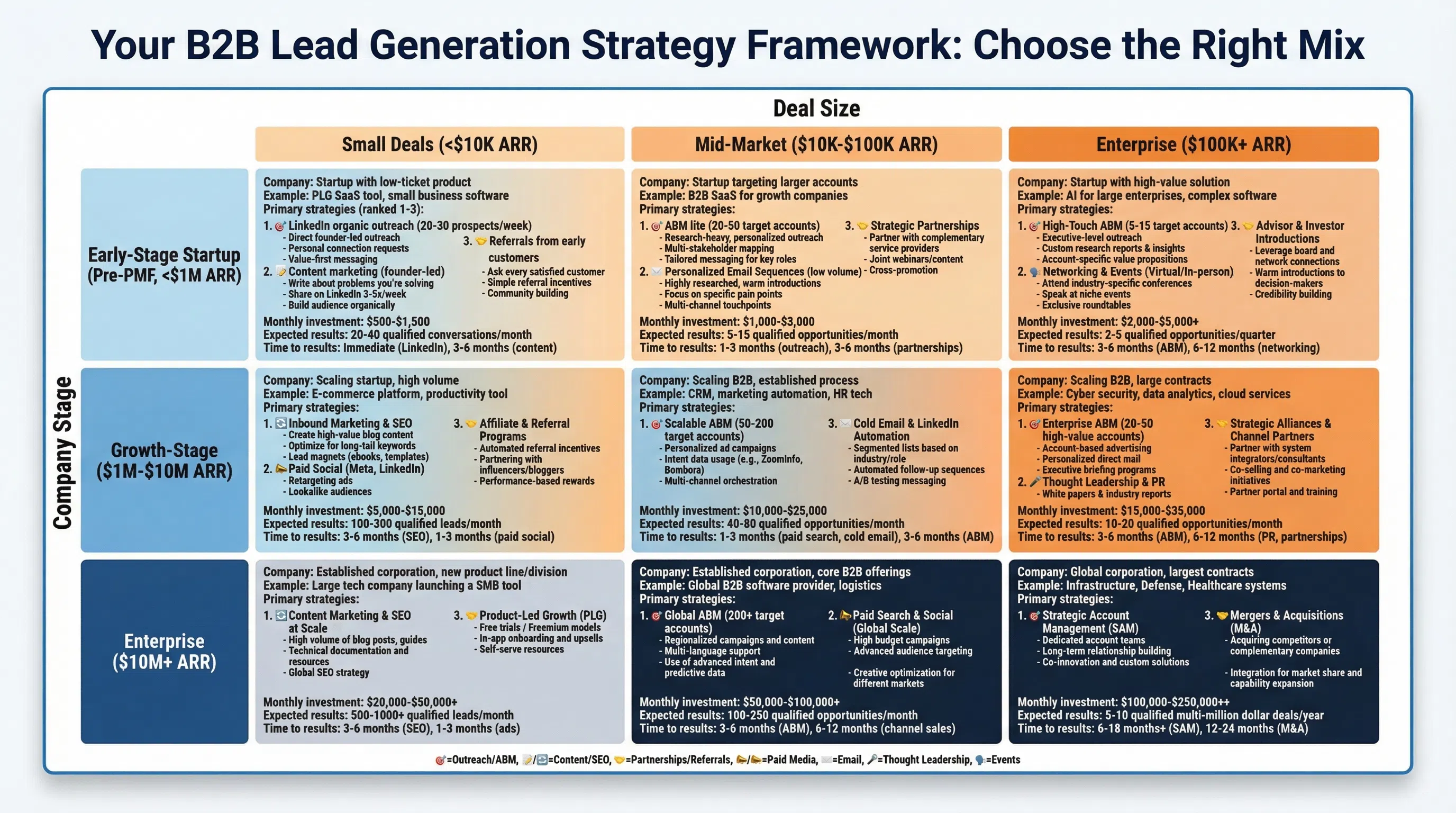
Framework by Company Stage
Early-Stage Startups (Pre-Product-Market Fit)
Focus: Fast learning and validation
Primary strategies:
- LinkedIn outreach (20-30 prospects per week)
- Referrals from early customers
- Thought leadership content (founder-led)
Monthly investment: $500-$1,500
Expected results: 20-40 qualified conversations per month
Growth-Stage Companies ($1M-$10M ARR)
Focus: Scalable pipeline generation
Primary strategies:
- Content marketing + SEO (pillar content strategy)
- Multi-channel outreach (email + LinkedIn + phone)
- Webinars (monthly, tactical topics)
- LinkedIn ads (retargeting engaged visitors)
Monthly investment: $5K-$15K
Expected results: 100-300 qualified leads per month
Enterprise Companies ($10M+ ARR)
Focus: Account-based targeting and market leadership
Primary strategies:
- ABM for top-tier accounts (50-200 target accounts)
- Thought leadership (executive content, speaking, research)
- Intent data + coordinated outreach
- Partner ecosystem
- Community building
Monthly investment: $25K-$100K+
Expected results: 50-150 highly qualified enterprise leads per month
Framework by Deal Size
Small deals (<$10K ARR)
- Prioritize: Content marketing, LinkedIn ads, automated email sequences
- Goal: High volume, low touch
Mid-market deals ($10K-$100K ARR)
- Prioritize: Multi-channel outreach, webinars, intent data
- Goal: Balance volume and personalization
Enterprise deals ($100K+ ARR)
- Prioritize: ABM, executive outreach, strategic partnerships
- Goal: Deep relationships with few high-value accounts
Measuring Lead Generation Success
Track these metrics to optimize your lead generation efforts:
Top-of-Funnel Metrics
- Traffic sources: Organic, paid, social, referral, direct
- Visitor-to-lead conversion rate: Target 2-5% (B2B average)
- Cost per lead by channel: Track SEO, LinkedIn, content, webinars separately
- Lead volume by source: Understand which channels drive quantity
Mid-Funnel Metrics
- MQL to SQL conversion rate: Target 12-21% (40% for top performers)
- Lead quality score: Track how source impacts downstream conversion
- Time in each stage: Identify bottlenecks in lead qualification
- Sales engagement rate: % of leads sales actually contacts
Bottom-Funnel Metrics
- SQL to opportunity conversion: Target 20-40%
- Opportunity to customer: Target 20-30%
- Overall lead-to-customer: Target 2-5% (well-qualified leads 10-20%)
- Cost per customer by source: Full-funnel attribution
Business Impact Metrics
- Customer acquisition cost (CAC): Total marketing + sales cost / new customers
- CAC payback period: Months to recover acquisition cost
- Return on marketing investment: (Revenue - Marketing Cost) / Marketing Cost
- Lead source influence on deal size: Do certain sources bring larger deals?
Common Mistakes to Avoid
Mistake #1: Chasing vanity metrics
More leads doesn't mean more revenue. A campaign generating 1,000 unqualified leads is worse than one generating 100 highly qualified leads. Focus on conversion rates and revenue, not just lead volume.
Mistake #2: Single-channel dependency
Relying only on one channel (usually cold email) exposes you to platform risk and limits reach. Multi-channel approaches generate 31% more leads and provide resilience.
Mistake #3: Weak lead qualification
Passing unqualified leads to sales destroys trust between marketing and sales. Implement clear qualification criteria (BANT, MEDDIC, or similar frameworks) before handoff.
Mistake #4: Slow follow-up
Responding to inbound leads within 5 minutes vs 30 minutes increases conversion by 100%. Speed to lead matters dramatically—automate alerts and respond immediately.
Mistake #5: Forgetting to nurture
Only 5-10% of leads are ready to buy now. The other 90-95% need nurturing over 6-18 months. Build automated nurture campaigns for leads not yet ready.
Mistake #6: Not measuring properly
Without proper attribution and funnel metrics, you're flying blind. Implement tracking from first touch through closed-won to understand what actually drives revenue.
Conclusion: Quality Over Quantity Wins in 2026
The B2B lead generation landscape has fundamentally shifted. The winning strategies in 2026 prioritize:
- Quality over quantity: Better to have 100 engaged prospects than 10,000 cold leads
- Personalization at scale: AI enables customized outreach to thousands of prospects
- Multi-channel coordination: Combine LinkedIn, email, content, and phone for maximum impact
- Intent-based timing: Reach prospects when they're actively researching, not randomly
- Value-first engagement: Provide insights before asking for meetings
For most B2B companies, the winning formula combines:
- LinkedIn prospecting (organic or AI-powered for scale)
- Content marketing (builds authority and organic inbound)
- Multi-channel sequences (email + LinkedIn + phone for outbound)
- Intent data (timing and relevance)
The specific mix depends on your deal size, sales cycle, and target market—but the foundation remains the same: be where your buyers are (LinkedIn), provide value before asking (content), reach them when they're ready (intent), and coordinate across channels (multi-touch).
Generate More B2B Leads with AI-Powered LinkedIn Prospecting
If LinkedIn is your primary B2B lead generation channel (and the data says it should be), AI-powered personalization is the fastest way to scale without sacrificing quality.
LeadSpark AI helps B2B teams generate 70-90% response rates on LinkedIn by analyzing prospect profiles, recent posts, and company news to create hyper-personalized messages at scale.
How it works:
- Upload your prospect list (from Sales Navigator, Apollo, or your CRM)
- AI analyzes LinkedIn profiles and recent activity for personalization opportunities
- Generate contextual messages referencing specific posts and company developments
- Send at scale while maintaining authentic, personalized messaging
- Track responses and integrate with your CRM
Sales teams using LeadSpark AI save 20+ hours per week on prospecting while increasing response rates from 18-25% (manual LinkedIn) to 70-90% (AI-personalized).
Start your free trial and see how AI-powered LinkedIn prospecting compares to your current lead generation approach. No credit card required.
Ready to Generate Personalized Icebreakers?
Join sales professionals using LeadSpark AI to create hyper-personalized LinkedIn icebreakers in minutes.