Outreach Best Practices
How to Write a Sales Cadence That Actually Books Meetings
Learn how to build a winning sales cadence with proven templates for B2B. Get 8-12 multi-channel touchpoints that convert prospects into booked meetings in 2026.
LeadSpark AI Team
11 min read
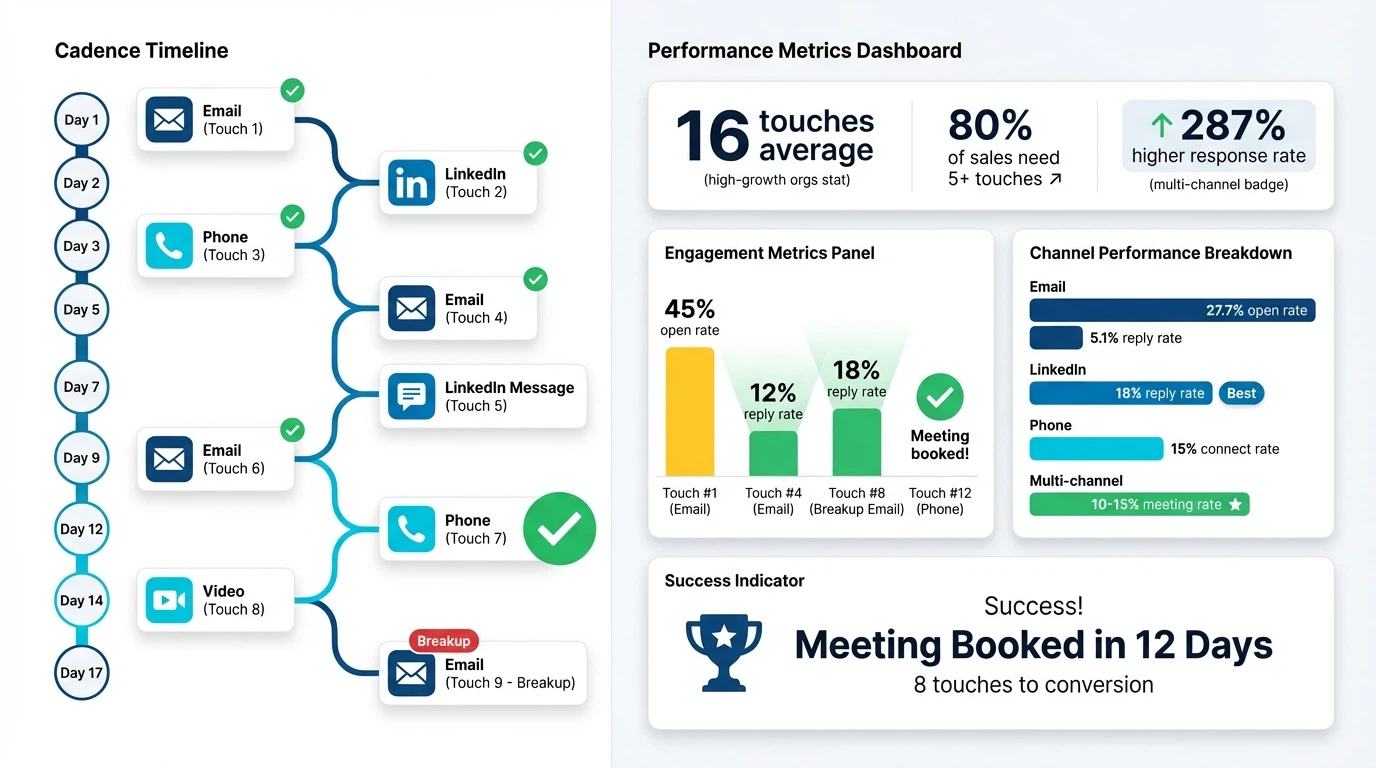
Most sales reps quit after 1-2 attempts. Yet 80% of sales require 5+ follow-ups.
Here's why: The average prospect needs to see your message 8-12 times before they're ready to take action. Without a structured sales cadence, you're leaving 80% of your potential deals on the table.
High-growth B2B organizations average 16 touches per prospect over 2-4 weeks. They don't wing it—they follow proven, multi-channel cadences that systematically move prospects from cold outreach to booked meetings.
This guide shows you exactly how to build sales cadences that actually work in 2026, complete with templates you can use today.
What is a Sales Cadence?
A sales cadence (also called an outreach sequence or sales sequence) is a structured series of touchpoints that sales reps use to engage prospects over a specific timeframe. Think of it as a recipe for moving prospects from initial contact to a booked meeting.
A sales cadence typically includes:
- Multiple channels: Email, phone, LinkedIn, video
- Specific timing: When to reach out (Day 1, Day 3, Day 7, etc.)
- Varied messaging: Different value propositions and angles
- Clear next steps: What to do if they respond (or don't respond)
Example cadence at a glance:
- Day 1: Email #1 (Introduction)
- Day 2: LinkedIn connection request
- Day 3: Phone call + voicemail
- Day 5: Email #2 (Case study)
- Day 7: LinkedIn DM (if connected)
- Day 9: Phone call + voicemail
- Day 12: Email #3 (Breakup email)
The goal? Book qualified meetings consistently and predictably.
Why Sales Cadences Matter in 2026
Random, one-off outreach doesn't work anymore. Here's what the data shows:
The Numbers That Matter
- 80% of sales require 5+ touches, yet 44% of reps give up after just one
- High-growth orgs average 16 touches per prospect over 2-4 weeks
- Inbound leads need 8-12 touchpoints over 10-15 days
- Cold outreach requires 6-8 touchpoints minimum (many experts recommend 17+)
- Sales cycles are 22% longer than in 2022, making persistence more critical
- 80% of B2B sales interactions now happen via digital channels
- 75%+ of B2B buyers expect seamless, personalized experiences across channels
What Changed in 2026
Old approach (2020):
- 3-5 touches over 1 week
- Email-only sequences
- Generic templates
- Give up after no response
New approach (2026):
- 8-17 touches over 2-4 weeks
- Multi-channel coordination (email + phone + LinkedIn + video)
- Personalized messaging per channel
- Systematic follow-up with varied value propositions
The companies booking the most meetings aren't working harder—they're following better cadences.
How Many Touches Should Your Sales Cadence Have?
The answer depends on your lead source and deal size:
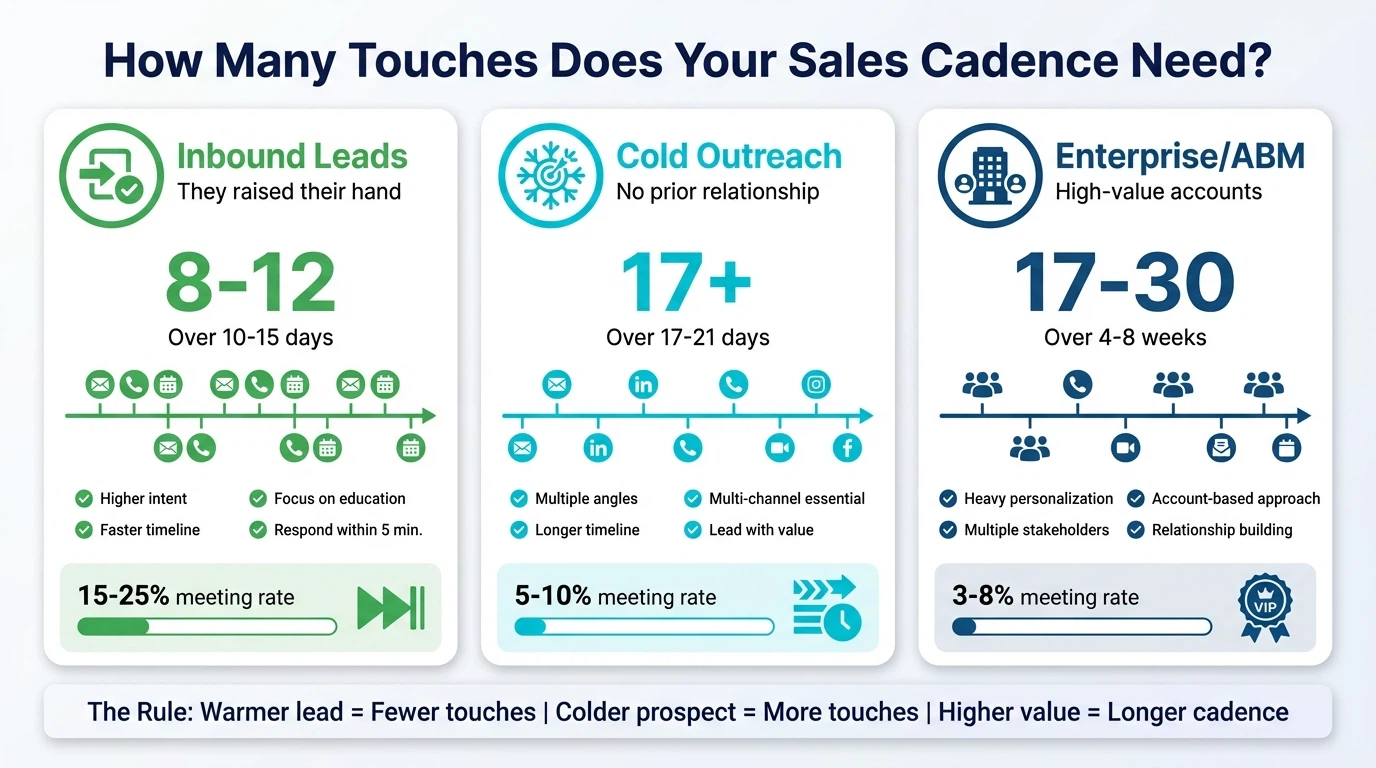
Inbound Leads (Warm)
Recommended: 8-12 touches over 10-15 days (2-3 weeks)
Inbound leads have shown interest, so you want to strike while the iron is hot:
- More compressed timeline (10-15 days vs 17-21)
- Higher frequency (daily touches acceptable)
- Focus on education and demos
- Speed matters—respond within 5 minutes for 100x better conversion
Cold Outreach (Cold)
Recommended: 6-8 touches minimum, 17+ for best results
Cold prospects need more nurturing before they're ready:
- Longer timeline (17-21 days, or longer)
- More varied messaging (test different angles)
- Multi-channel essential (287% higher response rates)
- Lead with value, not pitch
Enterprise/High-Value Accounts
Recommended: 17-30 touches over 4-8 weeks
Complex deals require relationship building:
- Much longer timeline (4-8 weeks)
- Account-based approach (multiple stakeholders)
- Heavy personalization (video, custom content)
- Mix of education, insights, and social engagement
The Rule of Thumb:
Warmer lead = fewer touches needed. Colder prospect = more touches required. Higher deal value = longer, more personalized cadence.
The Anatomy of a High-Performing Sales Cadence
Every successful sales cadence includes these 7 elements:
1. Multiple Channels (Not Just Email)
Why: Multi-channel outreach increases response rates by 287% compared to email-only.
Use:
- Email: Detailed information, case studies, resources
- Phone: Personal connection, immediate questions, urgency
- LinkedIn: Social proof, relationship building, light touches
- Video: Personalization at scale, demonstrations, personality
Best practice: Mix 2-4 channels per cadence. Don't use all channels in every touchpoint.
2. Strategic Spacing (Not Random Timing)
Why: Too frequent = annoying. Too spaced out = they forget you.
Optimal spacing:
- Days 1-7: Every 1-2 days (building initial awareness)
- Days 8-14: Every 2-3 days (maintaining presence)
- Days 15-21: Every 3-5 days (final attempts)
Best practice: Front-load your touches early (more frequent), then space them out as the cadence progresses.
3. Varied Value Propositions (Not the Same Message)
Why: If one angle doesn't resonate, try another.
Vary by:
- Pain point addressed: Different problems your solution solves
- Proof type: Case studies, ROI data, testimonials, demos
- Offer type: Education, free trial, consultation, tool/resource
- Format: Text, video, PDF, link to resource
Best practice: Each touchpoint should stand alone. Don't assume they saw your previous messages.
4. Personalization Hooks (Not Generic Templates)
Why: Generic messages get ignored. Personalized messages get 6x higher open rates.
Personalize using:
- Specific LinkedIn posts they shared
- Recent company news (funding, expansion, hires)
- Mutual connections or shared experiences
- Industry-specific challenges
- Competitor mentions or pain points they've expressed
Best practice: Use AI tools like LeadSpark AI to automate LinkedIn post analysis and generate personalized hooks in under 30 seconds instead of 30 minutes.
5. Clear Next Steps (Not Vague CTAs)
Why: Confused prospects don't reply. Clear CTAs get responses.
Good CTAs:
- "Worth 15 minutes next Tuesday or Thursday?"
- "Should I send you the case study PDF?"
- "Can I take you off this list?"
- "Quick question: Are you the right person for this?"
Bad CTAs:
- "Let me know your thoughts"
- "Interested in chatting?"
- "What does your calendar look like?"
Best practice: Ask for the smallest possible commitment. Low friction = higher response.
6. Breakup Moment (Not Endless Following Up)
Why: Respect their time. Create urgency. Get a definitive yes or no.
Breakup email approach:
- Touch 8-12 in the sequence
- Direct: "Should I stop emailing you?"
- Give easy opt-out: "Just reply 'not interested'"
- Often gets 30-40% higher response rates than regular emails
Best practice: Make it your final attempt. If no response after breakup email, move them to long-term nurture (quarterly touches).
7. Response Protocols (What Happens When They Reply)
Why: A response doesn't equal a booked meeting. You need next steps.
Define:
- Positive response: Move to meeting booking sequence
- Negative response: Ask permission to follow up in 6 months
- Question/objection: Address it, then pivot to meeting
- Out-of-office: Note return date, follow up day after
- Wrong person: Ask for referral to right person
Best practice: Respond within 5 minutes if possible. Speed kills in sales.
Sales Cadence Templates (Copy & Use)
Template #1: Inbound Lead Cadence (10 Days, 8 Touches)
Use case: Someone downloaded your content, signed up for trial, or submitted contact form
Timeline: 10 days | Touches: 8 | Channels: Email (5), Phone (2), LinkedIn (1)
Day 1 - Email #1 (Within 5 minutes of lead coming in)
`
Subject: [Resource] you requested
Hi [Name],
Here's the [guide/tool/resource] you requested: [link]
Quick question while I have you—what specific challenge made you interested in this?
Best,
[Your Name]
`
Day 1 - Phone Call #1 (30-60 minutes after email)
- If answer: Qualify and book meeting
- If voicemail: "Hi [Name], [Your Name] from [Company]. Sent you the [resource]—wanted to answer any quick questions. Call me back at [number]."
Day 2 - Email #2
`
Subject: Quick question about [their company]
Hi [Name],
Saw that [specific company fact: recent hire, product launch, etc.].
We helped [similar company] with [specific result]. Worth 15 minutes this week to see if there's a fit?
[Calendar link]
[Your Name]
`
Day 3 - LinkedIn Connection Request
"Hi [Name]—sent you [resource] earlier this week. Would love to connect and share insights on [their industry/challenge]."
Day 5 - Email #3 (Case study)
`
Subject: How [Similar Company] got [Result]
Hi [Name],
Thought you'd find this interesting: [Similar Company] was struggling with [problem]. We helped them [specific solution and result].
Here's the 2-page case study: [link]
Want to see if we could do something similar for [Their Company]?
[Your Name]
`
Day 7 - Phone Call #2
- Attempt #2 with different approach
- Reference previous email
- Leave voicemail with specific value prop
Day 7 - LinkedIn DM (if they connected)
`
Thanks for connecting! I know you downloaded our [resource]—curious what specific challenge you're working on? Happy to share what's working for teams like yours.
`
Day 10 - Email #4 (Breakup)
`
Subject: Should I stop emailing you?
Hi [Name],
I've reached out a few times about [value prop]. Haven't heard back, so I'm guessing:
- Not a priority right now
- Wrong person
- Not a good fit
Should I stop emailing you, or is the timing just not right?
[Your Name]
`
Template #2: Cold Outreach Cadence (17 Days, 12 Touches)
Use case: Complete cold prospect, no prior engagement
Timeline: 17 days | Touches: 12 | Channels: Email (5), Phone (3), LinkedIn (4)
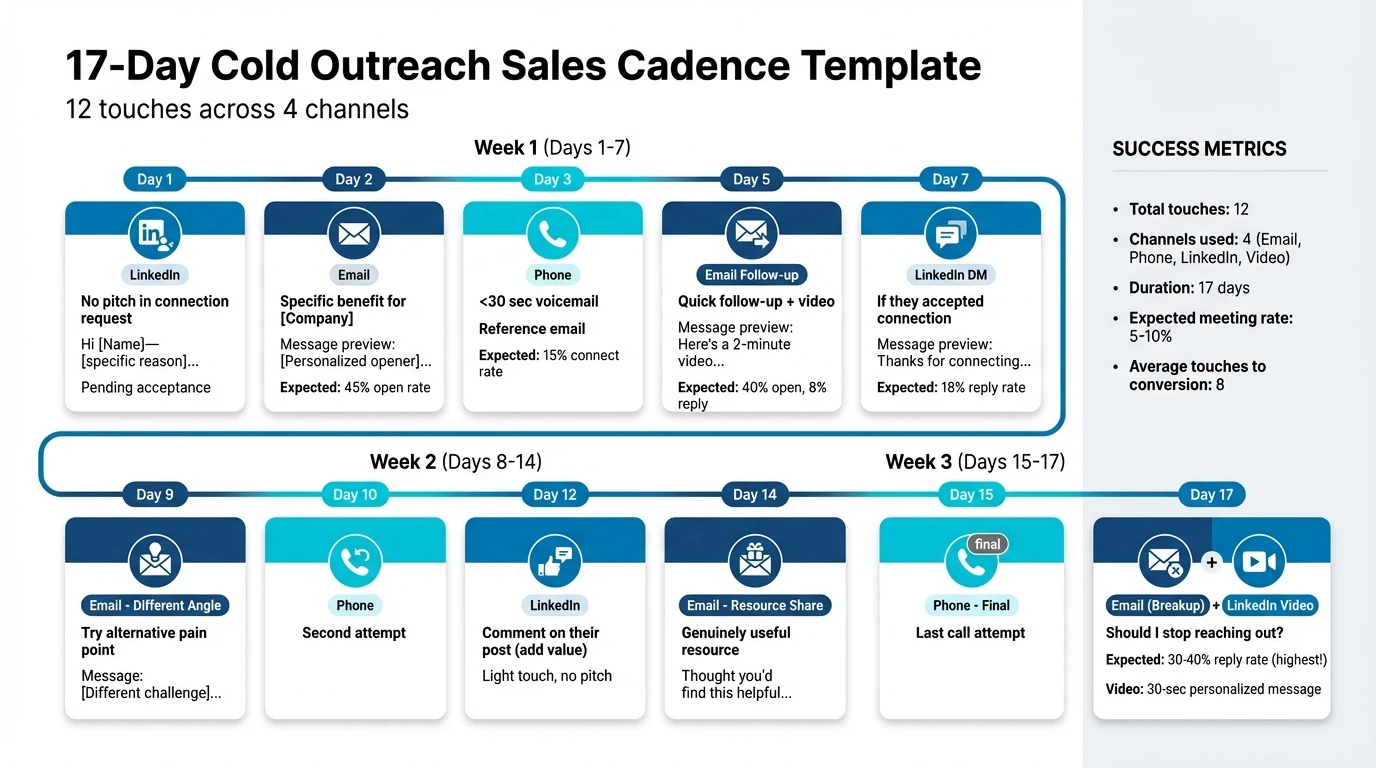
Day 1 - LinkedIn Connection Request
"Hi [Name]—[specific reason you're reaching out based on their profile]. Would love to connect."
(No pitch in connection request!)
Day 2 - Email #1
`
Subject: [Specific benefit] for [Their Company]
Hi [Name],
[Personalized opener: their LinkedIn post, company news, or industry insight]
We helped [similar company] [specific result in specific timeframe].
Worth 15 minutes next week to show you how?
[Your Name]
`
Day 3 - Phone Call #1
- Voicemail: Keep under 30 seconds, reference email, give callback number
Day 5 - Email #2
`
Subject: Quick follow-up
Hi [Name],
Following up on my email from Tuesday.
Here's a 2-minute video showing how [Similar Company] used our approach: [video link]
Thoughts?
[Your Name]
`
Day 7 - LinkedIn DM (if they accepted connection)
`
Thanks for connecting, [Name]! I know you're busy ramping [their recent initiative you researched]. If [pain point] is on your radar, I'd love to share what's working for [industry] teams.
`
Day 9 - Email #3 (Different angle)
`
Subject: [Alternative pain point]
Hi [Name],
Switched gears—wanted to share something specific about [different challenge].
[Brief insight or statistic]
[Similar company] saw [result] when they addressed this. Worth a quick call?
[Your Name]
`
Day 10 - Phone Call #2
Day 12 - LinkedIn Engagement
- Comment on their recent post (add value, don't pitch)
Day 14 - Email #4 (Resource share)
`
Subject: Thought you'd find this useful
Hi [Name],
Even if we never work together, thought this might help: [link to genuinely useful resource]
[Brief summary of why it's relevant to them specifically]
[Your Name]
`
Day 15 - Phone Call #3
Day 17 - Email #5 (Breakup)
`
Subject: Last email, I promise
Hi [Name],
I've reached out several times about helping [Their Company] with [pain point].
If the timing's not right, that's totally fine. Should I stop emailing, or would you prefer I check back in 6 months?
[Your Name]
`
Day 17 - LinkedIn Video Message (if connected)
Record 30-second personalized video: "Hey [Name], know you're busy. Wanted to check if [value prop] is even on your radar right now, or if I should stop bothering you?"
Template #3: Enterprise Account-Based Cadence (30 Days, 17 Touches)
Use case: High-value enterprise account with multiple stakeholders
Timeline: 30 days | Touches: 17 | Channels: Email (6), Phone (4), LinkedIn (5), Video (2)
Day 1 - Research Phase
- Identify 3-5 stakeholders
- Map org chart and buying committee
- Research each person's LinkedIn, recent posts, priorities
Day 2 - LinkedIn - Stakeholder #1 (Economic Buyer)
Connection request with personalized note
Day 3 - Email #1 - Stakeholder #1
Highly personalized based on research, reference specific company initiative
Day 5 - LinkedIn - Stakeholder #2 (Technical Buyer)
Connection request
Day 5 - Phone Call #1 - Stakeholder #1
Day 7 - Video Message #1 - Stakeholder #1
30-60 second personalized video showing understanding of their challenges
Day 9 - Email #2 - Stakeholder #1 (Case study)
Day 10 - LinkedIn Engagement
Comment on Stakeholder #1's post
Day 12 - Email #1 - Stakeholder #2
Introduce yourself, reference mutual connection or shared interest
Day 14 - Phone Call #1 - Stakeholder #2
Day 15 - LinkedIn DM - Stakeholder #1
Day 17 - Email #3 - Stakeholder #1 (Different angle)
Day 19 - Phone Call #2 - Stakeholder #1
Day 21 - LinkedIn - Stakeholder #3
Connection request with warm intro if possible
Day 23 - Email #4 - Stakeholder #1 (Executive insight share)
Day 24 - Video Message #2 - Stakeholder #1
Custom demo or walkthrough specific to their use case
Day 27 - Phone Call #3 - Stakeholder #1
Day 30 - Email #5 - Stakeholder #1 (Breakup)
Ask for 6-month follow-up or referral to right person if they're not the decision maker
How to Personalize Your Sales Cadence at Scale
The #1 challenge: Personalization takes time. Here's how to scale it:
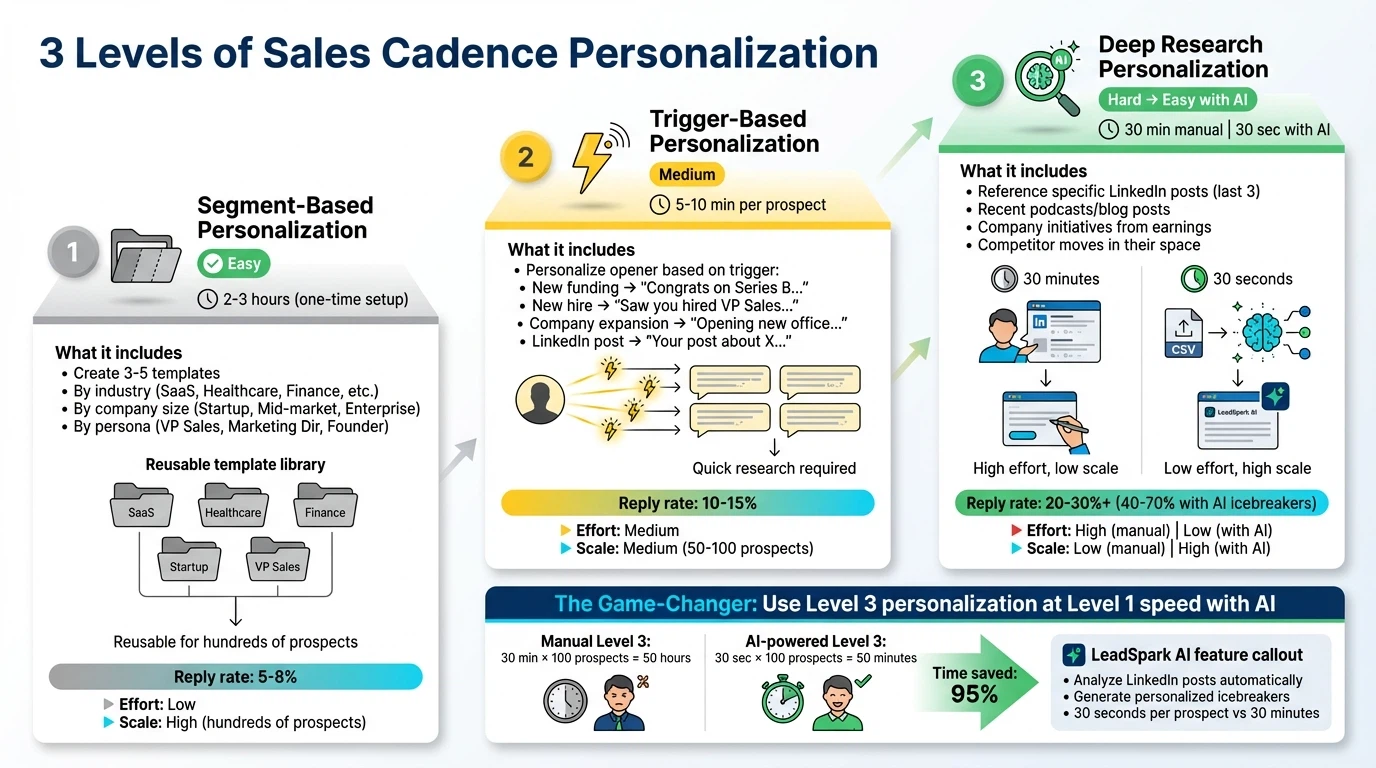
Level 1: Segment-Based Personalization (Easy)
Time: 2-3 hours one-time setup
Create 3-5 core cadence templates based on:
- Industry (SaaS, Healthcare, Financial Services, etc.)
- Company size (Startup, Mid-market, Enterprise)
- Persona (VP Sales, Marketing Director, Founder, etc.)
Customize pain points, case studies, and value props per segment.
Level 2: Trigger-Based Personalization (Medium)
Time: 5-10 minutes per prospect
Personalize the opener based on what triggered your outreach:
- New funding: "Congrats on the Series B—curious how you're planning to scale sales..."
- New hire: "Saw you just hired [Name] as VP Sales. Timing makes sense to discuss..."
- Company expansion: "Noticed you're opening offices in [Location]. As you scale..."
- LinkedIn post: "Your post about [topic] resonated—we've seen similar challenges with..."
Level 3: Deep Research Personalization (Hard)
Time: 30+ minutes per prospect (manual) OR 30 seconds (AI-powered)
Reference specific, recent information:
- Last 3 LinkedIn posts they shared
- Recent podcast appearances or blog posts
- Specific company initiatives from earnings calls
- Competitor moves in their space
The AI Shortcut:
Tools like LeadSpark AI automatically analyze prospects' recent LinkedIn activity and generate personalized icebreakers in under 30 seconds—what would take 30 minutes manually.
Example:
- Manual: Read prospect's last 5 LinkedIn posts, identify themes, craft personalized opener → 30 min
- With LeadSpark AI: Upload CSV → AI analyzes posts → Generates icebreaker → 30 sec
This lets you use Level 3 personalization at Level 1 speed.
Common Sales Cadence Mistakes (And How to Fix Them)
Mistake #1: Too Many Touches in Too Short a Time
The Problem: Emailing daily or calling multiple times per day.
Why It Fails: You come across as desperate or spammy. Prospects tune you out.
The Fix:
- Space touches 1-3 days apart (minimum)
- Max 2-3 touches per week after initial week
- Respect their time and attention
Mistake #2: All Email, No Phone or LinkedIn
The Problem: Email-only cadences.
Why It Fails: Response rates are 287% lower than multi-channel approaches. Email gets buried.
The Fix:
- Mix at least 2 channels (ideally 3)
- Use email for information, phone for urgency, LinkedIn for relationship
- Each channel reinforces the others
Mistake #3: Same Message, Different Channel
The Problem: Copying the same email into LinkedIn DMs and voicemails.
Why It Fails: Shows you're not thoughtful. Wastes the unique strengths of each channel.
The Fix:
- Email: Longer, more detailed, includes resources
- LinkedIn: Shorter, conversational, references their content
- Phone: Even shorter, direct, asks for immediate response
- Video: Personal, demonstrates personality, shows effort
Mistake #4: No Personalization Beyond {{FirstName}}
The Problem: "Hi {{FirstName}}, I noticed {{Company}}..."
Why It Fails: Prospects can spot templates instantly. Generic = ignored.
The Fix:
- Reference something specific (their post, company news, shared connection)
- Show you've done research (mention their recent initiative)
- Explain why you're reaching out now (timing/trigger)
Mistake #5: Pitching in Touch #1
The Problem: Leading with your product/service.
Why It Fails: They don't know you. They don't care about your solution yet.
The Fix:
- Touch #1: Start a conversation (ask a question, share insight)
- Touch #2-3: Build credibility (case studies, results)
- Touch #4+: Soft pitch (show relevance to their situation)
- Let them express interest before you pitch hard
Mistake #6: No Breakup Email
The Problem: Following up indefinitely with no end in sight.
Why It Fails: Wastes your time. Annoys prospects who've mentally moved on.
The Fix:
- Set a clear end point (Touch 8-12)
- Send explicit breakup email: "Should I stop reaching out?"
- Gives them easy opt-out
- Often gets highest response rate in sequence
Mistake #7: Not Tracking What Works
The Problem: Running the same cadence without analyzing results.
Why It Fails: You don't know which touches, channels, or messages drive responses.
The Fix:
- Track reply rate by touch number
- Measure response rate by channel
- Test subject lines, CTAs, and value props
- Double down on what works, cut what doesn't
Measuring Sales Cadence Performance
Track these metrics to optimize your cadences:
Activity Metrics (Leading Indicators)
- Cadences launched: How many prospects entered sequences
- Touches delivered: Total touchpoints across all cadences
- Touches per prospect: Average 8-16 is typical
- Completion rate: % of cadences that reach final touch (should be 70%+)
Engagement Metrics
- Open rate by touch: Which emails get opened? (Target: 40%+)
- Reply rate by touch: Which touches drive responses? (Target: 10%+)
- Channel response rate: Which channel works best? (Email vs Phone vs LinkedIn)
- Time to first response: How quickly do prospects engage? (Faster = warmer lead)
Conversion Metrics (Lagging Indicators)
- Meeting booking rate: % of cadences that result in booked meeting (Target: 5-15%)
- Meeting show rate: % of booked meetings that happen (Target: 70%+)
- Touches to conversion: Average touches needed to book meeting (8-12 typical)
- Days to conversion: Average days from first touch to booked meeting
Optimization Metrics
- Best performing touch: Which touch number gets most replies?
- Best performing channel: Email vs Phone vs LinkedIn response rates
- Best performing segment: Which ICP/persona responds best?
- Best performing messaging: Which pain points/angles work?
Pro tip: Most meetings are booked after touches 4-8. If you're giving up after touch 3, you're leaving money on the table.
Frequently Asked Questions
How long should my sales cadence be?
8-12 touches over 10-21 days is optimal for most B2B sales. Inbound leads need 8-12 touches over 10-15 days (shorter, faster timeline). Cold outreach requires longer: 17-21 days minimum, with many experts recommending 17+ touches for best results. Enterprise deals need even more: 17-30 touches over 4-8 weeks. The rule: warmer lead = shorter cadence, colder prospect = longer cadence needed.
What's the best channel for sales cadences?
No single channel wins—multi-channel increases response rates by 287%. Email works for detailed information and case studies (27.7% open rate average). Phone creates urgency and personal connection (15-20% connect rate). LinkedIn builds relationships and social proof (18% average reply rate). Video demonstrates personality at scale (16-26% higher response rates). Use 2-4 channels per cadence: email for reach, phone for urgency, LinkedIn for credibility, video for personalization.
How many touches does it take to book a meeting?
Most meetings are booked after 4-8 touches, with an average of 8-12 total touches needed. Research shows 80% of sales require 5+ touches, yet 44% of reps quit after just one attempt. High-growth organizations average 16 touches per prospect over 2-4 weeks. The key insight: 58% of replies come from the first touch, but 42% come from follow-ups—so persistence pays off. Don't give up before touch 8-12.
How do I personalize sales cadences at scale?
Use a three-tier approach: Segment-based personalization (easy, 2-3 hour setup: create 3-5 templates by industry/persona/company size), Trigger-based personalization (medium, 5-10 min per prospect: customize opener based on what triggered outreach like funding, new hire, LinkedIn post), and Deep research personalization (hard, 30 min manual OR 30 sec with AI: reference specific LinkedIn posts, company initiatives, or competitor moves). Use tools like LeadSpark AI to automatically analyze LinkedIn activity and generate personalized icebreakers in under 30 seconds.
Should I stop following up if they don't respond?
Yes, but only after 8-12 touches with a breakup email. Send explicit breakup email as your final touch (touch 8-12): "Should I stop emailing you?" This often gets 30-40% higher response rates than regular follow-ups because it acknowledges their silence, gives easy opt-out, and creates urgency (last chance). If still no response after breakup email, move them to long-term nurture (quarterly check-ins) or remove from list. Don't follow up indefinitely.
What's the difference between a sales cadence and a sales sequence?
They're the same thing—just different terminology. "Sales cadence" emphasizes the rhythm and timing of touchpoints, while "sales sequence" emphasizes the ordered series of messages. Both refer to a structured, multi-touch outreach plan. Some teams use "cadence" for the overall strategy and "sequence" for the automated workflow in their sales engagement platform, but functionally they mean the same thing.
How often should I touch prospects in my sales cadence?
Space touches 1-3 days apart early, then 3-5 days apart later. Week 1: Every 1-2 days (building awareness), Week 2: Every 2-3 days (maintaining presence), Week 3+: Every 3-5 days (final attempts). Never touch more than once per day (comes across as desperate). Front-load touches early when interest is highest, then space them out. The sweet spot: 2-3 touches per week after initial week.
Should my sales cadence be different for inbound vs cold leads?
Yes—inbound leads need faster, shorter cadences. Inbound leads: 8-12 touches over 10-15 days, daily touches acceptable, respond within 5 minutes for 100x better conversion, focus on education and demos. Cold leads: 17-21+ days minimum, space touches 1-3 days apart, lead with value not pitch, more varied messaging to test angles. The key difference: inbound leads have shown interest, so strike while iron is hot. Cold prospects need more nurturing before they're ready.
What should I include in a sales cadence breakup email?
A direct question asking if you should stop reaching out. Effective breakup emails include: Acknowledgment of previous attempts ("I've reached out a few times..."), Direct question ("Should I stop emailing you?"), Easy opt-out option ("Just reply 'not interested'"), Alternative timing option ("Or should I check back in 6 months?"). Keep it short (under 75 words), friendly (no guilt trips), and make it your final touch (touch 8-12). Breakup emails often get 30-40% higher response rates than regular follow-ups.
Start Booking More Meetings with Better Cadences
Sales cadences work—but only if you actually use them.
The fundamentals haven't changed:
- Follow up persistently (80% of sales need 5+ touches)
- Use multiple channels (287% better than email alone)
- Personalize your messaging (not just {{FirstName}})
- Test and optimize constantly (track what works)
- Know when to stop (breakup email at touch 8-12)
What has changed in 2026:
- More touches required (16+ for best results)
- Multi-channel is mandatory (not optional)
- Personalization is table stakes (generic gets ignored)
- AI enables personalization at scale (30 sec vs 30 min per prospect)
- Buyers expect seamless experiences across channels
The SDRs booking the most meetings aren't working random hours—they're following systematic, tested cadences that give prospects multiple chances to engage.
Ready to personalize your cadences without spending hours on research? Try LeadSpark AI free for 14 days. Automatically analyze prospects' LinkedIn posts and generate personalized icebreakers for touch #1 in your cadence—cutting research time from 30 minutes to 30 seconds while achieving 40-70% response rates.
Sources:
- How to Build a Sales Cadence: Examples, Tips and Tools
- Sales Cadence in 2026: A Complete Guide to Converting B2B Customers
- 45 Best Sales Statistics 2026: Contact, Follow-Up, Closing
- 2026 Sales Statistics: Cold Outreach, Pipeline, and Funnel Insights
- The 10-step sales cadence high-performing reps use
- 5 Winning Sales Cadence Examples to Boost B2B Conversions
Ready to Generate Personalized Icebreakers?
Join sales professionals using LeadSpark AI to create hyper-personalized LinkedIn icebreakers in minutes.