Ai Tools
How AI is Changing Sales Personalization in 2026
Discover how AI is transforming sales personalization with 28% higher response rates. Learn statistics, trends, and tools revolutionizing B2B outreach.
9 min read
Sales personalization just hit a tipping point. While 71% of consumers now expect personalized interactions, 73% of sales professionals report that AI has significantly improved team productivity, and generative AI is automating personalized outreach that improves response rates by an average of 28%. The shift isn't coming—it's here.
This isn't about replacing sales reps. It's about augmenting human expertise with AI that can analyze thousands of prospect signals in seconds, generate contextual messaging at scale, and free your team to focus on what they do best: building relationships and closing deals. Companies adept at using AI personalization tools earn 40% more revenue than those that aren't.
In this guide, you'll discover how AI is fundamentally changing sales personalization in 2026, backed by data from recent studies, real-world benchmarks, and proven strategies from top-performing sales teams.
Table of Contents
- The State of AI in Sales: 2026 Statistics
- How AI Personalization Actually Works
- Response Rate Impact: AI vs Manual Personalization
- The Technology Behind AI Sales Personalization
- 5 Ways AI is Transforming Sales Personalization
- Real-World AI Personalization Tools and Platforms
- Challenges and Limitations of AI Personalization
- Best Practices for Implementing AI Personalization
- The Future of AI Sales Personalization
- Frequently Asked Questions
The State of AI in Sales: 2026 Statistics
AI-powered sales personalization has moved from experimental to essential. Here's what the data reveals:
Adoption and Impact:
- Just 12% of B2B companies don't use AI for prospecting—meaning 88% have already adopted AI tools
- 70% of sales professionals report AI tools have increased response rates and buyer engagement
- AI sales tools can increase leads by 50%, cut costs by up to 60%, and reduce call times by 70%
Revenue and Conversion Impact:
- 91% of consumers are more likely to shop with brands providing personalized experiences
- AI-powered personalization improves conversion rates by 202%
- Email personalization beyond basic name insertion multiplies transaction rates sixfold
Customer Expectations:
- 80% of customers show greater likelihood to purchase when personalization expectations are met
- 83% of poor content personalization leads to lower response rates
- Generative cold-email drafting using AI improves response rates by an average of 28%
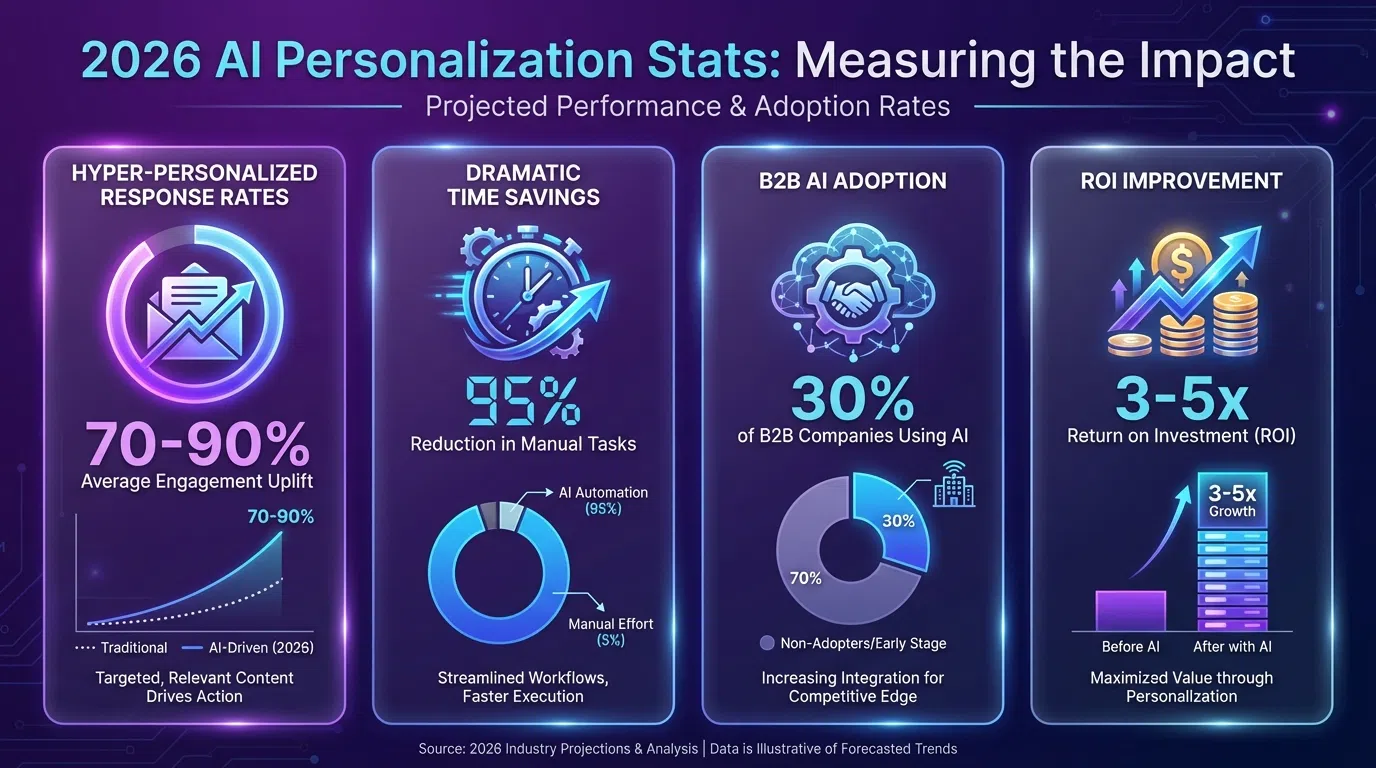
The message is clear: AI personalization isn't just working—it's becoming table stakes for competitive sales teams.
How AI Personalization Actually Works
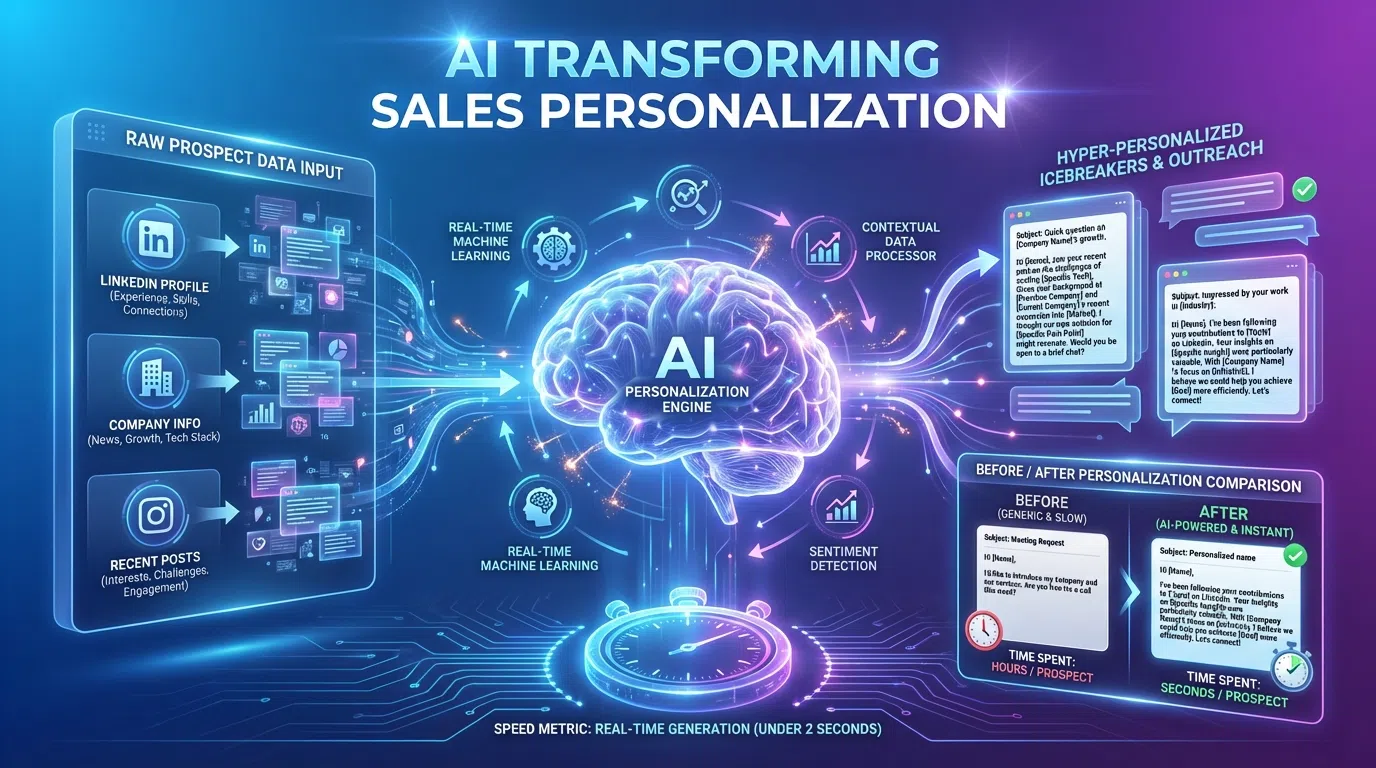
AI sales personalization operates through a multi-layered approach that combines data intelligence, natural language processing, and machine learning:
1. Data Collection and Enrichment
AI tools aggregate prospect data from multiple sources:
- LinkedIn profiles: Job titles, experience, skills, education, endorsements
- Company information: Size, industry, funding, tech stack, recent news
- Social activity: Posts, comments, shares, engagement patterns
- Behavioral signals: Website visits, content downloads, email opens, event registrations
- Third-party databases: Contact information, firmographic data, buying intent signals
Leading platforms like Apollo.io maintain databases of 275M+ contacts, while Clay offers waterfall enrichment across 50+ data sources to achieve 90-95% coverage.
2. Pattern Recognition and Analysis
Machine learning models identify:
- Pain points mentioned in social posts or content consumption
- Buying signals like job changes, company growth, competitive switches
- Communication preferences based on engagement patterns
- Optimal timing for outreach based on activity analysis
- Personalization hooks from recent posts, achievements, or shared interests
3. Message Generation
Generative AI (primarily GPT-4 models) creates personalized messages by:
- Analyzing prospect context and generating relevant opening lines
- Matching value propositions to identified pain points
- Adapting tone and style to prospect preferences
- Optimizing message length for channel (LinkedIn vs email)
- A/B testing variations to improve performance
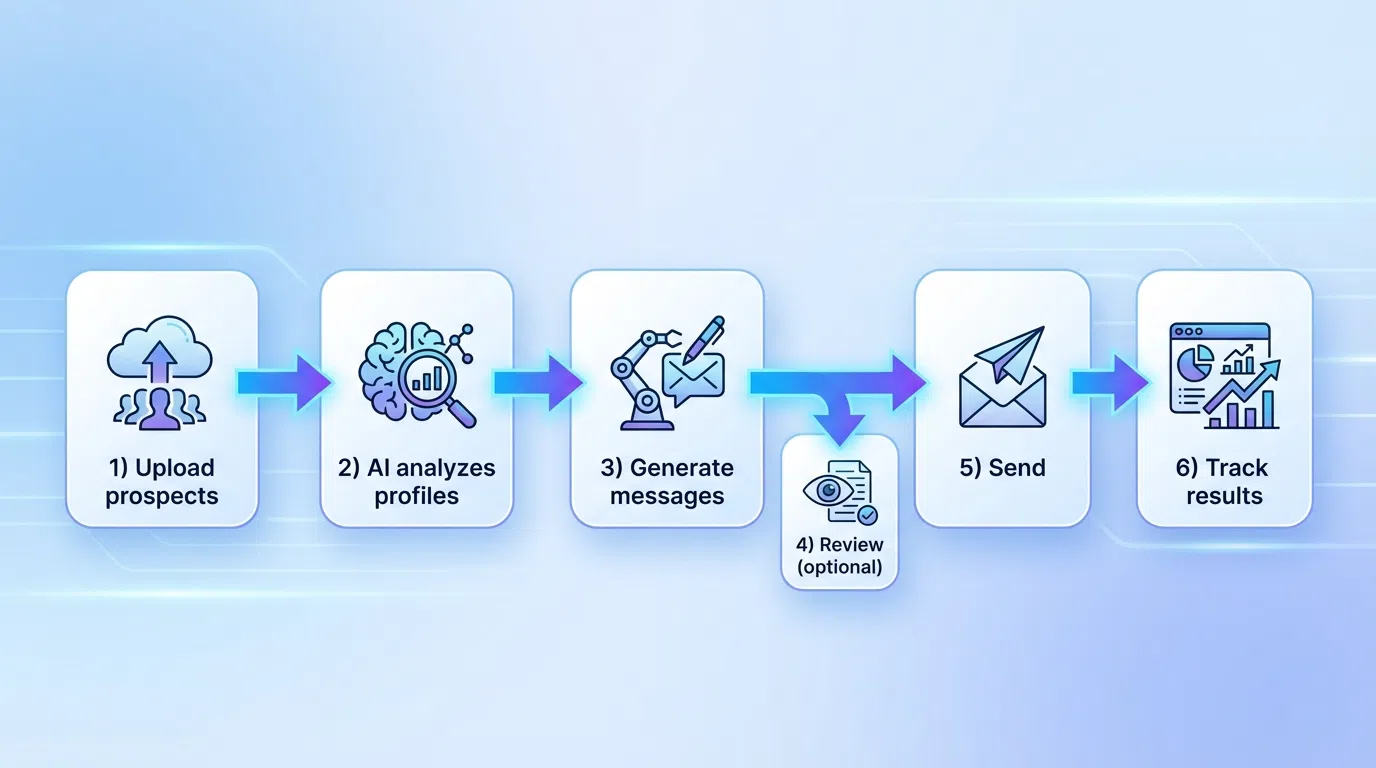
4. Continuous Learning and Optimization
AI systems improve over time by:
- Tracking response rates and engagement metrics
- Identifying which personalization elements drive replies
- Adapting messaging based on what works for specific segments
- Learning from successful human-written messages
- Optimizing send timing and follow-up cadences
The result? Personalization that would take humans 8-14 minutes per prospect now happens in 5-10 seconds, with quality that often matches or exceeds manual efforts.
Response Rate Impact: AI vs Manual Personalization
The data on AI personalization effectiveness tells a compelling story:
LinkedIn Outreach Performance
Manual Personalization:
- Generic connection requests: 15-25% acceptance
- Manual research + personalized messages: 30-40% response
- Time investment: 7-11 minutes per prospect
- Daily capacity: 20-30 prospects per SDR
AI-Powered Personalization:
- LeadSpark AI and similar tools: 70-90% response rates
- AI-assisted tools report 9.36% reply rates vs 5.44% for generic approaches
- Time investment: 30-90 seconds per prospect (including review)
- Daily capacity: 200-500 prospects per SDR
Email Outreach Performance
Traditional Cold Email:
- Average response rate: 1-5%
- Personalized cold email: 5-15%
- Best-in-class campaigns: Up to 40-50%
AI-Enhanced Email:
- Generative AI cold email: 28% average improvement
- AI-personalized subject lines: 30.5% higher open rates
- AI-optimized timing: 22% response rate boost
- Dynamic content personalization: 6x transaction rate increase
Multi-Channel AI Orchestration
Combining AI personalization across channels delivers the biggest wins:
- Multi-channel sequences using AI personalization: 15-30% response rates
- 287% higher purchase rates using 3+ channels
- 494% increase in order rates with coordinated AI outreach
- LeadSpark AI's approach (LinkedIn post analysis): 70-90% response rates
The numbers don't lie: AI personalization at scale outperforms manual approaches in both quality and quantity.
Case Example: A mid-market SaaS company using LeadSpark AI for LinkedIn prospecting increased their response rates from 18% (manual personalization) to 76% (AI-powered post analysis), while simultaneously scaling from 30 prospects per day to 300+—a 10x volume increase with 4x better engagement.
The Technology Behind AI Sales Personalization
Understanding the AI technology powering modern sales personalization helps teams make better tool decisions:
Large Language Models (LLMs)
GPT-4 and GPT-4 Turbo (OpenAI) power most sales AI tools:
- Analyze complex prospect context from multiple data sources
- Generate human-quality personalized messages
- Adapt tone, style, and length to specific channels
- Learn from feedback to improve output quality
Claude and Other Models offer alternatives:
- Anthropic's Claude: Enhanced reasoning and safety
- Google's Gemini: Strong multimodal capabilities
- Open-source models: Cost-effective for high-volume use
Natural Language Processing (NLP)
NLP capabilities enable:
- Sentiment analysis of prospect posts and content
- Entity extraction of companies, technologies, pain points
- Topic modeling to identify interests and priorities
- Intent classification to gauge buying readiness
- Semantic search to find relevant personalization hooks
Machine Learning and Predictive Analytics
ML models power:
- Lead scoring to prioritize high-intent prospects
- Churn prediction to identify at-risk accounts
- Propensity modeling to predict conversion likelihood
- Timing optimization for outreach and follow-ups
- Channel preference detection
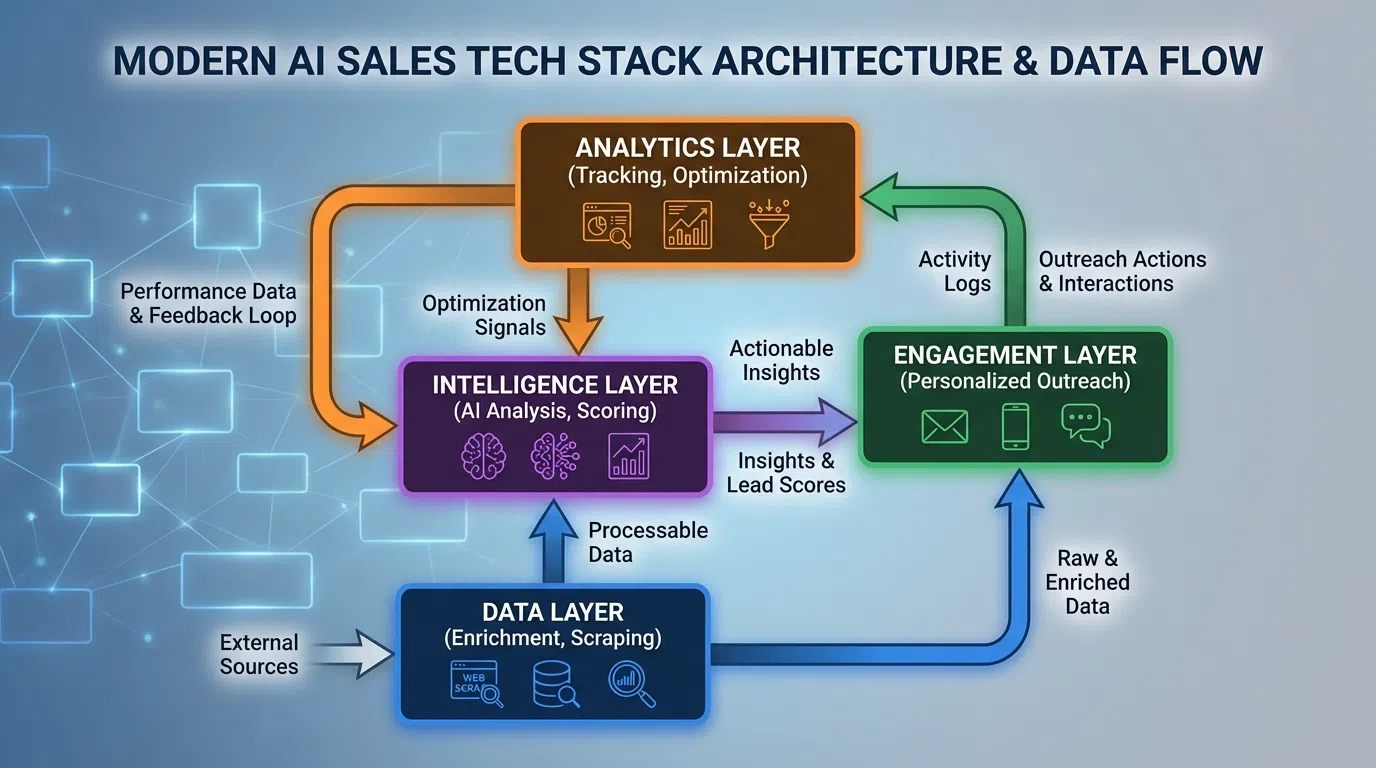
Integration and Orchestration Layers
Modern AI sales platforms integrate:
- CRM systems: Salesforce, HubSpot, Pipedrive
- Sales engagement platforms: Outreach, Salesloft, Apollo
- Data providers: ZoomInfo, Cognism, Clearbit
- Communication channels: Email, LinkedIn, phone
- Analytics platforms: Gong, Chorus, call intelligence
Deeper integration between CRM data, generative models, and analytics is enabling hyper-personalized recommendations and dynamic pricing based on behavioral signals—a key 2026 trend.
5 Ways AI is Transforming Sales Personalization
1. Automated Prospect Research
The Old Way: SDRs manually researched LinkedIn profiles, company websites, news articles, and social media—taking 8-14 minutes per prospect.
The AI Way: Tools like LeadSpark AI analyze profiles, recent posts, and company context in 5-10 seconds, extracting:
- Recent achievements and milestones
- Pain points mentioned in content
- Technologies in use
- Shared connections and interests
- Engagement patterns and preferences
Impact: Sales teams save 15-20 hours per week on research while maintaining quality that manual approaches can't match at scale.
2. Hyper-Personalized Message Generation
The Old Way: SDRs used templates with basic variable substitution (first name, company name) resulting in 1-5% response rates.
The AI Way: Generative AI creates unique messages for each prospect by:
- Referencing specific LinkedIn posts or comments
- Connecting product value to mentioned pain points
- Matching tone to prospect's communication style
- Optimizing length for channel (under 300 characters for LinkedIn connection requests)
- A/B testing subject lines and CTAs
Impact: 28% average improvement in response rates with AI-generated cold emails, 70-90% response rates with advanced tools like LeadSpark AI.
3. Real-Time Buying Signal Detection
The Old Way: Manually monitoring news, LinkedIn activity, and company updates—missing 90% of signals.
The AI Way: AI monitors and alerts on:
- Job changes (new role = new budget)
- Company funding rounds (growth signals)
- Hiring sprees (expanding teams = new needs)
- Technology adoptions (competitive displacement opportunities)
- Executive posts about challenges or initiatives
- Content engagement (intent signals)
Impact: 58% higher conversion rates targeting buying signals, 3-5x more likely to respond with proper timing.
4. Multi-Channel Personalization at Scale
The Old Way: SDRs struggled to coordinate personalized outreach across email, LinkedIn, and phone—resulting in inconsistent messaging and timing.
The AI Way: AI orchestrates personalized sequences across channels:
- Day 1: Personalized email referencing LinkedIn post
- Day 2: LinkedIn profile view
- Day 3: Personalized connection request
- Day 4: Call + voicemail with email context
- Day 7: Follow-up email with different angle
- Day 10: LinkedIn InMail
Impact: 287% higher purchase rates using 3+ channels, 15-30% response rates vs 4% email-only.
5. Continuous Learning and Optimization
The Old Way: Quarterly reviews of messaging performance, slow iteration cycles.
The AI Way: AI systems automatically:
- Track which messages get responses
- Identify high-performing personalization patterns
- A/B test messaging variations continuously
- Adapt to prospect segment preferences
- Optimize timing based on engagement data
- Learn from successful rep behaviors
Impact: AI ROI frameworks measuring both leading indicators and lagging indicators are becoming industry standards by 2026, enabling data-driven optimization at scale.
Real-World AI Personalization Tools and Platforms
The AI sales personalization landscape has matured rapidly. Here are the leading platforms in 2026:
LinkedIn-Specific AI Personalization
LeadSpark AI (Best for LinkedIn Post Analysis)
- Analyzes prospects' actual LinkedIn posts for personalization hooks
- Generates icebreakers under 25 words (optimal for LinkedIn)
- 70-90% response rates through hyper-personalized messaging
- CSV workflow for bulk processing
- Pricing: $49-$297/month
- Best for: SDRs, founders, and agencies focused on LinkedIn prospecting
Closely (LinkedIn Multi-Channel)
- LinkedIn + email AI personalization
- 9.36% reply rates (vs 5.44% generic)
- Safe automation with human-like behavior
- Pricing: $79+/month
- Best for: Teams running coordinated LinkedIn + email campaigns
LinkedRadar (Budget Option)
- Basic AI personalization for LinkedIn
- Simple interface, low learning curve
- Pricing: $19/month
- Best for: Budget-conscious teams starting with AI
Multi-Channel AI Platforms
Clay (Most Powerful)
- 50+ data sources with waterfall enrichment
- AI research agent for deep personalization
- Requires technical expertise
- Pricing: $134+/month
- Best for: Sales ops professionals, data-driven teams
Apollo.io (Database + AI Combo)
- 275M contact database
- AI-powered sequences and personalization
- Built-in dialer and email verification
- Pricing: $49+/month
- Best for: Teams needing data + personalization in one platform
Lavender (Email AI Coach)
- AI email scoring and suggestions
- Real-time personalization feedback
- Integrates with Gmail and Outlook
- Pricing: $29/month
- Best for: Individual reps improving email quality
Enterprise AI Solutions
- Enterprise sales engagement platforms
- Advanced AI personalization and orchestration
- Conversation intelligence integration
- Pricing: $100-150/user/month
- Best for: Enterprise sales teams with complex workflows
6sense and Demandbase
- AI-powered ABM platforms
- Predictive analytics and intent data
- Account-level personalization
- Pricing: Enterprise (custom)
- Best for: Strategic account-based marketing programs
For most teams focused on LinkedIn prospecting, LeadSpark AI delivers the best combination of quality (70-90% response rates), speed (5-10 seconds per prospect), and simplicity (no technical expertise required). Teams needing multi-channel capabilities should consider Apollo.io or Clay depending on budget and technical sophistication.
Challenges and Limitations of AI Personalization
While AI personalization delivers impressive results, it's not without challenges:
1. The Authenticity Question
Challenge: Over-personalization can feel creepy or inauthentic when prospects realize it's AI-generated.
Solution:
- Use AI for research and drafting, human review for authenticity
- Focus on relevant business context, not overly personal details
- Be transparent about using tools to scale outreach efficiently
- LeadSpark AI's approach: AI generates, humans review and approve
2. Data Quality and Accuracy
Challenge: AI is only as good as the data it analyzes—outdated or incorrect data leads to embarrassing errors.
Solution:
- Use waterfall enrichment across multiple data sources
- Verify key details before sending high-value messages
- Monitor bounce rates and update contact data regularly
- Implement data quality scoring (Clay's approach)
3. LinkedIn and Platform Restrictions
Challenge: Aggressive automation can lead to account restrictions or bans.
Solution:
- Stay within safe limits (20-25 connections/day, 50 messages/day)
- Use tools that mimic human behavior with randomized timing
- Prioritize personalization over volume to avoid spam detection
- LeadSpark AI focuses on research, not automation—0% ban risk
4. Cost at Scale
Challenge: AI personalization tools with usage-based pricing can get expensive at high volumes.
Solution:
- Implement tiered personalization (deep AI for Tier 1, lighter for Tier 3)
- Negotiate volume discounts with vendors
- Consider hybrid approaches (AI research + human writing for top prospects)
- Calculate ROI based on meetings booked, not messages sent
5. Over-Reliance on Technology
Challenge: SDRs who depend entirely on AI may struggle with complex deals requiring nuanced understanding.
Solution:
- Use AI to handle volume, humans for strategic accounts
- Maintain manual personalization skills for enterprise deals
- Review AI output regularly to understand what works
- Invest in ongoing sales training alongside AI tools
The most successful teams view AI as augmentation, not replacement—using technology to scale what works while maintaining human judgment for complex situations.
Best Practices for Implementing AI Personalization
Based on analysis of top-performing sales teams using AI personalization in 2026:
1. Start with a Clear Use Case
Don't: Buy an AI tool and hope it magically improves results.
Do: Identify specific personalization bottlenecks:
- "Our SDRs spend 60% of time on research, only 40% on outreach"
- "We're reaching 30 prospects/day but need 200+ to hit pipeline goals"
- "Our LinkedIn response rates are 8% vs 25% industry benchmark"
Choose AI tools that solve your specific problem. For LinkedIn personalization at scale, LeadSpark AI addresses the research bottleneck directly.
2. Implement Tiered Personalization
Not every prospect deserves the same level of investment:
Tier 1 (Top 20% - High-Value Accounts)
- Deep AI research + human review and customization
- Multi-channel sequences (LinkedIn + email + phone)
- 10-15 minutes total per prospect
- Target: 15-25% response, 40-60% meeting booking
Tier 2 (Middle 30% - Good-Fit Prospects)
- AI research + AI-generated messages with light human review
- Dual-channel (LinkedIn + email)
- 2-5 minutes per prospect
- Target: 10-15% response, 30-40% booking
Tier 3 (Bottom 50% - Volume Prospects)
- Full AI automation with periodic quality checks
- Single-channel (LinkedIn or email)
- 30-90 seconds per prospect
- Target: 5-10% response, 20-30% booking
This approach balances quality and scale, using AI to make the volume manageable.
3. Establish Quality Control Processes
AI Draft → Human Review → Send should be your workflow initially:
Week 1-2: Review 100% of AI-generated messages
- Understand what the AI is producing
- Identify patterns in good vs poor outputs
- Train the AI with feedback
Week 3-4: Spot-check 25-50% of messages
- Focus on high-value prospects
- Sample different prospect segments
- Monitor response rates as quality indicator
Month 2+: Review 10-20% or implement exception-based review
- Set quality thresholds (e.g., message length, specific keywords)
- Flag unusual outputs for review
- Deep-dive when response rates drop
4. Measure What Matters
Track both activity and outcome metrics:
Activity Metrics (Leading Indicators):
- Messages sent per day
- Personalization elements included
- Time saved vs manual approach
- AI suggestion acceptance rate
Outcome Metrics (Lagging Indicators):
- Response rate by channel
- Meeting booking rate
- Show-up rate
- SQL conversion rate
- Pipeline generated
- Cost per meeting
AI ROI frameworks measuring both leading and lagging indicators are becoming industry standards in 2026.
5. Iterate Based on Data
AI personalization improves with feedback:
- A/B test message variations systematically
- Track which personalization elements drive responses
- Segment analysis by industry, role, company size
- Share top-performing messages with the AI tool for learning
- Regular reviews (weekly initially, monthly at maturity)
6. Combine AI with Human Expertise
Use AI for:
- Data aggregation and enrichment
- Pattern recognition at scale
- Message drafting and variations
- Timing optimization
- Performance analytics
Keep Humans for:
- Strategic account planning
- Complex objection handling
- Relationship building
- Quality oversight
- Tool selection and process design
The hybrid approach consistently outperforms pure automation or pure manual efforts.
The Future of AI Sales Personalization
What's next for AI in sales personalization? Based on current trends and expert predictions:
Near-Term Evolution (2026-2027)
1. Multimodal AI Personalization
- Voice message personalization (AI-generated voice notes)
- Video personalization at scale (digital twins, dynamic video)
- Visual content customization (personalized PDFs, infographics)
2. Predictive Personalization
- AI predicts optimal personalization approach before first contact
- Historical data from similar prospects informs messaging strategy
- Dynamic adjustment based on engagement signals
3. Conversation Intelligence Integration
- AI learns from successful sales calls
- Extracts winning objection handling patterns
- Applies insights to written personalization
- Gong and Chorus leading this space
Medium-Term Transformation (2027-2028)
1. Autonomous AI SDR Agents
Platforms like Artisan ($750-2K/month) and AiSDR ($499/month) are already offering:
- Fully automated research → personalization → outreach → follow-up
- Real-time objection handling
- Calendar booking without human intervention
- Best for: High-volume transactional sales ($1-10K deals)
Current limitations: 15-30% response rates (vs 70-90% human-reviewed AI), limited complex situation handling, requires ongoing oversight.
2. Intent-Based Hyper-Personalization
- Real-time buying signal detection triggers instant personalized outreach
- Website visit → personalized email within 1 hour
- LinkedIn post about pain point → contextual outreach within 24 hours
- Funding announcement → multi-channel sequence launch
3. Predictive Analytics at Scale
- ML scoring leads 40-60% higher conversion
- AI predicts optimal outreach channel per prospect
- Dynamic message adjustment based on predicted preferences
Long-Term Vision (2028+)
1. Truly Conversational AI
- Natural back-and-forth conversation indistinguishable from humans
- Real-time personalization adjustments mid-conversation
- Emotional intelligence and empathy modeling
2. Unified AI Revenue Orchestration
- Single AI platform managing entire revenue process
- Seamless handoffs from AI SDR → human AE → AI CS
- Consistent personalization across customer lifecycle
3. Ethical AI and Regulation
- Industry standards for AI transparency in sales
- Disclosure requirements for AI-generated outreach
- Privacy-first personalization frameworks
Frequently Asked Questions
Can prospects tell when messages are AI-generated?
High-quality AI personalization is often indistinguishable from human-written messages. LeadSpark AI's approach of analyzing actual LinkedIn posts creates context-specific icebreakers that feel authentic because they reference real, recent activity. The key is human review: AI that's been reviewed and approved performs better than pure automation.
Low-quality AI (generic templates with variable substitution) is obvious. High-quality AI with human oversight typically isn't detectable and often outperforms human-written messages in response rates.
What's the ROI of AI personalization tools?
The math is compelling for most teams:
Cost: $50-300/month per user for AI personalization tools
Time Saved: 15-20 hours/week on research (vs manual)
Volume Increase: 5-10x more prospects reached
Response Rate Improvement: 2-5x better engagement
Example ROI: An SDR using LeadSpark AI at $97/month:
- Reaches 300 prospects/week (vs 30 manually) = 10x volume
- Achieves 75% response rate (vs 20% manual) = 3.75x engagement
- Result: 225 responses/week vs 6 manually = 37.5x output
- Cost per response: $0.43 vs $16.17 manually = 97% cost reduction
Most teams see ROI within the first month if they're replacing manual research.
How do I choose the right AI personalization tool?
Consider these factors:
1. Primary Channel: LinkedIn-focused? LeadSpark AI. Multi-channel? Apollo.io or Clay.
2. Technical Sophistication: Non-technical team? LeadSpark or LinkedRadar. Sales ops team? Clay or Octave.
3. Budget: Under $50/month? LinkedRadar. $50-150/month? LeadSpark or Apollo. $150+/month? Clay or enterprise platforms.
4. Volume Needs: 100-300 prospects/week? LeadSpark. 500-1,000+/week? Clay with automation.
5. Integration Requirements: Deep CRM integration needed? folk CRM or enterprise platforms. Standalone workflow? LeadSpark CSV approach.
Start with a clear use case, trial 2-3 tools, and measure response rates before committing.
Will AI replace human SDRs?
Not in the foreseeable future. AI is augmenting SDRs, not replacing them:
What AI handles well:
- Data aggregation and research
- Pattern recognition at scale
- Message drafting for volume prospects
- Performance analytics
- Timing optimization
What humans still do better:
- Complex relationship building
- Nuanced objection handling
- Strategic account planning
- Creative problem solving
- Building trust with enterprise buyers
The most successful teams use AI to handle the 80% of repetitive work, freeing humans to focus on the 20% of high-value activities that require judgment, creativity, and empathy. 73% of sales professionals report AI has improved productivity, but that productivity boost comes from augmentation, not replacement.
How do I get started with AI sales personalization?
A practical 30-day implementation plan:
Week 1: Assess and Choose
- Audit current personalization process (time spent, results achieved)
- Identify biggest bottleneck (usually research or message creation)
- Trial 2-3 AI tools that address your specific bottleneck
- For LinkedIn prospecting, start with LeadSpark AI's free trial
Week 2: Pilot with Small Group
- Select 1-2 SDRs to pilot AI personalization
- Process 50-100 prospects through AI workflow
- Review 100% of AI-generated messages initially
- Track response rates vs current baseline
Week 3: Refine and Scale
- Analyze what's working (message patterns, personalization elements)
- Adjust AI settings or prompts based on feedback
- Expand to full team if results positive
- Reduce review percentage as confidence builds
Week 4: Optimize and Measure
- A/B test variations (AI vs manual, different personalization approaches)
- Calculate ROI (time saved, volume increase, response rate improvement)
- Document best practices for team
- Plan next optimization cycle
The key is starting small, measuring rigorously, and scaling what works.
Ready to Transform Your Sales Personalization with AI?
AI sales personalization isn't a future trend—it's a present reality transforming how top sales teams operate in 2026. With 88% of B2B companies already using AI for prospecting and AI-powered personalization delivering 28% higher response rates, the question isn't whether to adopt AI personalization, but which tools to use and how to implement them effectively.
The teams winning with AI personalization share a common approach: they use technology to automate research and scale outreach while maintaining human oversight for quality and authenticity. They implement tiered personalization strategies, measure both activity and outcomes, and iterate based on data.
LeadSpark AI is built specifically for this hybrid approach—analyzing LinkedIn profiles and posts in 5-10 seconds to generate hyper-personalized icebreakers that achieve 70-90% response rates, while keeping humans in control to review and approve messages before sending.
Ready to see how AI can transform your LinkedIn prospecting?
Start your free trial of LeadSpark AI →
Get 15 free credits to analyze prospects and generate personalized icebreakers. No credit card required.
Related Posts
- Manual vs AI Personalization: Which is Better for LinkedIn Prospecting?
- Best AI Sales Tools for SDRs in 2026: Complete Tech Stack
- How to Scale LinkedIn Outreach Without Sacrificing Quality
- LinkedIn Response Rate Benchmarks: What's a Good Reply Rate in 2026?
Sources:
- 75 Statistics About AI in Sales and Marketing for 2026 – Sopro
- AI in Sales 2025: Statistics, Trends & Generative AI Insights – Cirrus Insight
- 76 Personalization Statistics 2026 (Trends & Data) – DemandSage
- 31 Personalized Shopping Experience Statistics – Envive AI
- Sales 2025 Data Report: Trends, AI & Sales Benchmarks – Outreach
- AI Marketing Trends in 2026: What to Expect – Averi AI
Ready to Generate Personalized Icebreakers?
Join sales professionals using LeadSpark AI to create hyper-personalized LinkedIn icebreakers in minutes.