Linkedin Prospecting
How to Scale LinkedIn Outreach Without Sacrificing Quality
Scale your LinkedIn prospecting from 20 to 500+ weekly without losing personalization. AI-powered strategies achieving 30-40% response rates at scale.
11 min read
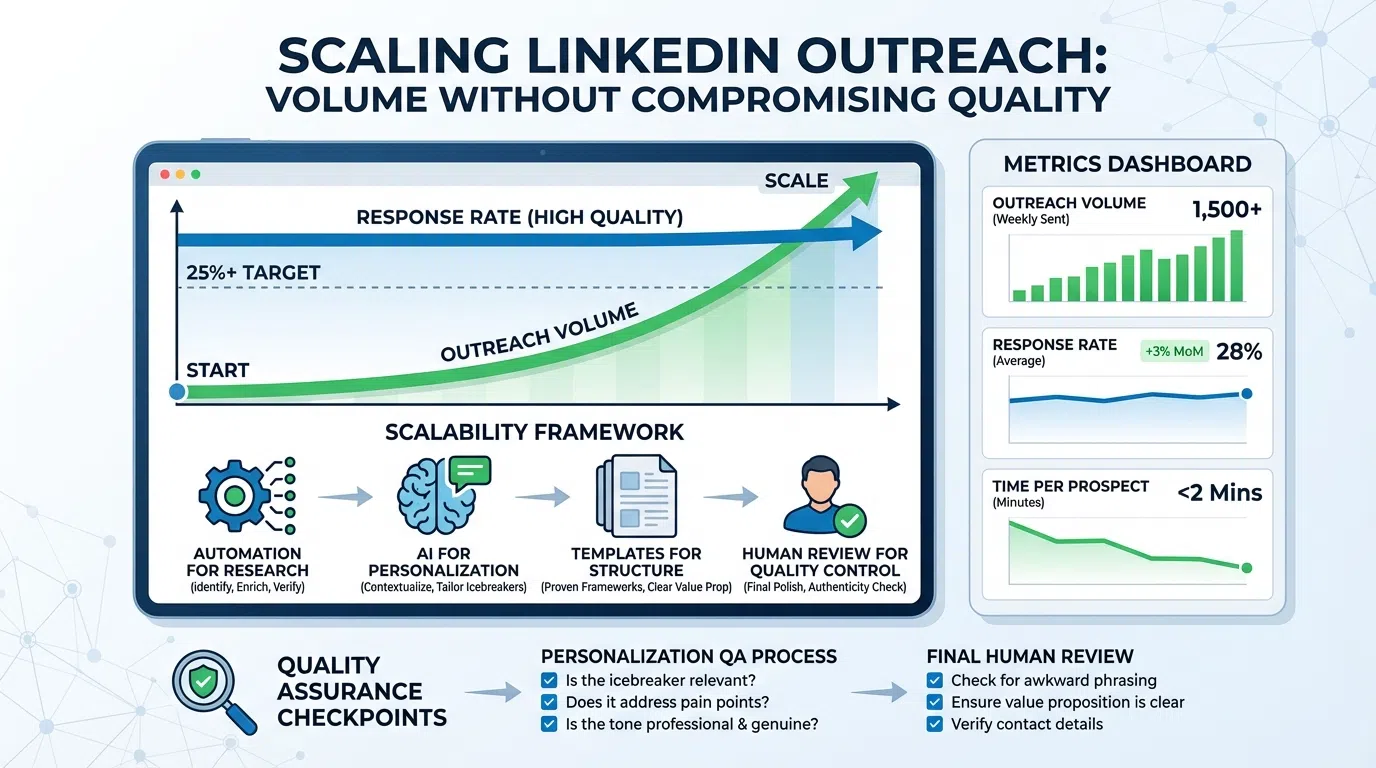
Every SDR faces the same impossible dilemma: your quota demands volume, but response rates demand quality. Manual personalization gets you 30-40% response rates but caps you at 20-30 prospects per day. Generic automation scales to 500+ weekly but tanks your response rate to 2-5%.
In 2026, this trade-off is finally solved. Top-performing SDRs are achieving 30-40% response rates on 500+ weekly prospects—combining the quality of manual research with the scale of automation.
This guide shows you exactly how they're doing it, with the frameworks, tools, and workflows that make personalization at scale possible.
Table of Contents
- The Scale vs Quality Dilemma
- Why Traditional Scaling Fails
- The 2026 Approach: AI-Powered Hyper-Personalization
- 3-Tier Outreach Framework for Scaling
- Building Your Scaling Tech Stack
- Step-by-Step Scaling Workflow
- Measuring Quality at Scale
- Common Scaling Mistakes to Avoid
- Frequently Asked Questions
The Scale vs Quality Dilemma
The numbers tell a brutal story about LinkedIn outreach in 2026:
Manual Personalization:
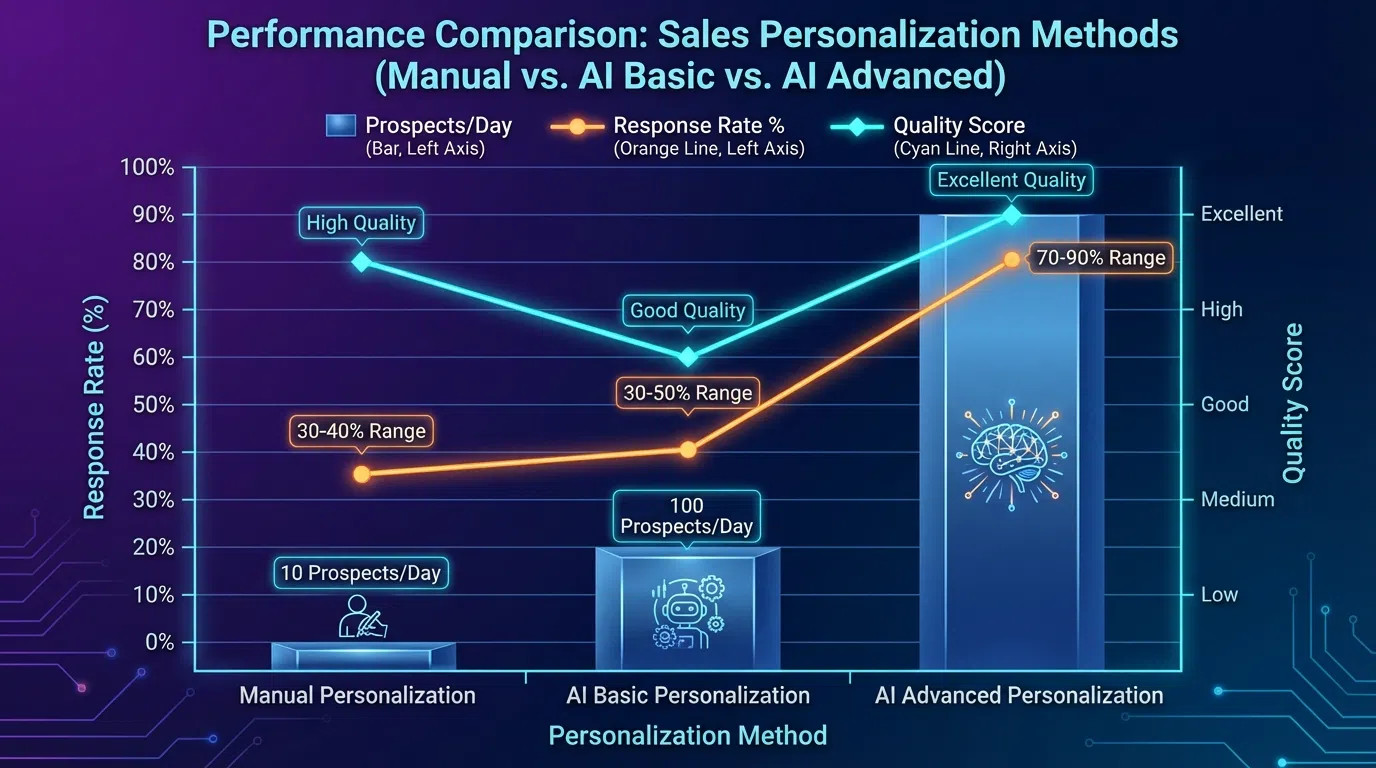
- Time per prospect: 5-10 minutes of deep research
- Daily capacity: 20-30 prospects maximum
- Response rate: 30-40% (excellent)
- Weekly volume: 100-150 prospects
- Monthly meetings: 30-45 (strong, but limited)
Generic Automation:
- Time per prospect: 5 seconds (template insertion)
- Daily capacity: 500+ prospects
- Response rate: 2-5% (terrible)
- Weekly volume: 2,000+ prospects
- Monthly meetings: 40-100 (volume compensates for poor quality)
The math creates an impossible choice. To hit aggressive quotas (15-20 meetings per month), SDRs either burn out doing manual research or sacrifice quality for volume and hope 2-5% response rates generate enough meetings.
According to SalesBread's 2026 LinkedIn Outreach Stats, the average LinkedIn outreach achieves just 10.3% response rates—roughly double email's 5.1% average, but far below what's possible with proper personalization.
Why Traditional Scaling Fails
Most SDRs attempt to scale by either:
1. Template-Based Personalization (Fails Quality)
Using basic tokens like {{FirstName}} and {{Company}} to create the illusion of personalization:
Example:
"Hi {{FirstName}}, I noticed {{Company}} is growing fast. Would love to chat about how we help companies like yours scale their sales."
Why it fails: Prospects instantly recognize template language. Including a personalized message in connection requests boosts response from 5.44% to 9.36%, but only if the personalization is genuine—not just name insertion.
2. Hiring More SDRs (Fails Economics)
Adding headcount to maintain manual quality at higher volume:
The math:
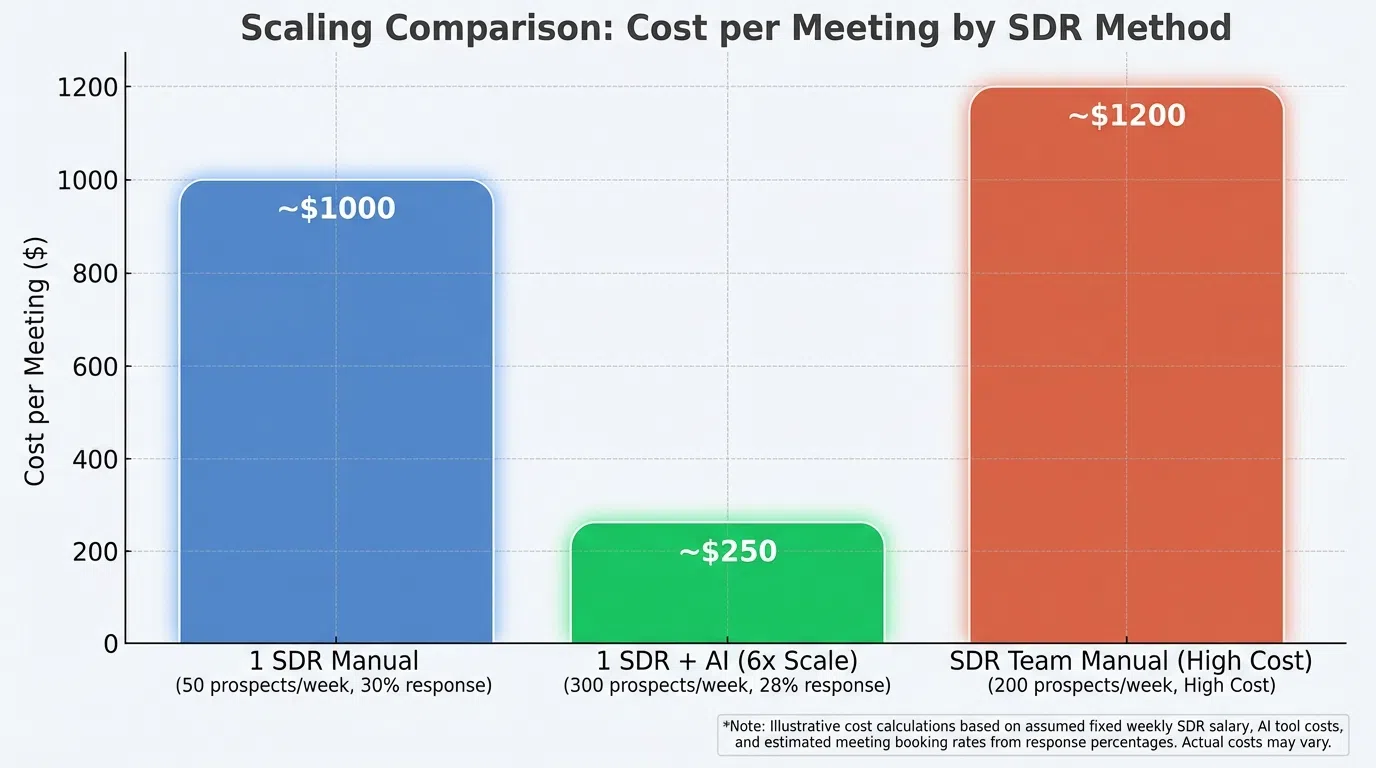
- Junior SDR salary: $50-70K + $20-30K benefits = $70-100K total
- Ramp time: 3-6 months to productivity
- Output: 100-150 prospects/week at 30% response = 30-45 responses weekly
- Cost per meeting: $150-250
Why it fails: It's expensive, slow to scale, and quality varies dramatically between SDRs (star performer at 40% response vs struggling rep at 12%).
3. Pure Automation Tools (Fails Compliance & Quality)
Using tools like Expandi or PhantomBuster to blast generic messages at scale:
Why it fails:
- LinkedIn's 2026 limits are stricter: 20-25 connection requests daily (down from 100/week in 2024)
- Acceptance rates below 15% trigger account restrictions
- Generic messages get 2-5% response rates—wasting your limited sends
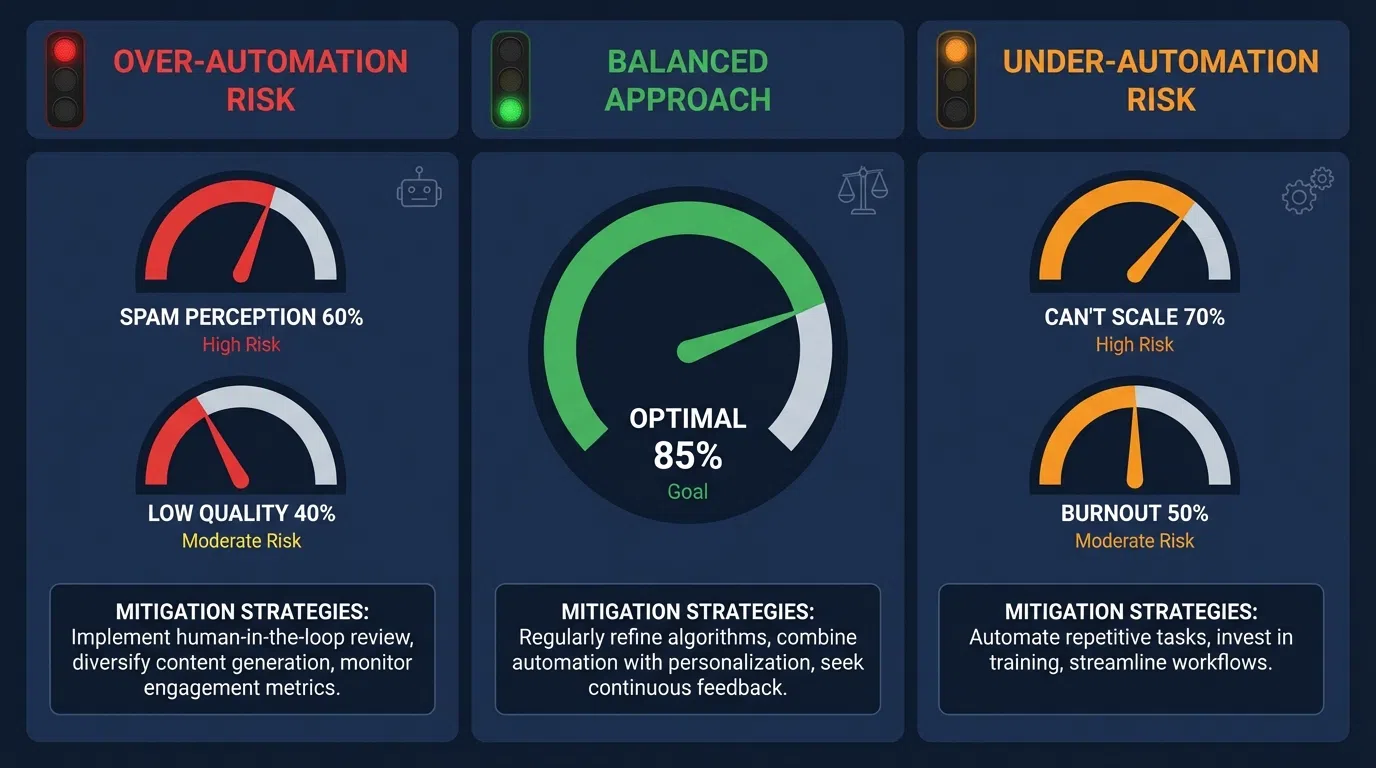
- Risk of account suspension eliminates the entire approach
According to LinkedIn automation safety guidelines for 2026, the platform's detection algorithms are at an all-time high, making the "spray and pray" method officially dead.
The 2026 Approach: AI-Powered Hyper-Personalization
The breakthrough in 2026 is AI that analyzes prospects' LinkedIn profiles and recent posts to generate genuinely personalized icebreakers in 5-10 seconds per prospect—combining manual-quality personalization with automation-level scale.
How AI Hyper-Personalization Works
Traditional Manual Research (8-14 minutes):
- Visit LinkedIn profile (30 sec)
- Read recent posts (2-3 min)
- Check company news (1-2 min)
- Review job history (1 min)
- Identify pain points (2-3 min)
- Craft personalized message (3-5 min)
AI-Powered Research (15-30 seconds):
- Upload prospect list (5 sec)
- AI analyzes profiles + posts automatically (5-10 sec/prospect)
- Generates contextual hooks referencing specific content (instant)
- Human reviews and approves (5-10 sec/prospect)
- Send or load into sequences (instant)
The AI doesn't just insert names—it reads actual LinkedIn activity and generates messages like:
"Saw your post about scaling past $1M ARR—the playbook shift from 10 to 50 customers hit home. When Salesforce faced the same challenge, we helped them cut SDR ramp from 7 months to 3. Worth comparing notes?"
According to Evaboot's 2026 hyper-personalized LinkedIn message guide, this approach achieves 30-40% response rates even at high volume—because the personalization is genuine, not templated.
The Performance Difference
Let's compare 500 prospects per week across approaches:
| Approach | Response Rate | Weekly Responses | Monthly Meetings | Time Investment |
|---|---|---|---|---|
| Generic templates | 2-5% | 10-25 | 10-25 | 2-3 hours |
| Manual personalization | 30-40% | 150-200 | 60-80 | 40-70 hours |
| AI + human review | 30-40% | 150-200 | 60-80 | 5-8 hours |
AI-powered personalization delivers manual-quality results at automation scale—87-95% time savings while maintaining 30-40% response rates.
3-Tier Outreach Framework for Scaling
To scale effectively, segment your prospects into three tiers based on deal value and allocate personalization effort accordingly:
Tier 1: High-Value Strategic Accounts (15-20% of volume)
Profile:
- Enterprise deals $50K+ ARR
- C-suite executives and VPs
- Named accounts from ABM list
- Complex multi-stakeholder sales
Approach:
- Deep manual research: 10-15 minutes per prospect
- Multi-stakeholder mapping: identify 3-5 influencers
- Custom value propositions per role
- Multi-channel: LinkedIn + email + phone + video
- Personalized follow-up sequences (7-8 touches)
Volume: 20-30 prospects per week
Expected Response: 35-50% (C-level baseline 5-8% boosted by deep research)
Cost per prospect: $15-25 (justified by $50K+ deal size)
Tools: Manual research + Sales Navigator + LeadSpark AI for LinkedIn insights + Clay for enrichment
Tier 2: Mid-Market High-Fit (30-40% of volume)
Profile:
- Mid-market deals $10-50K ARR
- Directors and senior managers
- High ICP fit on 7+ criteria
- Single decision-maker focus
Approach:
- AI-assisted research: 2-5 minutes per prospect
- LeadSpark AI analyzes profiles + posts automatically
- Human reviews and customizes AI-generated hooks (10-20% edits)
- Dual-channel: LinkedIn + email sequences
- Trigger-based: prioritize job changes, funding, hiring signals
Volume: 100-150 prospects per week
Expected Response: 25-35% (mid-market most responsive to quality outreach)
Cost per prospect: $3-6 (strong ROI on $10-50K deals)
Tools: LeadSpark AI (5-10 sec analysis) + Clay (waterfall enrichment) + Waalaxy (sequences)
Tier 3: High-Volume Scalable (40-50% of volume)
Profile:
- SMB deals $1-10K ARR
- Managers and team leads
- Moderate ICP fit on 4-6 criteria
- Transactional sales cycles
Approach:
- Fully automated research: 30-90 seconds per prospect
- AI generates hooks, human spot-checks 10% for quality
- Template-based with dynamic personalization tokens
- Single-channel: LinkedIn primary
- Batch processing: 100-200 prospects per session
Volume: 250-350 prospects per week
Expected Response: 15-25% (volume compensates for lower deal size)
Cost per prospect: $0.50-2 (highly profitable at scale with $1-10K deals)
Tools: LeadSpark AI bulk processing + Waalaxy automation + instant.ly templates
Balanced Portfolio
The 3-tier framework creates a balanced pipeline:
- Tier 3 provides consistent meeting volume and fills your calendar
- Tier 2 delivers the bulk of your pipeline value
- Tier 1 generates enterprise deals and strategic partnerships
Weekly Output Example:
- 400 total prospects (20% Tier 1, 30% Tier 2, 50% Tier 3)
- 8 hours total time investment
- 100-120 responses (25-30% blended response rate)
- 40-50 meetings booked (40% booking rate)
- 20-25 qualified opportunities
Building Your Scaling Tech Stack
The right tools make personalization at scale possible. Here's the proven stack by company stage:
Startup Stack ($300-500/month) - 1-5 SDRs
Core Tools:
- LinkedIn Sales Navigator ($99-149/mo): Advanced search, lead recommendations, intent signals
- LeadSpark AI ($97/mo Team Plan): AI profile + post analysis, bulk icebreaker generation (5-10 sec per prospect)
- HubSpot Free CRM: Pipeline tracking, contact management
- Waalaxy ($60/mo): LinkedIn automation, connection requests, message sequences
Capacity: 200-400 prospects/week, 5-10 clients maximum
Why it works: Minimal investment delivers AI personalization quality with automation scale. LeadSpark AI compresses research from 8-14 minutes to 10-30 seconds while maintaining 30-40% response rates.
Growth Stack ($1,500-2,500/month) - 5-15 SDRs
Startup tools plus:
- Sales Navigator Team (3 users, $447/mo): Team collaboration, shared lead lists
- Clay ($349/mo Pro): Waterfall enrichment (90-95% data coverage vs 60-70% single source), Claygent autonomous research
- LeadSpark AI Agency Plan ($297/mo for 10 users): Team standardization, multi-client workflows, bulk processing 100-500/session
- Reply.io or Instantly.ai ($60-150/mo): Multi-channel sequences (email + LinkedIn coordination), A/B testing, team inbox
Capacity: 1,000-2,000 prospects/week, 10-20 clients
Why it works: Waterfall enrichment achieves 90-95% contact coverage. LeadSpark AI standardizes team quality—every SDR performs like your star, not depending on individual research skills. Clay + LeadSpark combination enables personalization at scale across entire team.
Enterprise Stack ($5,000-8,000/month) - 15-50 SDRs
Growth tools plus:
- Sales Navigator Advanced (10 users, $1,490/mo): Advanced analytics, CRM integration
- ZoomInfo or Cognism ($2,000-5,000/mo): Premium contact data, intent signals, technographics
- LeadSpark AI Enterprise (custom for 20+ users): Dedicated support, custom integrations, white-label options
- Outreach or Salesloft (5 users, $500-750/mo): Enterprise engagement platform, advanced analytics, conversation intelligence
Capacity: 5,000-10,000 prospects/week, 20-50 clients
Why it works: Enterprise tooling enables massive scale while maintaining quality through AI personalization, advanced intent data, and sophisticated multi-channel orchestration.
Step-by-Step Scaling Workflow
Here's the exact process top SDRs use to achieve 30-40% response rates on 500+ weekly prospects:
Step 1: Build Targeted Lists (2-3 hours weekly)
Monday: List Building Session
- Define ICP criteria (if not already documented):
- Firmographic: industry, company size, revenue, location, funding stage
- Technographic: tech stack, tools used, integrations needed
- Behavioral: hiring, funding, expansion signals, recent job changes
- Export from Sales Navigator (30-45 min):
- Use saved searches with 7+ ICP filters
- Boolean search for specific titles + pain point keywords
- Export 200-300 leads per list
- Segment into 3 tiers based on deal value
- Enrich with Clay waterfall (30-45 min):
- Upload CSV to Clay
- Run waterfall: Sales Navigator → Apollo → Hunter → Snov
- Achieve 90-95% email + phone coverage
- Add trigger data: funding, hiring, tech stack changes
- Score and prioritize (15-30 min):
- Score 1-10 on ICP fit (focus on 7+)
- Tag tier (1/2/3 based on deal size + complexity)
- Flag high-intent signals (job changes, funding in last 90 days, hiring SDRs)
Output: 500-600 scored, enriched, tiered prospects ready for outreach
Step 2: AI-Powered Research & Personalization (2-3 hours weekly)
Monday-Tuesday: Bulk Analysis
- Tier 1 - Manual + AI hybrid (2-3 hours for 20-30 prospects):
- Manually review top 20-30 enterprise accounts
- Use LeadSpark AI for LinkedIn post analysis (5-10 sec each)
- Spend 5-10 minutes per prospect on multi-stakeholder mapping
- Craft fully custom messages incorporating AI hooks
- Tier 2 - AI + human review (1-2 hours for 100-150 prospects):
- Upload Tier 2 list to LeadSpark AI (bulk processing)
- AI analyzes profiles + recent posts (5-10 sec per prospect)
- Review AI-generated hooks, customize 10-20% where needed
- Approve and export for sequences
- Tier 3 - Automated with spot checks (30-45 min for 250-350 prospects):
- Batch upload to LeadSpark AI (processes 100s simultaneously)
- AI auto-generates personalized icebreakers
- Spot-check 10% for quality assurance
- Auto-approve remaining 90% if quality looks good
Output: 400-500 prospects with personalized messages (blend of 5-10 min manual, 2-5 min AI-assisted, 30 sec fully automated)
Step 3: Launch Multi-Channel Sequences (1 hour weekly)
Tuesday-Wednesday: Campaign Launch
- Load into Waalaxy or Outreach:
- Tier 1: 7-8 touch sequence (LinkedIn → email → call → video → LinkedIn → email → breakup)
- Tier 2: 5-6 touch sequence (LinkedIn → email → LinkedIn → call → breakup)
- Tier 3: 3-4 touch sequence (LinkedIn → LinkedIn follow-up → breakup)
- Set natural delays:
- Connection request → 3-5 days → first message (if accepted)
- Message → 5-7 days → follow-up 1
- Follow-up → 7-10 days → follow-up 2
- Randomize timing: +/- 1-2 days to avoid patterns
- Monitor acceptance rates:
- Track weekly acceptance percentage
- If <15%, pause and improve personalization (avoid LinkedIn restrictions)
- Target: 25-45% acceptance (personalized requests hit 45% vs 15% generic)
Step 4: Respond & Book Meetings (30-60 min daily)
Daily: Inbox Management
- Check LinkedIn + email 3-4x per day
- Respond to connections within 24 hours (boosts response from 6% to 22% with fast response)
- Answer questions with helpful, non-pushy value
- Share relevant content or case studies
- Offer meeting with calendar link when interest is shown
Meeting booking:
- Use Calendly or HubSpot meetings link
- Offer 2-3 specific times if no calendar tool
- Confirm 24 hours before meeting
- Send reminder with agenda 2 hours before
Step 5: Optimize & Iterate (1-2 hours weekly)
Friday: Performance Review
Metrics to track:
- Prospects contacted (by tier)
- Acceptance rates (target: 25-45%)
- Response rates (target: 25-40% blended)
- Meeting booking rate (target: 40-50% of responses)
- Show-up rate (target: 70%+)
- Qualified opportunity rate (target: 50-60% of meetings)
Optimization actions:
- A/B test message variations (change opening hook, adjust CTA, test message length)
- Double down on what works (if certain industries/personas respond better, shift tier allocations)
- Pause underperformers (if specific lists get <10% response, stop and diagnose ICP fit or messaging)
- Refine AI prompts (if LeadSpark hooks feel generic, adjust settings or add custom instructions)
Weekly output: 400-500 contacted, 100-120 responses, 40-50 meetings booked, 20-25 qualified opportunities
Measuring Quality at Scale
Scaling without quality metrics is a recipe for disaster. Here's what to track:
Leading Indicators (Weekly)
Volume Metrics:
- Prospects contacted: 400-500 (by tier: 20/30/50 split)
- Connection requests sent: 80-100 (20-25 daily to stay within safe limits)
- Messages sent: 300-400 (to accepted connections + existing network)
Quality Metrics:
- Connection acceptance rate: 25-45% (personalized vs 15% generic)
- Message response rate: 25-40% blended (Tier 1: 35-50%, Tier 2: 25-35%, Tier 3: 15-25%)
- Response time: <3 hours optimal (vs 24+ hours poor)
Red flags:
- Acceptance rate <15%: LinkedIn may restrict account, improve personalization immediately
- Response rate <10%: Poor targeting or messaging, pause and diagnose
- Unsubscribe rate >5%: Messages too aggressive or sales-y
Lagging Indicators (Monthly)
Conversion Metrics:
- Meetings booked: 160-200 (40% of 400-500 responses)
- Meeting show-up rate: 70%+ (112-140 actual meetings)
- Qualified opportunities: 56-84 (50% of meetings)
- Deals closed: 8-14 (15-20% close rate)
Efficiency Metrics:
- Time per prospect: 30-90 sec (blended across tiers)
- Cost per meeting: $50-150 (much lower than $150-250 with pure manual)
- Pipeline generated: $200K-400K (assumes $2.5-5K avg deal size)
Quality benchmark: If you're maintaining 25-40% response rates at 400-500 weekly volume, you've successfully scaled without sacrificing quality.
Quality Assurance Process
Weekly Spot Checks (30 min):
- Randomly sample 20 messages (10 from AI, 10 from manual Tier 1)
- Rate 1-10 on personalization quality
- Check for:
- Specific reference to prospect's content/activity (not generic)
- Natural language (not obviously templated)
- Clear value proposition (not just features)
- Appropriate CTA (not overly aggressive)
- If AI messages score <7/10, adjust prompts or increase human review percentage
Common Scaling Mistakes to Avoid
1. Scaling Before Repeatability
Mistake: Trying to hit 500 prospects/week when you're still getting 12% response on 50/week.
Fix: Perfect your messaging and targeting on 50-100 prospects per week until you consistently hit 25-30% response for 3-4 weeks straight. Then scale gradually (100 → 200 → 400 over 4-6 weeks).
Why it matters: Scaling broken processes just creates more poor results faster. According to Martal Group's LinkedIn statistics for 2026, campaigns achieving 30-35% reply rates require profile optimization, personalized multi-touch sequences, and strategic follow-ups—foundational elements you must nail before scaling.
2. Over-Automating Too Quickly
Mistake: Moving 100% of outreach to fully automated Tier 3 approach to save time.
Fix: Maintain the 20/30/50 tier split. Even at scale, 15-20% should still get deep manual research. This keeps you connected to your market and helps you iterate messaging.
Why it matters: When you lose touch with prospect pain points through over-automation, your messaging becomes stale and generic. Keep enough manual research to stay sharp.
3. Ignoring LinkedIn Limits
Mistake: Sending 100+ connection requests per day using aggressive automation tools.
Fix: Respect 2026 safe limits:
- 20-25 connection requests daily (100-125 weekly maximum)
- 50-100 messages daily (to existing connections)
- 200-300 profile views daily
- Acceptance rate above 15% (below triggers restrictions)
According to LinkedIn automation safety guidelines, LinkedIn's detection algorithms in 2026 are sophisticated enough to catch aggressive automation, making the "spray and pray" method officially dead.
Why it matters: Account restrictions or suspension eliminates your entire outreach channel. Better to scale sustainably at 400-500/week within safe limits than risk losing access trying to hit 1,000+.
4. Not Tracking Tier Performance Separately
Mistake: Only looking at blended metrics (25% overall response) without breaking down by tier.
Fix: Track each tier separately:
- Tier 1: Should hit 35-50% response (if not, research quality is insufficient)
- Tier 2: Should hit 25-35% response (if not, AI personalization needs improvement)
- Tier 3: Should hit 15-25% response (if not, templates are too generic or ICP is off)
Why it matters: Blended metrics hide problems. You might have 25% overall but it's only because Tier 3 volume compensates for Tier 1 failing at 12%. Fix the weak tier rather than masking with volume.
5. Forgetting to Iterate Messaging
Mistake: Using the same hooks and CTAs for 3+ months because "it's working okay."
Fix: Monthly message refresh:
- A/B test new opening hooks every 2-4 weeks
- Try different CTAs (compare notes vs quick call vs check out case study)
- Vary message length (150 chars vs 300 chars)
- Test different personalization angles (recent post vs company news vs mutual connection)
Why it matters: Prospects see hundreds of LinkedIn messages. Fresh messaging stands out. Plus, as your AI learns what works, incorporating those insights improves performance over time.
6. Sacrificing Speed of Response
Mistake: Getting so focused on outbound volume that you respond to interested prospects 24+ hours later.
Fix:
- Check LinkedIn inbox 3-4x daily minimum
- Set mobile notifications for new messages
- Respond within 3 hours when possible (sub-3hr response boosts conversion dramatically)
- Have calendar link ready to book immediately when interest is shown
Why it matters: Slow response kills warm leads. When a prospect replies positively to your outreach, they're hot right now—not 24 hours from now when they've cooled off or engaged with a competitor.
Frequently Asked Questions
Can AI really match manual personalization quality?
Leading AI tools analyzing LinkedIn profiles and posts can match 80-90% of manual quality on mid-market accounts. According to research on hyper-personalized LinkedIn messages, AI-generated messages achieve 30-40% response rates when properly implemented—equivalent to manual research.
However, enterprise strategic accounts still benefit from human research for multi-stakeholder complexity. That's why the 3-tier framework reserves Tier 1 (15-20% of volume) for manual + AI hybrid approach.
How long does it take to scale from 50 to 500 prospects per week?
Plan for 6-10 weeks of gradual scaling:
- Weeks 1-2: Perfect messaging at 50-100/week (validate 25-30% response)
- Weeks 3-4: Scale to 150-200/week (maintain response rates)
- Weeks 5-6: Scale to 250-350/week (implement 3-tier framework)
- Weeks 7-10: Reach 400-500/week (optimize tier allocation based on performance)
Rushing this timeline typically results in quality drops and having to scale back down to fix messaging.
What response rate should I expect at scale?
Realistic 2026 benchmarks:
- Generic/templated: 2-5% (don't do this)
- Basic personalization (name/company only): 8-12%
- AI-powered personalization: 25-40% (blended across tiers)
- Tier 1 (deep manual + AI): 35-50%
- Tier 2 (AI + human review): 25-35%
- Tier 3 (automated with spot checks): 15-25%
If you're maintaining 25%+ blended response at 400-500 weekly volume, you're in the top 10% of SDRs.
How much does a scaling tech stack cost?
By company stage:
- Startup (1-5 SDRs): $300-500/month for 200-400 prospects/week
- Growth (5-15 SDRs): $1,500-2,500/month for 1,000-2,000 prospects/week
- Enterprise (15-50 SDRs): $5,000-8,000/month for 5,000-10,000 prospects/week
Core investment is in LeadSpark AI ($97-297/mo depending on team size) which delivers the AI personalization enabling scale. Sales Navigator ($99-149/mo) and a CRM (HubSpot Free or $50-800/mo paid) round out minimum stack.
ROI calculation: If you're generating 40-50 meetings/month worth $5K-10K in pipeline each, $300-500/month tooling is easily justified.
Is LinkedIn automation against their Terms of Service?
LinkedIn's terms prohibit aggressive automation and bot-like behavior, but responsible automation with personalization is widely used in 2026. According to LinkedIn automation safety research, tools that comply with engagement rules, send messages at natural intervals, and avoid high-volume mass messaging are safe.
Best practices:
- Stay within daily limits (20-25 requests, 50-100 messages)
- Use cloud-based tools (not browser extensions that LinkedIn easily detects)
- Maintain >15% acceptance rate (shows your outreach is welcomed)
- Personalize every message (avoid generic spam)
- Tools like Waalaxy, Expandi, and LeadSpark AI are designed for compliant automation
Golden rule: If your acceptance rate is high (25-45%) and people are responding positively, LinkedIn won't restrict your account. The algorithm punishes spam, not authentic outreach at scale.
How do I know if I should scale further?
Green lights to keep scaling:
- Maintaining 25-40% response rates as you increase volume
- Acceptance rate staying 25-45%
- Calendar filling with qualified meetings
- Pipeline growing faster than you can close
- You're working 6-8 hours on outreach comfortably (not 14-hour days)
Red lights to pause scaling:
- Response rate dropping below 20%
- Acceptance rate below 15% (LinkedIn restriction risk)
- Meeting quality declining (unqualified leads)
- Burning out trying to respond to volume
- Can't keep up with meeting volume (good problem, but hire help)
Most SDRs plateau around 400-600 weekly before response quality starts declining. That's the sustainable maximum for most team structures.
Ready to Scale Your LinkedIn Outreach?
Scaling from 20 to 500+ weekly prospects without sacrificing quality is no longer theoretical—it's the proven approach top SDRs use in 2026 to consistently hit quota while maintaining 30-40% response rates.
The secret is AI-powered personalization combined with smart tier segmentation: let AI handle 80% of research while you focus on the 20% requiring human creativity and strategic thinking.
LeadSpark AI makes this possible by analyzing LinkedIn profiles and recent posts in 5-10 seconds per prospect—compressing what used to take 8-14 minutes of manual research into automated insights that maintain the same quality.
Try it yourself:
- Upload your first 100-prospect CSV
- Let LeadSpark AI analyze profiles + posts automatically
- Review AI-generated personalized hooks
- Launch sequences and watch response rates climb
Related Posts
Ready to Generate Personalized Icebreakers?
Join sales professionals using LeadSpark AI to create hyper-personalized LinkedIn icebreakers in minutes.