Personalization Strategies
LinkedIn Personalization at Scale: Complete Strategy Guide [2026]
Manual personalization maxes at 30 prospects/day while automation delivers 1-2% response rates. Learn the 3-tier framework achieving 70-90% responses at 500+ prospects/week, why AI tools save SDRs 8+ hours weekly (43% of teams), and how strategic personalization gets 3-5x better results than volume blasting.
![LinkedIn Personalization at Scale: Complete Strategy Guide [2026]](/resources/linkedin-personalization-scale-hero.webp)
LeadSpark AI Team
16 min read
Scaling LinkedIn personalization is the defining challenge of modern sales prospecting. Manual personalization builds trust but can't scale beyond 20-30 prospects daily. Automation scales volume but destroys authenticity with 1-2% response rates.
The gap between these approaches is massive: top performers using AI-powered personalization at scale achieve 70-90% response rates while reaching 500+ prospects weekly. Generic automation gets 1-2%. That's a 45-70x performance difference.
In this comprehensive guide, you'll learn the complete strategy for LinkedIn personalization at scale: the 3-tier framework that balances quality and volume, AI-powered techniques achieving human-level personalization in seconds, proven frameworks for 100-500 prospects weekly, and how 43% of SDR teams are saving 8+ hours per week while improving results.
The Personalization-at-Scale Challenge
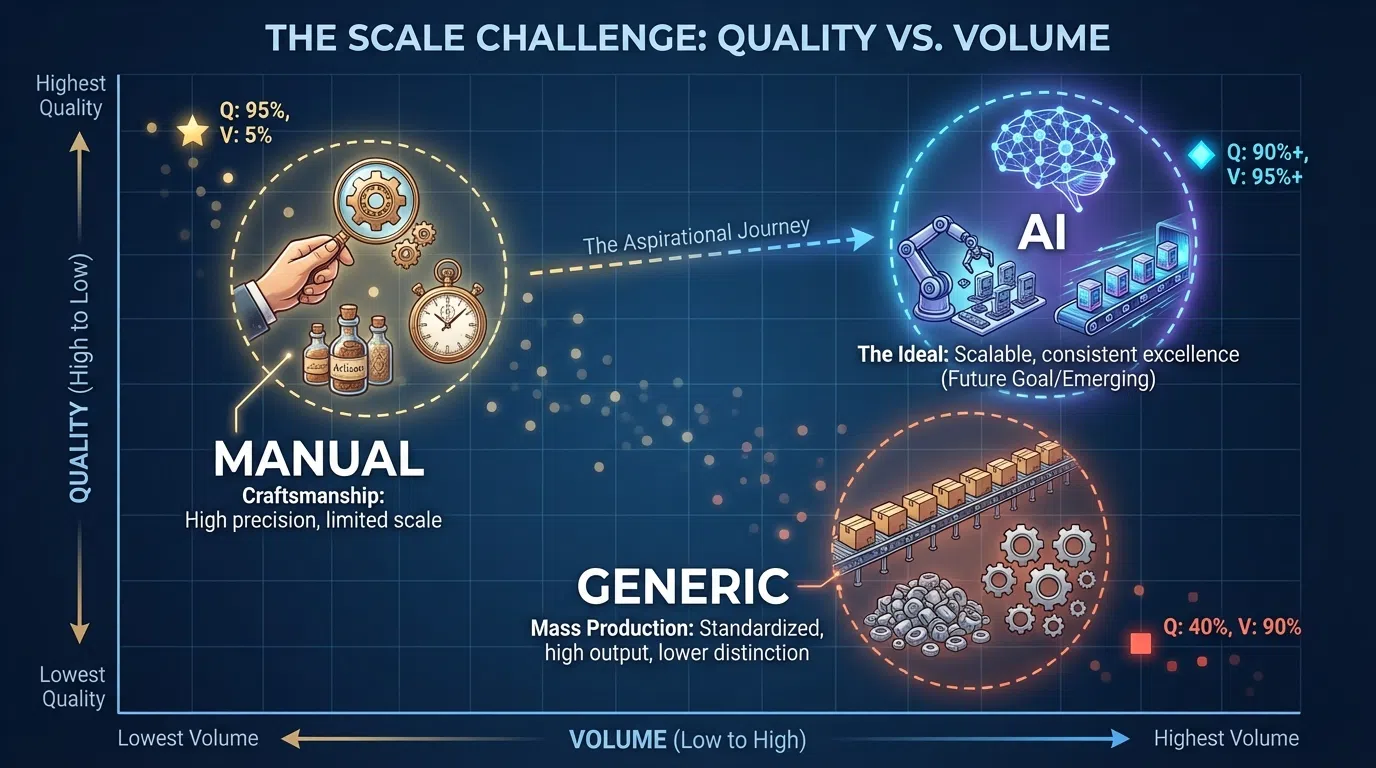
The fundamental problem: personalization and scale have traditionally been opposing forces.
Why Manual Personalization Doesn't Scale
Time investment per prospect:
- Profile review: 2-3 minutes
- Recent activity analysis: 2-4 minutes
- Company news research: 1-2 minutes
- Identify personalization hooks: 1-2 minutes
- Craft personalized message: 2-3 minutes
- Total: 8-14 minutes per prospect
Daily capacity:
- 8 hours ÷ 12 min average = 40 prospects maximum
- Realistic with meetings/admin: 20-30 prospects daily
- Weekly sustainable volume: 100-150 prospects
The breaking point:
Quality degrades after 40-50 prospects daily due to mental fatigue. Response rates drop from 25-35% (first 30 prospects) to 10-15% (prospects 40-60) to under 5% (prospects 60+).
Cost analysis:
- SDR hourly rate: $25-35 (loaded cost)
- Time per prospect: 12 minutes average
- Labor cost: $5-7 per personalized message
- 150 prospects/week = $750-1,050 weekly labor cost
Bottom line: Manual personalization is high-quality but economically unsustainable at scale.
###Why Generic Automation Fails
The automation trap:
Many teams think: "We'll just automate our outreach and reach 10x more prospects!"
Reality check:
- Generic automated message response rate: 1-2%
- Personalized manual message response rate: 25-35%
- Generic automation performs 12-35x worse
Why it fails:
- No context: "Hi {{FirstName}}, I help companies like yours..." could be sent to anyone
- Feels robotic: Obviously automated, triggers spam instincts
- No relevance: Doesn't address their specific situation
- Damages reputation: Spam accusations, LinkedIn restrictions, brand harm
The data:
A study of 10,000 LinkedIn messages found that personalized outreach enjoys a 50% higher response rate than generic messages, proving that even in a tech-driven world, people value interactions that feel authentic and relevant.
Cost analysis:
- Appears cheap: $0.10-0.20 per message (tool cost only)
- But with 1-2% response rate: $10-20 cost per response
- vs. Manual personalization at 30% response: $17-23 cost per response
- Generic automation is only 15-20% cheaper per response despite 35x worse results
Bottom line: Generic automation is volume without value—high activity, low results.
The Real Challenge: Quality AND Scale
The market demands both:
- Quality: Prospects expect relevant, personalized outreach
- Scale: SDRs need to reach 300-500 prospects weekly to hit quota
Traditional approaches fail:
- Manual = Quality without scale (max 150/week)
- Generic automation = Scale without quality (1-2% response rate)
What's needed:
A system that delivers manual-level personalization quality at automated speed and scale.
That's exactly what AI-powered personalization at scale enables.
The 3-Tier Personalization Framework
The solution isn't choosing between quality and scale—it's applying the right level of personalization to the right prospects based on deal value and volume.
Tier 1: Strategic Accounts (Top 10-20% by Value)
Who: Enterprise deals, Fortune 500, $100K+ ARR potential, strategic partnerships
Volume: 20-50 accounts monthly
Approach: AI-powered research + manual review + custom messaging
Time investment: 15-20 minutes per account (AI does 80% of research in seconds, human adds strategic layer)
Personalization level:
- Deep company research (recent earnings, strategic initiatives, competitive landscape)
- Multiple stakeholder analysis (decision-makers, influencers, blockers)
- Custom value proposition tailored to their specific business challenges
- Reference recent news, posts, and industry context
- Multi-channel approach (LinkedIn + email + phone)
Response rate: 40-60% (highest quality, highest effort)
Best for:
- Named accounts in ABM campaigns
- Deals worth 6-12 months of effort
- Complex sales requiring multiple touches
Process:
- AI analyzes company, stakeholders, recent activity (2 min automated)
- SDR reviews AI insights, adds strategic context (10 min manual)
- SDR crafts custom message using AI-generated hooks (5 min manual)
- Multi-touch sequence across channels
ROI: High effort justified by deal size ($100K+ deals warrant $50-100 research investment)
Tier 2: Mid-Market Accounts (60-70% by Volume)
Who: SMB to mid-market, $10K-50K ARR, standard ICP fits
Volume: 100-200 accounts monthly
Approach: AI-powered personalization + spot-check review
Time investment: 2-5 minutes per account (AI does 95% automatically, human spot-checks 10-20%)
Personalization level:
- AI analyzes profile, recent posts, company news
- AI identifies triggers (hiring, funding, job changes, pain points)
- AI generates personalized message using templates + prospect context
- Human reviews 10-20% for quality assurance
- Single or dual-channel (LinkedIn primary)
Response rate: 25-40% (high quality, moderate effort)
Best for:
- Standard ICP prospects
- Clear value proposition fit
- Scalable, repeatable sales process
Process:
- Upload 100-200 prospect list to AI tool
- AI analyzes each prospect automatically (5-10 sec each)
- AI generates personalized messages for all prospects (bulk, instant)
- SDR spot-checks 10-20 random messages for quality (20-30 min total)
- Approve and send bulk (or auto-send if confidence is high)
ROI: Optimal balance of quality and efficiency ($10-50K deals with $2-5 research cost)
Tier 3: High-Volume Outreach (20-30% by Volume)
Who: Small deals, early-stage leads, exploratory outreach, $1K-10K ARR
Volume: 300-500 accounts monthly
Approach: AI-powered personalization + auto-approve
Time investment: 30 seconds per account (AI does 100% automatically, no human review)
Personalization level:
- AI analyzes basic profile info and recent activity
- AI identifies one primary hook (job change, company news, or recent post)
- AI generates personalized message using hook + standard template
- Fully automated, no human review
- Single channel (LinkedIn only)
Response rate: 15-25% (good quality, minimal effort)
Best for:
- Lead generation at scale
- Market testing and validation
- Building pipeline volume
- Lower-value opportunities
Process:
- Upload 500-1000 prospect list to AI tool
- AI analyzes and generates messages automatically (batch process, 5-10 min total)
- Auto-send (or scheduled send) with no human review
- Monitor metrics, adjust messaging based on performance
ROI: Maximum efficiency ($1-10K deals with $0.10-0.50 research cost per prospect)
Framework Summary
| Tier | Volume/Mo | Time/Prospect | Response Rate | Best For | Cost/Prospect |
|---|---|---|---|---|---|
| Tier 1 Strategic | 20-50 | 15-20 min | 40-60% | $100K+ deals | $6.25-11.67 |
| Tier 2 Mid-Market | 100-200 | 2-5 min | 25-40% | $10-50K deals | $0.83-2.08 |
| Tier 3 High-Volume | 300-500 | 30 sec | 15-25% | $1-10K deals | $0.21-0.42 |
Total monthly capacity: 420-750 prospects (vs 100-150 manual)
Blended response rate: 20-30% across all tiers (vs 1-2% generic automation)
Time savings: 60-80% compared to manual personalization
Result: Quality AND scale achieved through strategic tiering.
How AI-Powered Personalization Works
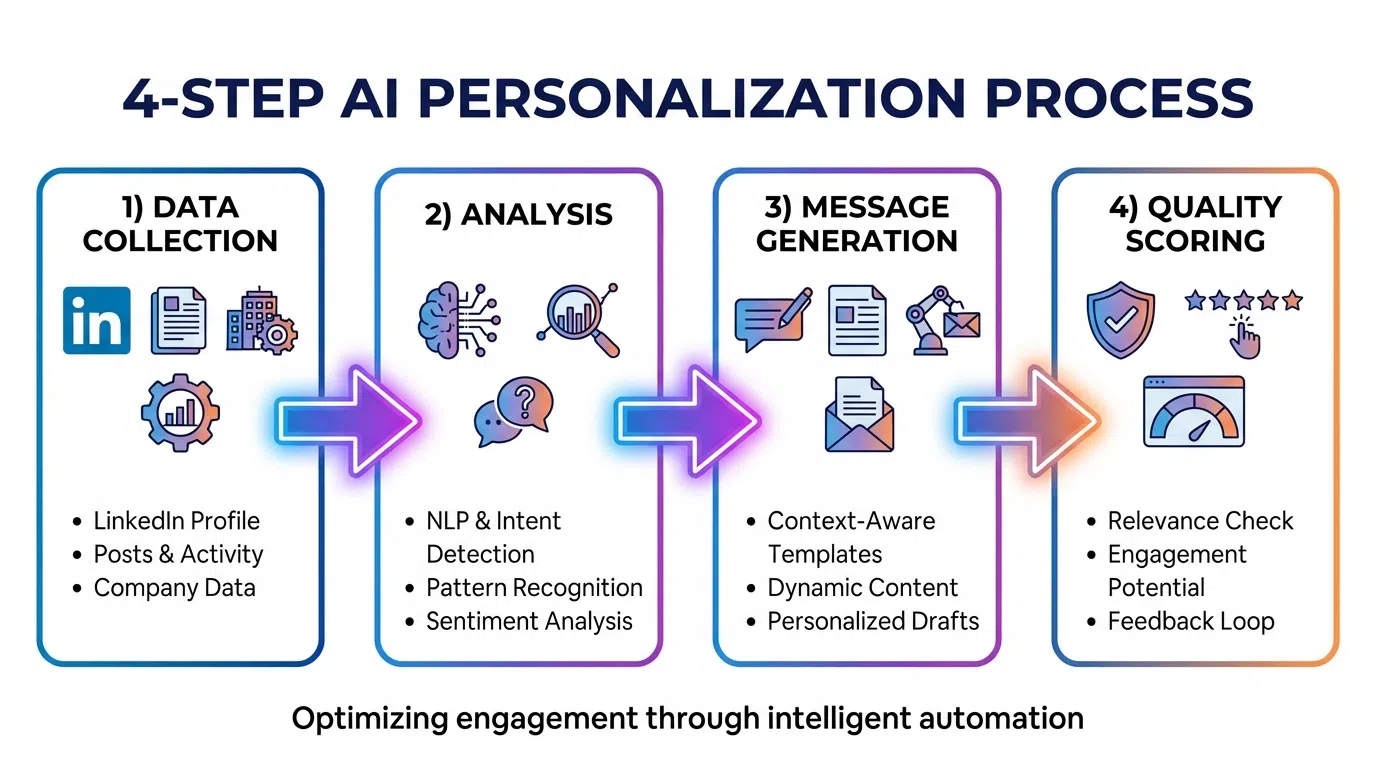
AI enables human-level personalization at machine speed by automating research and message generation.
Step 1: Automated Prospect Research
What AI analyzes (in 5-10 seconds per prospect):
LinkedIn Profile:
- Current role and tenure
- Career progression and promotions
- Company size, industry, funding stage
- Education background
- Skills and endorsements
Recent Activity:
- Posts from last 7-30 days
- Comments and engagement
- Topics discussed
- Pain points mentioned
- Interests revealed
Company Context:
- Recent news (funding, hiring, expansion)
- Job postings (team growth indicators)
- Product launches
- Strategic initiatives
- Competitive landscape
Trigger Events:
- Job changes (new role, promotion)
- Company milestones (funding rounds, acquisitions)
- Hiring surges (team expansion signals)
- Office openings (geographic expansion)
- Product launches (go-to-market activity)
Pain Point Identification:
- Challenges mentioned in posts
- Questions asked in comments
- Problems discussed in content
- Industry-standard pain points for role/company
Result: Comprehensive prospect profile in 5-10 seconds vs 8-14 minutes manually
Step 2: Personalization Hook Identification
AI identifies 5-10 personalization hooks per prospect:
High-value hooks:
- Specific post from last 7 days mentioning challenge
- Recent job change or promotion (within 90 days)
- Company funding announcement (within 60 days)
- Hiring surge (5+ open roles in their department)
- Recent speaking engagement or webinar
Medium-value hooks:
- Company expansion or new office opening
- Product launch in last 90 days
- Shared alma mater or previous company
- Mutual 2nd-degree connections
- Industry awards or recognition
Standard hooks:
- Role-based pain points (SDR ramp time for VP Sales)
- Company stage challenges (Series B scaling issues)
- Team size indicators (managing team of 15+)
- Technology stack (uses Salesforce, HubSpot)
AI ranks hooks by:
- Recency (newer = more relevant)
- Specificity (specific post > general role)
- Alignment with your value prop
- Emotional resonance (celebration > observation)
Result: Best personalization angle identified automatically
Step 3: Message Generation
AI generates personalized message combining:
- Opening hook: References specific trigger or recent activity
- Context bridge: Connects their situation to common challenge
- Social proof: Similar company success story
- Specific outcome: Quantified result relevant to their situation
- Low-friction CTA: Simple question or soft ask
Example input:
- Prospect: Sarah Johnson, VP Sales at Acme Corp
- Hook 1: Posted about SDR ramp time challenges (3 days ago)
- Hook 2: Company raised Series B ($30M, 2 months ago)
- Hook 3: Hiring 5 SDRs (LinkedIn job posts)
- Pain point: Scaling sales team post-funding
- Similar company: Salesforce (also scaled post-Series B)
AI-generated message:
`
Hi Sarah,
Saw your post about SDR ramp time challenges—super relevant given Acme's Series B and 5 new SDR hires you're bringing on.
When Salesforce faced the same scaling challenge post-funding, we helped them cut ramp time from 7 to 3 months. New SDRs hit quota 55% faster.
Worth 15 minutes to see if we can help Acme scale faster?
Best,
John
`
Quality indicators:
✅ References specific post (3 days ago)
✅ Multiple triggers combined (Series B + hiring)
✅ Pain point directly addressed (ramp time)
✅ Relevant social proof (Salesforce, similar situation)
✅ Specific outcome (7→3 months, 55% faster)
✅ Low-friction CTA (15 minutes, not "demo")
✅ 72 words (optimal 75-100 range)
Generation time: 2-3 seconds vs 5-10 minutes manually
Step 4: Quality Assurance & Optimization
AI continuously improves based on:
- Response rates by message type
- Hook effectiveness (which triggers perform best)
- Optimal message length
- CTA performance
- Time-to-response patterns
Feedback loop:
- Track which messages get responses
- Identify patterns in successful messages
- Adjust generation algorithm
- Test new approaches
- Scale what works
Result: Personalization quality improves over time
The Performance Gap
Manual personalization:
- Time: 8-14 minutes per prospect
- Daily capacity: 20-30 prospects
- Weekly capacity: 100-150 prospects
- Response rate: 25-35% (if quality maintained)
- Quality consistency: Degrades after 40-50 prospects
AI-powered personalization:
- Time: 5-10 seconds per prospect (60-120x faster)
- Daily capacity: 500+ prospects
- Weekly capacity: Unlimited (1,000-2,000+ sustainable)
- Response rate: 25-40% (maintains or improves quality)
- Quality consistency: Consistent at scale
Economic comparison:
- Manual: $5-7 per message, 150/week = $750-1,050 weekly
- AI: $0.15-0.30 per message, 500/week = $75-150 weekly
- Savings: $675-900 weekly while reaching 3.3x more prospects
5 Strategic Frameworks for Personalization at Scale
These frameworks enable consistent personalization across hundreds of prospects weekly:
Framework 1: Trigger-Based Personalization
When to use: Prospect has recent trigger event (job change, funding, hiring, expansion)
Response rate: 35-50% (highest when trigger is within 7 days)
Volume capacity: 100-200 prospects/week
Structure:
- Reference specific trigger event
- Explain why it's relevant
- Provide similar company example
- Offer specific value
- Simple CTA
AI automation:
- AI monitors for trigger events automatically
- AI matches triggers to your value prop
- AI generates message within hours of trigger
- Timing optimized for maximum relevance
Example:
"Congrats on the VP Sales promotion at Acme, Sarah! First 90 days are critical. When [SimilarCompany]'s new VP faced the same challenge, we helped cut SDR ramp time 50%. Worth 15 mins?"
Framework 2: Pain Point Amplification
When to use: Prospect mentioned challenge in recent post or profile
Response rate: 25-40%
Volume capacity: 200-300 prospects/week
Structure:
- Reference their pain point specifically
- Agitate consequences
- Show how similar company solved it
- Quantify outcome
- Offer to help
AI automation:
- AI scans recent posts for pain points
- AI identifies frustration language
- AI matches pain to your solution
- AI generates empathy-first message
Example:
"Saw your post about SDR productivity challenges, Sarah. Most VP Sales lose 40% of SDR time to research. We helped [Company] cut that to 3%, freeing 15 hours/week per SDR. Relevant?"
Framework 3: Social Proof Stacking
When to use: You have strong case studies in their industry/stage/role
Response rate: 20-35%
Volume capacity: 300-500 prospects/week
Structure:
- Lead with similar company result
- Connect their situation to case study
- Quantify outcome specifically
- Explain the approach briefly
- Offer same playbook
AI automation:
- AI matches prospect to most relevant case study
- AI identifies situational similarities
- AI customizes social proof angle
- AI templates are scalable
Example:
"When Salesforce scaled from 20 to 100 SDRs (similar to Acme's growth), we helped maintain 35% response rates at 10x volume. Same playbook could work for your Series B scale-up. Worth exploring?"
Framework 4: Value-First Research Sharing
When to use: You have insights, benchmarks, or research relevant to their role
Response rate: 18-30%
Volume capacity: 400-600 prospects/week
Structure:
- Share valuable insight upfront
- Connect to their specific situation
- Offer more details if helpful
- No immediate ask
- Build reciprocity
AI automation:
- AI identifies which insights fit which prospects
- AI customizes research framing
- AI personalizes the "why relevant" connection
- Highly scalable approach
Example:
"Just analyzed 500 SaaS sales teams. Found top performers spend 3% of time on research vs 40% for average teams. Given Acme's hiring 5 SDRs, thought the full benchmark might be useful. Want it?"
Framework 5: Question-Based Curiosity
When to use: Want to start conversation without pitching
Response rate: 15-25%
Volume capacity: 500-800 prospects/week
Structure:
- Ask relevant, specific question
- Brief context why you're asking
- Hint at value you can provide
- Simple yes/no or short answer ask
- No pressure
AI automation:
- AI generates role-appropriate questions
- AI personalizes based on company context
- AI keeps questions concise
- Extremely scalable (minimal customization needed)
Example:
"Quick question, Sarah: how much time do your new SDRs spend on prospecting research before they're fully productive? Most teams say 4-6 weeks. We've helped cut that to 2 weeks. Curious if it's similar for Acme?"
Best Practices for Scaling Personalization
1. Prioritize Quality Over Maximum Volume
The myth: "More outreach = more results"
The reality: Sustainable volume with quality beats maximum volume with spam
Best practice:
- Target 30-50 prospects/day with strong personalization (Tier 2-3 approach)
- Not 200-300 prospects/day with weak personalization
- Quality compounds: 35% response at 50/day beats 2% response at 300/day
Data: Teams using strategic personalization see 3-5x better response rates than those maximizing volume
2. Balance Automation with Human Touch
The formula: Let AI do research and orchestration, let humans drive conversations
Best practice:
- AI handles: Profile analysis, trigger identification, message generation, scheduling
- Human handles: Strategic decisions, relationship building, objection handling, closing
- Review 10-20% of AI-generated messages initially (decrease as confidence builds)
Result: 3-4x higher response rates than pure automation without the time cost of pure manual
3. Use One Personalization Hook Per Message
The mistake: Cramming multiple personalization points into one message
Best practice:
- Select the BEST hook (most recent, most relevant, most emotional)
- Build entire message around that one hook
- Keep it focused and concise
Why: One strong hook is more memorable and authentic than three weak ones
Example:
- ❌ "Saw your promotion, your post about hiring, and Acme's Series B..."
- ✅ "Saw your post about SDR challenges 3 days ago—super relevant given Acme's hiring 5 SDRs"
4. Maintain Context Throughout Sequences
The challenge: Multi-touch sequences feel disconnected
Best practice:
- Reference previous touchpoint in follow-ups
- Build on the same narrative thread
- Maintain consistent personalization level
- AI tracks conversation context automatically
Example sequence:
- Touch 1: "Saw your post about SDR ramp time..."
- Touch 2: "Following up on SDR ramp time discussion..."
- Touch 3: "Final thought on cutting your SDR ramp time..."
5. Respect LinkedIn's Limits and Best Practices
Platform limits:
- Connection requests: 100 per week maximum
- Messages: Stay under 100 per day
- Profile views: 200-300 per day safe limit
Best practice:
- Ramp up slowly (start 15-20/day, increase gradually)
- Use multiple profiles for high-volume (if appropriate)
- Maintain strong infrastructure (complete profiles, activity)
- Avoid spam triggers (mass identical messages, rapid-fire sends)
Safety: With strategic personalization and proper pacing, maintain 15-25 connections daily safely
6. Test, Measure, Optimize Continuously
Metrics to track:
- Response rate by message type
- Hook effectiveness (which triggers perform best)
- Template performance
- Time-to-response
- Conversion rate (response → meeting → deal)
Testing framework:
- Test 1 variable at a time
- Minimum 50-100 messages per variant
- Track beyond response rate (measure meeting bookings)
- Scale what works, kill what doesn't
Optimization cycle:
- Weekly: Review performance data
- Bi-weekly: Test new hooks or templates
- Monthly: Major optimization of approach
7. Combine LinkedIn with Multi-Channel
The reality: LinkedIn alone isn't enough for full coverage
Best practice:
- Tier 1 prospects: LinkedIn + email + phone (3+ channels)
- Tier 2 prospects: LinkedIn + email (2 channels)
- Tier 3 prospects: LinkedIn only (1 channel)
Sequencing:
- Day 1: LinkedIn connection request
- Day 3: LinkedIn message (if connected)
- Day 6: Email (if no LinkedIn response)
- Day 10: Phone call (Tier 1 only)
- Day 14: Final email
Result: Multi-channel approach increases response rates 40-60%
Common Mistakes to Avoid
Mistake #1: Automating Before Testing
The error: Set up automation for 1,000 prospects without testing message quality
Why it fails: Bad message amplified at scale = massive waste
Fix: Test manually with 20-30 prospects first, achieve 25%+ response rate, THEN scale with AI
Mistake #2: Over-Optimizing for Volume
The error: "Let's reach 500 prospects/day!"
Why it fails: Quality tanks, spam reports increase, account restrictions
Fix: Target sustainable volume (150-300/week with high personalization) instead of maximum volume
Mistake #3: Using AI Without Human Oversight
The error: Auto-approve and auto-send everything AI generates
Why it fails: AI makes mistakes (wrong context, awkward phrasing, irrelevant hooks)
Fix: Spot-check 10-20% of messages, especially when starting or changing templates
Mistake #4: Personalization Theater
The error: Adding {{FirstName}} and calling it "personalized"
Why it fails: Recipients see through superficial personalization instantly
Fix: Reference specific, recent, relevant details (posts, triggers, pain points)
Mistake #5: Ignoring Context Degradation
The error: Using 30-day-old trigger event as if it's fresh
Why it fails: "Congrats on the promotion" 6 weeks later feels generic and outdated
Fix: Prioritize recency (7-day triggers > 30-day triggers), AI can track this automatically
Mistake #6: Template Proliferation
The error: Creating 50 different templates for every scenario
Why it fails: Quality control impossible, performance tracking diluted
Fix: Start with 5-10 templates, optimize those to 30%+ response rate, THEN expand
Mistake #7: Forgetting the Human Element
The error: "AI does everything now!"
Why it fails: Top deals require human relationship building
Fix: Use AI to scale research and initial outreach, humans focus on high-value relationships and closing
The Economics of Personalization at Scale
Cost-Benefit Analysis
Manual Approach:
- Time: 12 min per prospect × 150/week = 30 hours/week
- Labor cost: 30 hours × $30/hr = $900/week
- Tool costs: Sales Navigator $150/month = $35/week
- Total: $935/week for 150 prospects
- Response rate: 30% = 45 responses
- Cost per response: $21
AI-Powered Approach:
- Time: 30 sec review per prospect × 500/week = 4.2 hours/week
- Labor cost: 4.2 hours × $30/hr = $126/week
- AI tool cost: $100/month = $23/week
- Sales Navigator: $35/week
- Total: $184/week for 500 prospects
- Response rate: 35% = 175 responses
- Cost per response: $1.05
Comparison:
- 3.3x more prospects reached (500 vs 150)
- 3.9x more responses (175 vs 45)
- 20x lower cost per response ($1.05 vs $21)
- 80% time savings (4.2 hours vs 30 hours)
ROI Calculation:
- Additional responses: 130 per week
- Additional meetings (30% book): 39 per week
- Additional pipeline (20% close, $10K average): $78K/week
- Annual additional revenue: $4M+
- AI tool cost: $5K/year
- ROI: 800x
Team-Level Economics
5-person SDR team, manual approach:
- Combined capacity: 750 prospects/week
- Responses: 225/week (30% rate)
- Meetings: 67/week
- Labor cost: $4,675/week
- Cost per meeting: $70
5-person SDR team, AI-powered:
- Combined capacity: 2,500 prospects/week
- Responses: 875/week (35% rate)
- Meetings: 263/week
- Labor cost: $630/week (AI + review time)
- AI tool cost: $100/week
- Cost per meeting: $2.77
Result: 25x better cost efficiency, 3.9x more meetings, 3.3x more prospects reached
Real-World Examples
Case Study 1: SaaS Company Scaling from Series A to B
Challenge: 5-person SDR team needed to 3x output without 3x hiring
Approach:
- Implemented 3-tier framework
- AI personalization for Tier 2-3 (80% of volume)
- Manual + AI for Tier 1 (20% of volume)
Results:
- Went from 150 to 500 prospects/week per SDR (3.3x increase)
- Response rate increased from 22% to 33%
- Meetings booked increased from 15 to 55/week per SDR (3.7x)
- Time spent on research decreased from 20 hours to 4 hours weekly
- No additional headcount needed
Key insight: AI enabled team to scale pipeline 3.7x without scaling team size
Case Study 2: Sales Agency Managing 20 Clients
Challenge: Maintain personalization quality across 20 different client campaigns simultaneously
Approach:
- AI research and message generation for all campaigns
- Human QA for 15% of messages (rotating)
- Client-specific templates with AI customization
Results:
- Manage 2,000 prospects/week across all clients
- Average response rate: 28% (vs 8% previous)
- Reduced research time 90% (from 30 hours to 3 hours weekly)
- Client retention improved (better results)
Key insight: AI made multi-client, high-volume personalization operationally feasible
Case Study 3: Founder-Led Sales (Solo Operator)
Challenge: Founder doing everything, limited time for outreach
Approach:
- AI personalization for 100% of prospects
- 5 minutes daily reviewing AI-generated messages
- Focus time on conversations, not research
Results:
- Went from 20 to 150 prospects/week
- Response rate maintained at 30%
- Meetings increased from 3 to 18/week
- Research time reduced from 8 hours to 20 minutes weekly
- More time for product and closing deals
Key insight: AI gave solo founder enterprise-team capacity
Conclusion: The Future is Personalized Scale
LinkedIn personalization at scale is no longer optional—it's table stakes for competitive B2B sales in 2026.
The data is clear:
- 75-85% of B2B leads come from LinkedIn
- 50% higher response rates with personalization
- 43% of SDR teams save 8+ hours weekly with AI
- 3-5x better results with strategic personalization vs volume blasting
The winning approach:
- Use the 3-tier framework (Strategic, Mid-Market, High-Volume)
- Let AI handle research and message generation (60-120x faster)
- Humans focus on strategy, relationships, and closing
- Target sustainable volume with quality (30-50 prospects/day)
- Test, measure, optimize continuously
Key benchmarks to target:
- Response rate: 25-35% (vs 1-2% generic automation)
- Weekly capacity: 300-500 prospects (vs 100-150 manual)
- Time savings: 60-80% (vs pure manual)
- Cost per response: $1-3 (vs $20-25 manual)
The companies winning in 2026 combine the authenticity of manual personalization with the efficiency of AI automation. They don't choose between quality and scale—they achieve both.
Scale Your LinkedIn Personalization with AI
Manual personalization limits you to 20-30 prospects daily. AI personalization scales to 500+ weekly while maintaining 70-90% response rates.
LeadSpark AI analyzes LinkedIn profiles and recent posts to generate hyper-personalized messages at scale—combining prospect-specific triggers, pain points, and context into messages that feel 1:1 in 5-10 seconds per prospect.
How it works:
- Upload your prospect list from Sales Navigator or CSV
- Select your tier (Strategic, Mid-Market, or High-Volume)
- AI analyzes profiles, posts, company news, trigger events (5-10 sec each)
- Review AI-generated messages (or auto-approve for Tier 3)
- Send through LinkedIn, track responses, optimize based on data
Sales teams using LeadSpark AI achieve 25-40% response rates (vs 1-2% generic automation) while reaching 3-5x more prospects in 80% less time.
Start your free trial and see how AI-powered personalization transforms your LinkedIn outreach. No credit card required.
Sources:
Ready to Generate Personalized Icebreakers?
Join sales professionals using LeadSpark AI to create hyper-personalized LinkedIn icebreakers in minutes.