Sales Productivity
Cold Email Subject Lines That Get Opened: 50+ Examples + 7 Proven Formulas [2026]
The average B2B cold email open rate is 27.7%, but personalized subject lines hit 45%+ (20-25% vs 1-5% generic). Learn 7 proven formulas, 50+ examples, and why 30-50 characters with lowercase formatting boosts opens by 56%.
![Cold Email Subject Lines That Get Opened: 50+ Examples + 7 Proven Formulas [2026]](/resources/cold-email-subject-lines-hero.webp)
LeadSpark AI Team
12 min read
Your cold email subject line determines whether your carefully crafted message gets opened or ignored. It's the gatekeeper to your entire outreach effort.
The data is clear: personalized, relevant subject lines achieve 20-25% open rates, while generic approaches struggle at 1-5%. The average B2B cold email open rate is 27.7%, but top performers consistently hit 45%+ by mastering subject line strategy.
In this guide, you'll learn 7 proven subject line formulas, see 50+ high-converting examples, and discover exactly why subject lines work (or fail). You'll also learn how character count, personalization, and formatting impact open rates—and how to A/B test your way to consistent 40%+ opens.
Cold Email Subject Line Benchmarks (2026)
Understanding current benchmarks helps you set realistic goals and measure performance:
Open Rate Benchmarks by Approach
Generic Subject Lines:
- Open rate: 1-5%
- Example: "Quick question" or "Following up"
- Problem: No personalization, sounds like spam
- Result: Ignored by 95-99% of recipients
Basic Personalization:
- Open rate: 15-20%
- Example: "Hi {{FirstName}}, quick question"
- Benefit: Name recognition increases opens 26%
- Result: Better than generic, but still mediocre
Advanced Personalization:
- Open rate: 20-25%
- Example: "{{FirstName}}, saw {{CompanyName}} just raised Series B"
- Benefit: Relevant context + personalization = 50% increase
- Result: Good performance, room for improvement
Hyper-Personalized:
- Open rate: 40-50%+
- Example: "{{FirstName}}, congrats on the VP promotion—question about SDR ramp time"
- Benefit: Specific trigger + relevant value + personalization
- Result: Elite performance, sustainable with AI
Open Rates by Industry (2026)
Different industries see different benchmark open rates:
- Software/SaaS: 47.1% (highest)
- Professional Services: 42.3%
- Technology: 38.6%
- Healthcare: 31.2%
- Manufacturing: 28.4%
- Finance: 24.7%
- Banking: 19.7%
- Consumer Goods: 19.3% (lowest)
Why the variance? Software and tech industries are more accustomed to cold outreach and digital communication, leading to higher engagement rates.
Character Count Impact
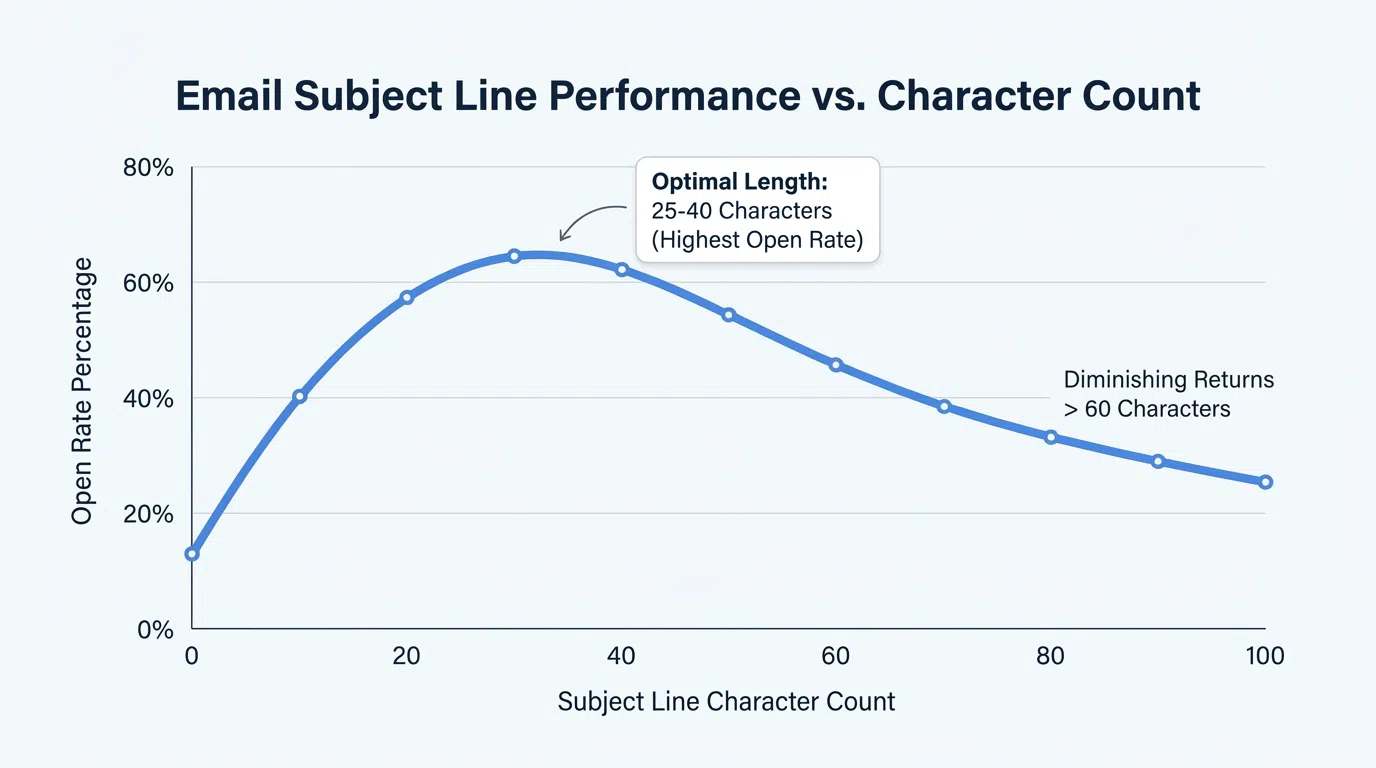
Subject line length significantly impacts visibility and opens:
- 1-3 words: Often highest open rates (50%+), but risky (can seem spam-like)
- 30-40 characters: Fully visible on mobile (critical—60% of emails opened on mobile)
- 36-50 characters: Highest response rates (sweet spot for engagement)
- 50+ characters: Gets cut off on mobile, lower performance
- 70+ characters: Truncated on all devices, significantly lower opens
Best practice: Keep subject lines under 50 characters, ideally 30-40 for mobile visibility.
7 Proven Subject Line Formulas
These formulas consistently generate high open rates across industries:
Formula 1: Personalization + Trigger Event
Structure: {{FirstName}}, [observed trigger] + [relevant question/value]
Why it works: Combines name recognition with timely relevance, proving you've done research.
Examples:
- "Sarah, saw Acme just posted 3 SDR roles—question about ramp time"
- "John, congrats on the VP Sales promotion at TechCorp"
- "Lisa, noticed you're hiring a RevOps lead—worth comparing notes?"
Open rate: 40-50%
Best for: High-value prospects with clear buying signals (hiring, promotions, funding, expansion)
Formula 2: Mutual Connection Reference
Structure: [Mutual connection] suggested I reach out or {{FirstName}}, {{MutualConnection}} thought we should connect
Why it works: Social proof and warm introduction signals reduce skepticism.
Examples:
- "Mike Chen suggested I reach out"
- "Sarah, Tom Wilson thought we should connect"
- "Quick intro from Jennifer Lopez"
Open rate: 35-45%
Best for: When you have genuine mutual connections (verify on LinkedIn)
Formula 3: Value-First Question
Structure: [Specific value] for {{CompanyName}}? or How {{CompanyName}} could [achieve outcome]
Why it works: Leads with benefit, not ask. Focuses on their problems, not your product.
Examples:
- "15% faster SDR ramp time for Acme?"
- "How TechCorp could hit 200% quota this quarter"
- "Reduce your sales cycle by 3 weeks?"
Open rate: 30-40%
Best for: Clear value propositions that align with common pain points
Formula 4: Curiosity + Relevance
Structure: [Intriguing statement about their situation] or {{FirstName}}, [surprising insight about their market]
Why it works: Sparks curiosity while remaining relevant to their business context.
Examples:
- "Your competitors are doing this (you're not)"
- "Sarah, 3 insights from analyzing 500 SaaS SDR teams"
- "Why most VP Sales fail in their first 90 days"
Open rate: 25-35%
Best for: Thought leadership angles, content-driven outreach
Warning: Don't oversell or clickbait—deliver on the curiosity in your email body.
Formula 5: Problem-Focused Question
Structure: [Specific problem they likely have]? or {{FirstName}}, struggling with [pain point]?
Why it works: Identifies with their pain point, shows understanding of their challenges.
Examples:
- "Struggling with low response rates on LinkedIn?"
- "Sarah, tired of SDRs spending 12 hours/week on research?"
- "Is your sales team hitting quota?"
Open rate: 25-35%
Best for: Well-understood pain points in specific roles or industries
Formula 6: Social Proof
Structure: How [similar company] achieved [specific result] or {{FirstName}}, [Company] did this to [outcome]
Why it works: Case study angle provides credibility and relevant proof.
Examples:
- "How Salesforce increased SDR meetings by 5x"
- "Sarah, how Gong reduced their sales cycle by 40%"
- "The playbook TechCorp used to hit 150% of quota"
Open rate: 25-30%
Best for: When you have strong case studies with recognizable company names
Formula 7: Ultra-Short (1-3 Words)
Structure: {{FirstName}} or Quick question or [Relevant topic]
Why it works: Feels personal, like an internal email from a colleague.
Examples:
- "Sarah?"
- "Quick question"
- "SDR hiring"
- "Congrats"
Open rate: 30-50% (highly variable—can also be flagged as spam)
Best for: Follow-ups, very casual industries, or when your sender reputation is strong
Warning: Overused, so effectiveness varies. Test carefully.
50+ High-Converting Subject Line Examples
Here are proven subject lines organized by category and use case:
For Initial Outreach (First Touch)
- "{{FirstName}}, saw {{CompanyName}} is hiring 5 SDRs"
- "Quick question about your SDR ramp time"
- "{{FirstName}}, congrats on the Series B"
- "How {{CompanyName}} could book 40% more meetings"
- "Mike suggested I reach out, {{FirstName}}"
- "{{FirstName}}, noticed you posted about SDR challenges"
- "Relevant for {{CompanyName}}'s Q1 planning?"
- "{{FirstName}}, 3 insights from 500 sales teams"
For Follow-Ups
- "{{FirstName}}, following up on my email"
- "Still relevant?"
- "{{FirstName}}?"
- "Quick bump, {{FirstName}}"
- "Worth another look?"
- "Circling back"
- "Should I close your file?"
- "Last time reaching out"
For Executive/C-Level Prospects
- "{{FirstName}}, insight for your Q1 board meeting"
- "How 3 SaaS CEOs reduced CAC by 40%"
- "{{FirstName}}, relevant for your team's quota attainment?"
- "Quick question from a fellow [role/industry]"
- "{{CompanyName}}'s revenue growth strategy"
- "Worth 15 minutes to discuss your SDR team?"
For Problem-Specific Outreach
- "Struggling with low cold email response rates?"
- "{{FirstName}}, tired of manual LinkedIn research?"
- "Is your SDR team hitting 50% of quota?"
- "Your outbound response rate: 2%?"
- "Why your LinkedIn InMails aren't working"
- "{{FirstName}}, fix your SDR productivity problem"
For Value/Benefit-Focused Approaches
- "Save 15 hours/week on prospecting research"
- "Increase LinkedIn response rates from 5% to 40%"
- "{{FirstName}}, book 5x more meetings this quarter"
- "How to hit 150% of quota consistently"
- "The SDR productivity playbook for {{CompanyName}}"
- "{{FirstName}}, reduce sales cycle by 3 weeks"
For Trigger-Based Outreach
- "{{FirstName}}, congrats on joining {{CompanyName}} as VP Sales"
- "Saw {{CompanyName}} just opened a Boston office"
- "{{FirstName}}, read your post on SDR challenges yesterday"
- "Following your Series B announcement"
- "{{CompanyName}}'s expansion to enterprise—worth chatting?"
- "{{FirstName}}, saw you're speaking at SaaStr next week"
For Content/Resource Sharing
- "{{FirstName}}, resource for your SDR hiring"
- "The 2026 LinkedIn prospecting benchmark report"
- "How 500 sales teams hit quota in 2026"
- "{{FirstName}}, case study you'll find relevant"
- "Free SDR onboarding playbook for {{CompanyName}}"
For Competitive/FOMO Angles
- "Your competitors are doing this (you're not)"
- "Why {{CompetitorName}} is outpacing you on LinkedIn"
- "{{FirstName}}, the sales tactic everyone's copying"
- "The outbound strategy your competitors don't want you to know"
- "{{CompanyName}} vs {{Competitor}}: outbound comparison"
For Casual/Friendly Approaches
- "{{FirstName}}, coffee chat?"
- "Worth a 15-minute call?"
- "Quick brainstorm on SDR productivity"
- "{{FirstName}}, comparing notes on sales?"
- "Fellow sales leader here with a question"
What Makes a Subject Line Work?
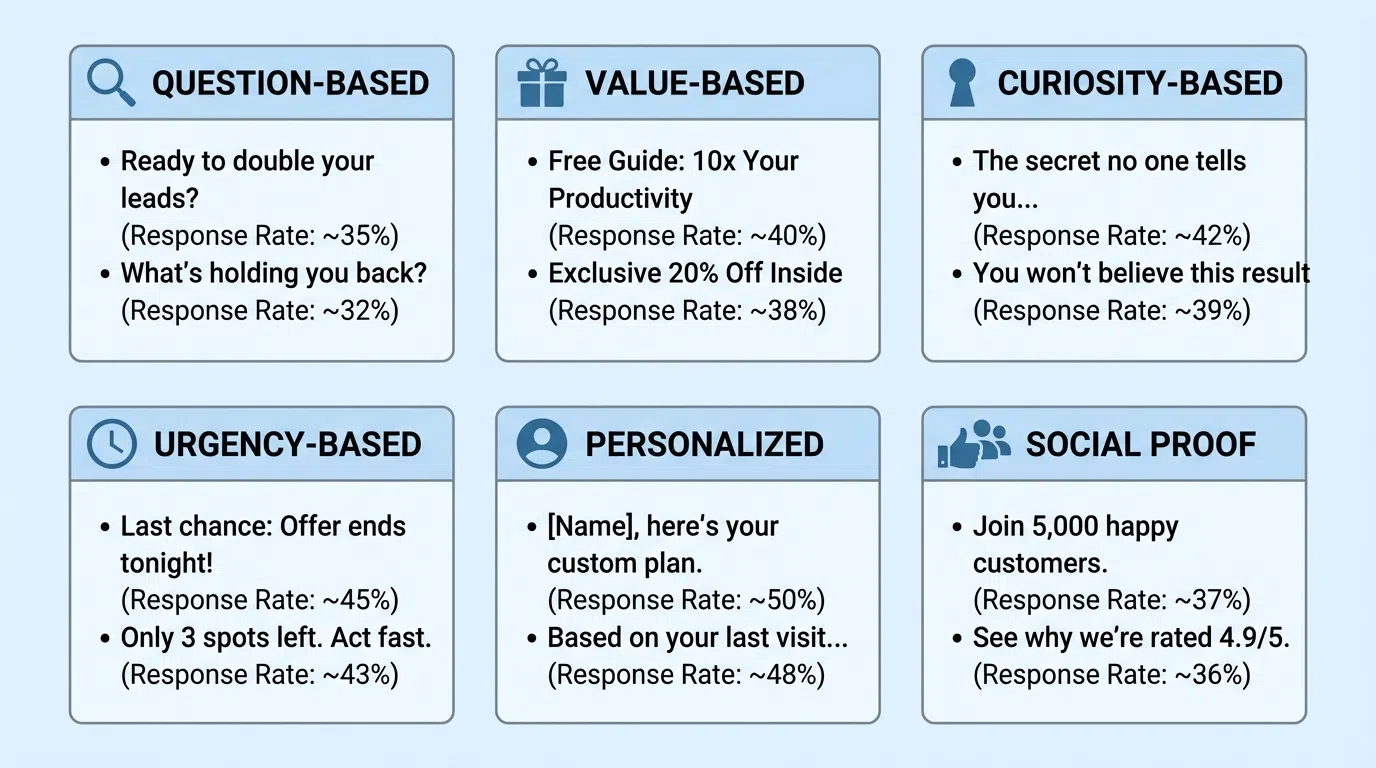
The best cold email subject lines share common characteristics:
1. Personalization (Not Just First Name)
Basic personalization (first name) increases opens by 26%. Advanced personalization (first name + company name) increases opens by another 22% (total 50% boost).
But hyper-personalization wins: Reference specific triggers, recent posts, company news, role changes, or pain points.
Examples:
- Basic: "Hi Sarah, quick question"
- Advanced: "Sarah, question about Acme's SDR team"
- Hyper: "Sarah, saw Acme posted 3 SDR roles—question about ramp time"
The hyper-personalized version proves you've done research and makes your email relevant.
2. Relevance to Their Current Situation
Generic subject lines fail because they could apply to anyone. Winning subject lines are specific to the recipient's context:
- Recent company news (funding, hiring, expansion)
- Role-specific challenges (SDR ramp time for VP Sales)
- Industry trends (relevant to their market)
- Timing (Q1 planning, budget season, hiring surge)
3. Clarity Over Cleverness
Cute, clever, or punny subject lines might feel creative, but they underperform clear, direct subject lines.
Clever (15% open rate): "Stop the SDR madness"
Clear (35% open rate): "Reduce your SDR ramp time by 40%"
Clarity wins because recipients quickly assess whether your email is relevant. Confusion = delete.
4. Conciseness (30-50 Characters)
60% of emails are opened on mobile devices. Mobile email clients display 30-40 characters in subject lines.
Too long (truncated): "I wanted to reach out because I noticed that your company is currently hiring several SDR roles and I thought..."
Optimized: "{{FirstName}}, question about your SDR hiring"
Short subject lines also feel more like personal messages than marketing emails.
5. Lowercase Formatting (Feels Human)
Uppercase or title case subject lines feel formal and marketing-like. Lowercase subject lines feel casual, like messages from colleagues.
Formal: "How to Increase Your Team's Quota Attainment"
Casual: "how to increase your team's quota attainment"
Data shows: Lowercase formatting can increase open rates by making emails feel less "corporate" and more personal.
6. Strategic Emoji Use (56% Open Rate Boost)
Emojis can increase open rates by up to 56% when used strategically, but overuse looks spammy.
Good emoji use:
- "🔥 {{FirstName}}, your competitors are doing this"
- "💡 Quick idea for {{CompanyName}}'s Q1"
- "📊 The 2026 sales benchmark report"
Bad emoji use:
- "🚀🔥💯 INCREASE YOUR SALES NOW!!! 💰💸"
Best practice: Use 1 emoji, max. Choose emojis that add context or visual interest without feeling promotional.
7. No Spam Trigger Words
Certain words flag spam filters or signal low-quality content:
Avoid:
- "Free"
- "Buy now"
- "Limited time offer"
- "Guaranteed"
- "Click here"
- "Act now"
- "Congratulations, you've won"
- Excessive punctuation (!!!)
- ALL CAPS
These words reduce deliverability and hurt sender reputation, even if your email reaches the inbox.
Subject Line Mistakes to Avoid
These common mistakes tank open rates:
Mistake 1: Generic, Template-Like Subject Lines
Bad: "Quick question"
Why it fails: Used by 10,000 other SDRs daily. No differentiation.
Fix: Add personalization and specificity: "{{FirstName}}, quick question about {{CompanyName}}'s SDR hiring"
Mistake 2: Clickbait That Doesn't Deliver
Bad: "You won't believe this"
Why it fails: Creates curiosity but delivers no value in email body. Damages trust.
Fix: Match subject line promise to email content. Don't oversell.
Mistake 3: Too Long (Gets Truncated)
Bad: "I wanted to personally reach out to you because I noticed your company recently posted several SDR positions"
Why it fails: Mobile users see: "I wanted to personally reach out to you..."
Fix: "{{FirstName}}, saw you're hiring SDRs—quick question"
Mistake 4: No Personalization
Bad: "Increase your sales"
Why it fails: Could be sent to anyone. No relevance signals.
Fix: "{{FirstName}}, increase {{CompanyName}}'s SDR meetings by 40%"
Mistake 5: Overselling or Hype
Bad: "REVOLUTIONARY NEW TOOL THAT WILL 10X YOUR SALES!!!"
Why it fails: Feels like spam, triggers filters, damages credibility.
Fix: "{{FirstName}}, how {{CompanyName}} could book 40% more meetings"
Mistake 6: Using "RE:" or "FWD:" When Not a Reply
Bad: "RE: Our conversation"
Why it fails: Deceptive, breaks trust immediately, often flagged as spam.
Fix: Never fake reply chains. Be honest about first-touch outreach.
Mistake 7: Subject Line Doesn't Match Email Body
Bad: Subject: "Question about your SDR team" → Body: Pitches your product immediately
Why it fails: Bait-and-switch destroys trust and credibility.
Fix: Ensure subject line accurately previews email content.
A/B Testing Your Subject Lines
The best way to improve open rates is systematic A/B testing:
What to Test
- Personalization level: First name only vs first name + company vs first name + trigger
- Length: Short (1-3 words) vs medium (4-7 words) vs longer (8-12 words)
- Formatting: Lowercase vs title case vs sentence case
- Emoji use: No emoji vs 1 emoji vs 2+ emojis
- Question vs statement: "How to increase SDR productivity" vs "Increase SDR productivity?"
- Specificity: Generic vs specific: "Quick question" vs "Quick question about SDR ramp time"
How to Test
Test one variable at a time. If you change both personalization AND length, you won't know which drove results.
Example A/B test:
- Version A: "{{FirstName}}, quick question" (personalized, short)
- Version B: "Quick question" (not personalized, short)
- Variable tested: Personalization
- Result: Version A wins 35% open rate vs Version B 18% open rate
- Conclusion: Personalization drives +17% lift
Sample size: Send each version to at least 50-100 recipients for statistical significance.
Track beyond open rate: Also measure reply rate and meeting booking rate. A subject line that gets 50% opens but 0% replies isn't effective.
Testing Frequency
Test continuously. Subject line effectiveness changes over time as:
- Your audience becomes familiar with your patterns
- Industry trends shift
- Competitors copy your tactics
- Your sender reputation evolves
Run 1-2 A/B tests per week to continuously optimize.
How AI Personalization Improves Subject Lines
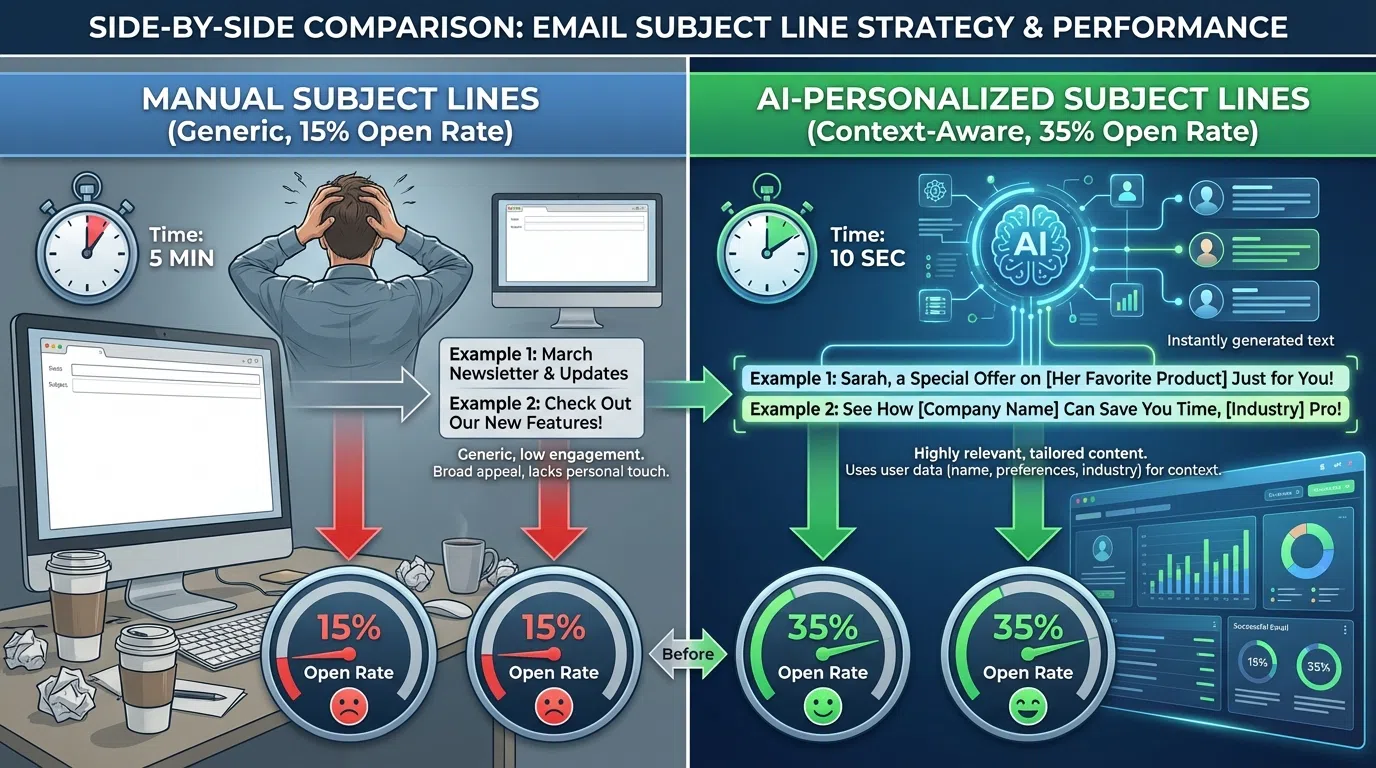
Manual personalization doesn't scale beyond 20-30 prospects daily. You can't research 100+ prospects, find relevant triggers, and craft unique subject lines for each.
AI-powered personalization solves this by:
1. Analyzing Profiles and Activity at Scale
AI scans LinkedIn profiles, recent posts, company news, job changes, and hiring activity in seconds—extracting personalization hooks automatically.
Manual: 7-11 minutes per prospect to find triggers
AI: 2-10 seconds per prospect
2. Generating Hyper-Personalized Subject Lines
AI combines triggers with your value proposition to create unique subject lines for each prospect:
Input: Prospect is Sarah, VP Sales at Acme Corp, recently posted about SDR ramp time challenges, company just raised Series B
AI Output: "Sarah, saw your post on SDR ramp time—relevant for Acme's Series B growth?"
This level of personalization achieves 40-50% open rates while scaling to 500+ prospects weekly.
3. Maintaining Quality at Volume
Manual personalization quality degrades after 40-60 prospects daily (fatigue, time pressure, burnout).
AI maintains consistent quality across unlimited volume—every prospect gets hyper-personalized subject lines based on their unique context.
4. Continuous Learning and Optimization
AI tracks which subject line types, lengths, and personalization hooks perform best for your audience—automatically optimizing future outreach.
Result: Your subject lines get better over time as AI learns what resonates with your ICP.
Conclusion: Master Subject Lines to 10x Your Cold Email Results
Your subject line determines whether your entire cold email campaign succeeds or fails. The difference between 5% and 45% open rates is subject line mastery:
Winning formula:
- Keep it short (30-50 characters)
- Personalize with triggers (not just first name)
- Make it relevant to their current situation
- Use lowercase formatting for casual feel
- Lead with value or curiosity
- Avoid spam words and clickbait
- Test continuously
Key benchmarks to target:
- 20-25% open rate: Good (basic personalization)
- 30-40% open rate: Excellent (advanced personalization)
- 40-50%+ open rate: Elite (hyper-personalization with AI)
The best subject lines combine personalization, relevance, and timing—proving you've done research and your message matters to the recipient.
Scale Hyper-Personalized Subject Lines with AI
Manual personalization limits you to 20-30 prospects daily. AI personalization scales to 500+ weekly while maintaining 40-50% open rates.
LeadSpark AI analyzes LinkedIn profiles and recent posts to generate hyper-personalized subject lines automatically—combining triggers, company context, and your value proposition into unique subject lines for every prospect.
How it works:
- Upload your prospect list from Sales Navigator or CSV
- AI analyzes profiles, posts, company news, job changes, hiring activity
- Generate personalized subject lines based on prospect-specific triggers
- Review (or auto-approve) and send through your email tool
- Track performance and optimize based on open/reply data
Sales teams using LeadSpark AI achieve 40-50% open rates (vs 5-12% manual generic) while reaching 10x more prospects in the same time.
Start your free trial and see how AI-powered subject lines transform your cold email performance. No credit card required.
Sources:
Ready to Generate Personalized Icebreakers?
Join sales professionals using LeadSpark AI to create hyper-personalized LinkedIn icebreakers in minutes.