Sales Productivity
Email Automation: Complete Guide for Sales Teams [2026]
Email automation delivers 30x more revenue than broadcast emails but cold email response rates dropped to 5-6% (vs LinkedIn's 8%). Learn multi-channel sequences combining email + LinkedIn for 287% better results, why AI-powered personalization doubles reply rates, and how elite teams use automation for 40% of email revenue with only 3% of send volume.
![Email Automation: Complete Guide for Sales Teams [2026]](/resources/email-automation-sales-teams-hero.webp)
LeadSpark AI Team
13 min read
Email automation is essential for modern sales teams, but the landscape has fundamentally changed. Cold email response rates have dropped to 5-6% on average, while multi-channel approaches combining email + LinkedIn achieve 287% better results.
The gap between top and bottom performers is widening: elite teams using AI-powered email automation achieve 10%+ reply rates and generate 40% of their email revenue from just 3% of send volume. Average teams sending high volumes get under 1% response rates.
In this comprehensive guide, you'll learn the complete email automation strategy for 2026: multi-channel sequences that combine email and LinkedIn, AI-powered personalization that doubles reply rates, proven workflows for different sales scenarios, and why precision targeting beats volume blasting by 3-5x.
Email Automation Benchmarks (2026)
Understanding current benchmarks helps you set realistic goals and identify what separates winners from losers:
Cold Email Response Rate Benchmarks
Overall averages:
- Average reply rate: 5-6% (down from 8-10% in 2023)
- Top quartile: 5.5% reply rate
- Elite performers: 10%+ reply rate
- Poor performers: Under 1% reply rate
The gap is widening: Top performers now achieve 10-20x better results than bottom performers (10% vs 0.5%).
Email vs LinkedIn Response Rates
Channel comparison:
- Cold email average: 5-6% response rate
- LinkedIn messages average: 8% response rate
- LinkedIn InMail: 10-25% response rate (if personalized)
Why LinkedIn outperforms:
- Immediate trust and context (visible profiles)
- People verify you're real before responding
- Professional platform context
- Higher perceived relevance
Bottom line: LinkedIn beats email for initial outreach, but email scales better for follow-ups.
Multi-Channel Performance
Single-channel approach:
- Email only: 5-6% response
- LinkedIn only: 8% response
Multi-channel approach:
- Email + LinkedIn: 15-20% response
- Email + LinkedIn + Phone: 25-30% response
- Result: +287% improvement with 3-channel approach
Why multi-channel wins:
- Multiple touchpoints increase visibility
- Prospects engage on their preferred channel
- Reinforces message credibility
- Captures prospects at different readiness stages
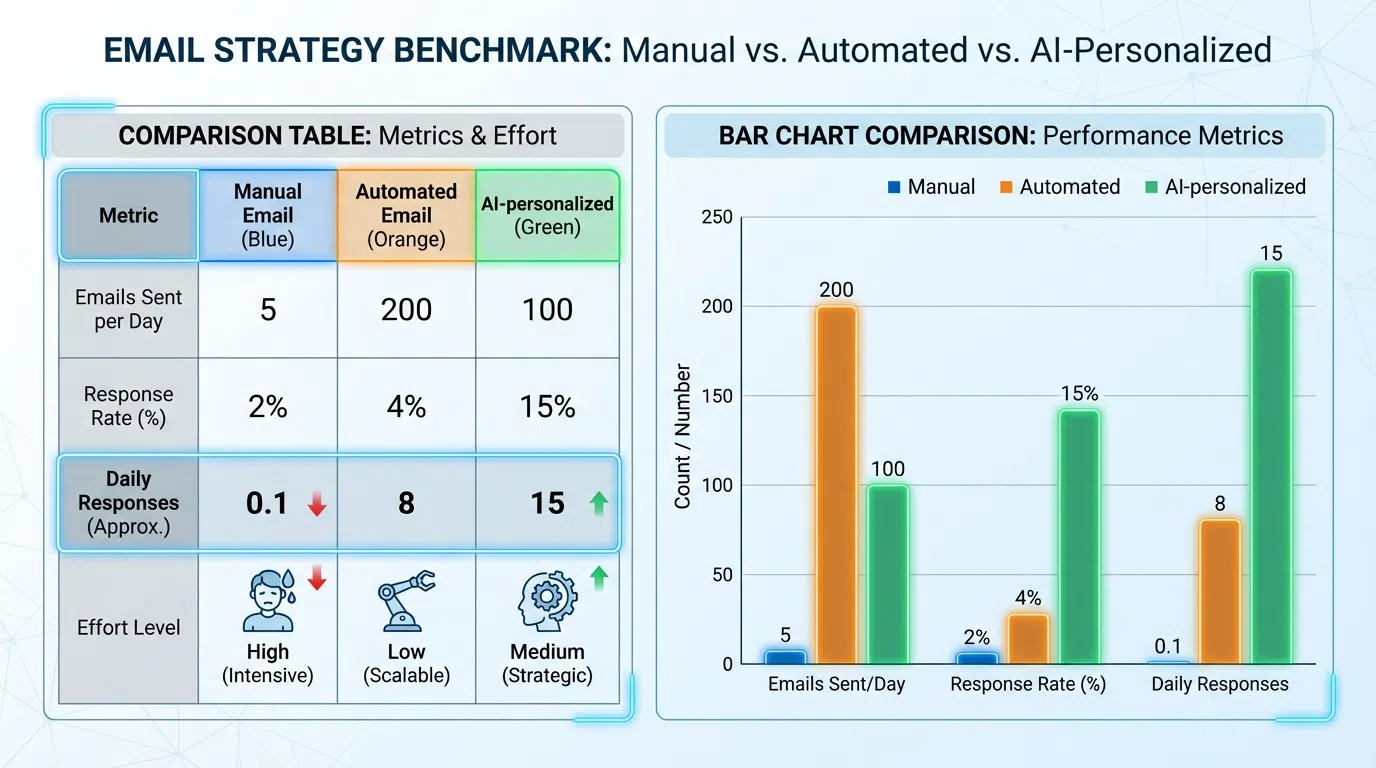
Automation vs Manual Performance
Manual emails:
- Response rate: 25-35% (with good personalization)
- Volume capacity: 20-30 emails/day
- Engagement: Higher open, click, reply rates
- Time investment: Unsustainable at scale
Generic automation:
- Response rate: 1-2% (terrible)
- Volume capacity: Unlimited
- Engagement: Low across all metrics
- Reputation risk: Spam complaints, restrictions
AI-powered automation:
- Response rate: 15-30% (matches or beats manual)
- Volume capacity: 500+ emails/week
- Engagement: High quality maintained
- Time investment: 80% reduction vs manual
Key insight: AI-powered personalization at scale achieves manual-quality results with automation efficiency.
Revenue Impact Benchmarks
Automated email flows vs broadcast:
- Automated sequences (welcome, nurture, re-engagement): 30x more revenue per send
- Generic broadcast emails: Baseline performance
- Ratio: Automated emails = 40% of revenue from 3% of volume
Why automated flows win:
- Targeted to specific behaviors/stages
- Personalized based on prospect actions
- Timed for maximum relevance
- Multi-touch nurture over time
Why Traditional Email Automation Fails
Many sales teams implement email automation wrong, leading to terrible results:
Mistake #1: Volume Over Precision
The broken approach:
"Let's send 10,000 cold emails per week and see what sticks!"
Why it fails:
- Response rate: Under 1% (50-100 responses from 10,000 sends)
- Reputation damage: Spam complaints harm sender score
- Platform restrictions: Account limitations or bans
- Wasted resources: 9,900+ emails that achieve nothing
The data:
Sending high volume often results in lower reply rates. Elite teams focus on precision: targeted outreach to 500-1,000 highly qualified prospects gets 5-10% response (50-100 responses) with no reputation damage.
Fix: Prioritize quality targeting over maximum volume.
Mistake #2: Generic Templates Without Personalization
The broken approach:
`
Subject: Quick question
Hi {{FirstName}},
I help companies like yours increase sales with our platform.
Would love to connect to discuss.
Best,
John
`
Why it fails:
- Could be sent to anyone (no relevance)
- No proof you've researched them
- Feels automated and impersonal
- Response rate: 1-2%
The data:
AI-powered personalization that references specific triggers, posts, or pain points achieves 76% higher relevance scores and doubles reply rates compared to generic templates.
Fix: Use AI to personalize based on recent activity, triggers, and company context.
Mistake #3: Email-Only Sequences
The broken approach:
Send 5-7 email touches, no other channels.
Why it fails:
- Many prospects don't engage via email
- Miss opportunities on LinkedIn, phone
- Lower overall response rates (5-6%)
The data:
Multi-channel sequences (email + LinkedIn + phone) increase response rates by 287% compared to email-only approaches.
Fix: Build multi-channel sequences that touch prospects where they engage.
Mistake #4: No AI or Intent Signals
The broken approach:
Send same message to everyone on list, no timing optimization.
Why it fails:
- Miss high-intent moments (job changes, funding, hiring)
- Equal effort on cold vs warm prospects
- Lower conversion rates
The data:
Elite cold email teams hit prospects at the right moments using intent signals and achieve 10%+ reply rates vs 3-5% for teams ignoring signals.
Fix: Use AI to identify intent signals and time outreach for maximum relevance.
Mistake #5: Set It and Forget It
The broken approach:
Build sequence once, run it for months without testing.
Why it fails:
- Performance degrades over time
- No learning or optimization
- Miss opportunities to improve
The data:
Top performing campaigns involve micro-segmentation, problem-focused messaging, frequent A/B testing, and smart automation.
Fix: Test continuously, optimize based on data, iterate messaging.
The 2026 Email Automation Strategy
Here's the proven approach that elite teams use:
1. Multi-Channel Sequence Architecture
Core principle: Combine email, LinkedIn, and phone in strategic sequences.
Tier 1 Sequence (High-Value Prospects: $50K+ deals):
- Day 1: LinkedIn connection request (personalized note referencing trigger)
- Day 3: LinkedIn message (if connected) OR Email #1 (if not connected)
- Day 6: Email #1 (value-first, share insight)
- Day 9: Phone call attempt + voicemail
- Day 12: Email #2 (reference previous touches, new angle)
- Day 15: LinkedIn message (different hook)
- Day 18: Phone call #2
- Day 21: Email #3 (breakup email: "Should I close your file?")
Channels used: 3 (LinkedIn, email, phone)
Total touches: 8
Expected response rate: 25-35%
Tier 2 Sequence (Mid-Market: $10-50K deals):
- Day 1: Email #1 (personalized, trigger-based)
- Day 3: LinkedIn connection request
- Day 6: Email #2 (value-add, new insight)
- Day 9: LinkedIn message (if connected)
- Day 12: Email #3 (social proof, case study)
- Day 15: Email #4 (breakup email)
Channels used: 2 (email, LinkedIn)
Total touches: 6
Expected response rate: 15-25%
Tier 3 Sequence (High-Volume: $1-10K deals):
- Day 1: Email #1 (AI-personalized, one hook)
- Day 4: Email #2 (different angle)
- Day 8: Email #3 (question-based)
- Day 12: Email #4 (breakup)
Channels used: 1 (email only)
Total touches: 4
Expected response rate: 8-15%
Key principle: More valuable prospects warrant more channels and touches.
2. AI-Powered Personalization at Scale
The challenge: Manual personalization doesn't scale beyond 30 emails/day.
The solution: AI analyzes prospects and generates personalized emails automatically.
How AI personalization works:
Step 1: AI Research (5-10 seconds per prospect)
- Analyzes LinkedIn profile (role, company, tenure)
- Scans recent activity (posts, comments, engagement)
- Identifies trigger events (job changes, funding, hiring)
- Extracts pain points from posts/profile
- Finds company context (news, product launches, expansion)
Step 2: Hook Identification (2-3 seconds)
- Ranks 5-10 personalization hooks by relevance
- Prioritizes recent, specific, emotional hooks
- Aligns hooks with your value proposition
Step 3: Email Generation (2-3 seconds)
- Combines best hook + context + social proof + outcome
- Maintains optimal length (75-125 words for cold email)
- Uses conversational tone, contractions
- Includes low-friction CTA
Step 4: Continuous Optimization
- Tracks which hooks and messages perform best
- Adjusts generation algorithm based on data
- Improves response rates over time (5% → 10%+)
Result: Human-quality personalization at 60-120x speed, scalable to 500+ prospects/week.
3. Intent Signal Targeting
The shift: From spray-and-pray to signal-based outreach.
High-intent signals to target:
Job Changes:
- New role within 90 days (extremely receptive)
- Promotion (celebrating, open to new ideas)
- Changed companies (setting up new processes)
Company Milestones:
- Funding rounds (growth mode, budget available)
- Hiring surges (team expansion challenges)
- Office openings (geographic expansion)
- Product launches (go-to-market support needed)
Engagement Signals:
- Visited your website
- Opened previous emails (interested but not ready)
- Engaged with your LinkedIn posts
- Downloaded content/resources
Pain Point Mentions:
- Posted about challenge you solve
- Asked question in comments related to your solution
- Shared content about problem area
Timing impact:
- Outreach within 7 days of trigger: 35-50% response rate
- Outreach 8-30 days of trigger: 20-30% response rate
- Outreach 31+ days: 10-15% response rate
Bottom line: Hit prospects when they're most receptive for 2-3x better results.
4. Precision Segmentation
The principle: Different segments require different messaging.
Segment by:
Company Stage:
- Seed/Series A: Focus on speed, efficiency, cost
- Series B/C: Focus on scaling, maintaining quality
- Enterprise: Focus on reliability, security, integration
Role:
- Founder: Time savings, ROI, strategic value
- VP Sales: Team productivity, quota attainment, cost per meeting
- SDR Manager: Ramp time, meeting volume, response rates
Industry:
- SaaS: Tech-forward, data-driven messaging
- Professional Services: ROI, billable hour efficiency
- Manufacturing: Reliability, process improvement
Pain Point:
- Low response rates: Share benchmark data, show improvement
- Long sales cycles: Case study on cycle reduction
- SDR productivity: Time savings, volume increase
Result: Relevant messaging for each segment drives 3-5x better response rates than generic "one size fits all."
5. Automated Flow Types
Different goals require different automated flows:
Cold Outreach Sequence:
- Goal: Book first meeting with new prospect
- Length: 4-8 touches over 2-3 weeks
- Personalization: High (AI-powered)
- Expected response: 5-15%
Nurture Sequence:
- Goal: Stay top-of-mind with not-ready prospects
- Length: 6-12 touches over 2-6 months
- Personalization: Medium (segment-based)
- Expected response: 10-20% over time
Re-Engagement Sequence:
- Goal: Revive cold leads who went dark
- Length: 3-5 touches over 1-2 weeks
- Personalization: High (reference previous conversations)
- Expected response: 15-25%
Event/Webinar Sequence:
- Goal: Drive registration and attendance
- Length: 4-6 touches (pre-event + post-event)
- Personalization: Medium
- Expected attendance: 30-50%
Post-Demo Follow-Up:
- Goal: Move from demo to deal
- Length: 5-8 touches over 2-4 weeks
- Personalization: High (demo-specific)
- Expected conversion: 25-40%
6. Testing and Optimization Framework
What to test:
Subject Lines:
- Length (short vs medium)
- Personalization (name vs trigger vs question)
- Tone (professional vs casual)
Email Body:
- Length (75-100 vs 100-150 words)
- Opening hook (trigger vs pain point vs value)
- Social proof inclusion (yes vs no)
- CTA (meeting vs call vs question)
Send Timing:
- Day of week (Tuesday vs Thursday vs Saturday)
- Time of day (6-8 AM vs 8-11 PM)
Personalization Level:
- Basic (name + company)
- Advanced (name + company + trigger)
- Hyper (specific post/pain point reference)
Testing protocol:
- Test 1 variable at a time
- Minimum 100 sends per variant
- Track response rate AND meeting booking rate
- Implement winners, re-test losers with modifications
Continuous improvement:
- Weekly: Review performance data
- Bi-weekly: Launch new A/B test
- Monthly: Major sequence optimization based on learnings
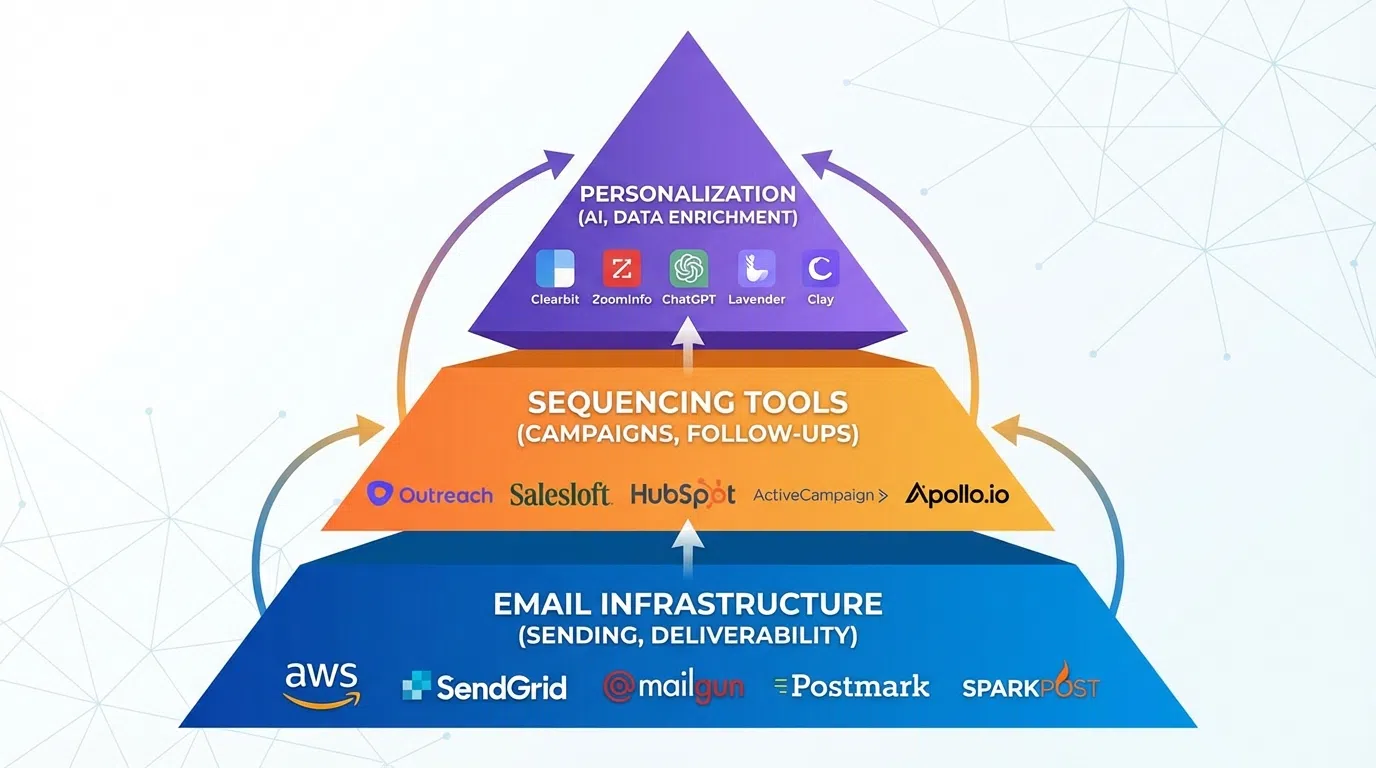
Email Automation Tools for 2026
The right tools enable effective automation:
Core Email Automation Platforms
For Cold Outreach:
- Instantly.ai: Email deliverability focus, unlimited sending
- Lemlist: Multi-channel (email + LinkedIn), strong personalization
- Saleshandy: Cold email + LinkedIn, affordable pricing
- Smartlead: AI-powered, multi-inbox management
For Marketing Automation:
- HubSpot: All-in-one, strong CRM integration
- ActiveCampaign: Advanced automation workflows
- Marketo: Enterprise-grade, complex workflows
AI Personalization Tools
For Research and Message Generation:
- LeadSpark AI: LinkedIn personalization at scale
- Persana: B2B sales intelligence, 76% higher relevance
- Clay: Multi-source data enrichment
- Closely: LinkedIn + email personalization
Multi-Channel Orchestration
For Combined Email + LinkedIn:
- Lemlist: Email sequences with LinkedIn steps
- Waalaxy: LinkedIn automation + email
- Zopto: LinkedIn + email multi-channel
Deliverability and Infrastructure
For Email Warming and Reputation:
- Warmup Inbox: Automated email warmup
- Instantly: Built-in warmup and deliverability
- Google Workspace + Custom Domains: For sending infrastructure
CRM Integration
For Workflow Automation:
- HubSpot: Native email sequences + CRM
- Salesforce: Advanced automation with Pardot/Marketing Cloud
- Pipedrive: Simple CRM with email sequences
Selection criteria:
- Multi-channel support (email + LinkedIn)
- AI personalization capabilities
- Deliverability focus (warming, rotation)
- Testing and analytics
- CRM integration
- Pricing and scalability
Best Practices for Email Automation Success
1. Start with Infrastructure
Before sending:
- Set up multiple sending domains (3-5 for volume)
- Warm up email accounts properly (30-60 days)
- Configure SPF, DKIM, DMARC records
- Use dedicated IP addresses (if high volume)
- Monitor sender reputation continuously
Why it matters: Poor infrastructure = emails land in spam, wasted effort.
2. Prioritize Quality Over Quantity
The shift: 500 highly targeted emails beat 5,000 spray-and-pray.
Quality indicators:
- ICP fit score (how well they match your ideal customer)
- Intent signals (job change, funding, pain point mention)
- Engagement history (website visit, email open, LinkedIn activity)
Volume targets:
- Tier 1 (high-value): 50-100 prospects/week
- Tier 2 (mid-market): 200-300 prospects/week
- Tier 3 (high-volume): 500-800 prospects/week
3. Combine Channels Strategically
Don't: Send 10 emails then give up.
Do: Email → LinkedIn → Phone → Email pattern.
Channel selection by tier:
- $50K+ deals: All 3 channels (email, LinkedIn, phone)
- $10-50K deals: 2 channels (email, LinkedIn)
- $1-10K deals: 1 channel (email)
4. Use AI for Personalization at Scale
Manual personalization maxes out at 30 emails/day.
AI enables:
- 500+ personalized emails/week
- Consistent quality (doesn't degrade with volume)
- 15-30% response rates (matches manual)
- 80% time savings
Where AI helps most:
- Prospect research (5-10 sec vs 8-14 min manually)
- Personalization hook identification
- Email copywriting with context
- Continuous optimization
5. Test Relentlessly
Elite teams test weekly:
- Subject lines
- Email length
- Opening hooks
- CTAs
- Send timing
Compound gains: 5% improvement per month = 80% improvement annually.
6. Respect Compliance and Best Practices
Legal requirements:
- Include unsubscribe link
- Honor opt-outs within 10 days
- Accurate from addresses
- CAN-SPAM compliance
Platform limits:
- Google Workspace: 500-2,000 emails/day per account (depending on age)
- Microsoft 365: 500-10,000 emails/day
- LinkedIn: 100 connection requests/week, <100 messages/day
Reputation protection:
- Keep bounce rate under 2%
- Keep spam complaint rate under 0.1%
- Monitor sender score (aim for 90+)
Common Email Automation Mistakes
Mistake #1: No Warmup Period
Error: Send 1,000 emails/day from brand new email account.
Result: All emails land in spam, account flagged or banned.
Fix: Warm up accounts for 30-60 days, gradually increasing volume (start 10/day, add 5-10/day weekly).
Mistake #2: Buying Email Lists
Error: Purchase "10,000 VP Sales emails" and blast them.
Result: 50-70% bounce rate, spam complaints, destroyed sender reputation, terrible response rates (under 0.5%).
Fix: Build lists organically through LinkedIn Sales Navigator, company websites, or reputable data providers (ZoomInfo, Apollo).
Mistake #3: Not Testing
Error: Build one sequence, run it for 6 months unchanged.
Result: Performance degrades, miss optimization opportunities, plateau at mediocre results.
Fix: Test 1-2 variables weekly, optimize based on data, continuously improve.
Mistake #4: Ignoring Deliverability
Error: Focus only on message content, ignore technical setup.
Result: Perfect emails that land in spam, zero results.
Fix: Monitor deliverability metrics (inbox placement, spam score), use warmup tools, maintain infrastructure.
Mistake #5: Same Message to Everyone
Error: One template for all prospects regardless of role, industry, or stage.
Result: Low relevance, poor response rates (2-3%).
Fix: Segment by role, industry, company stage—customize messaging for each segment (15-25% response).
The Future: AI-Powered Email Automation
Email automation is evolving rapidly with AI:
Current state (2026):
- AI handles research and personalization
- Humans review and approve
- Hybrid approach: AI speed + human oversight
Near future (2027-2028):
- AI generates and sends emails autonomously
- Humans focus only on conversations and closing
- AI optimizes in real-time based on engagement signals
- Predictive send timing (when prospect most likely to engage)
Technology trends:
- AI agents managing entire outbound motion
- Hyper-personalization at scale (video, images, custom content)
- Intent signal integration (real-time trigger identification)
- Multi-modal outreach (email, LinkedIn, video, direct mail)
Bottom line: Elite teams already using AI for 80% of research and sequencing work. This will increase to 95%+ within 2 years.
Conclusion: Email Automation Done Right
Email automation is essential for modern sales teams, but the old playbook doesn't work anymore.
What's changed:
- Cold email response rates dropped to 5-6% (down from 8-10%)
- LinkedIn outperforms email for initial outreach (8% vs 5-6%)
- Multi-channel beats single-channel by 287%
- AI-powered personalization doubles reply rates vs generic templates
- Precision targeting beats volume blasting by 3-5x
The winning approach:
- Build multi-channel sequences (email + LinkedIn + phone)
- Use AI for personalization at scale (15-30% response rates)
- Target intent signals (job changes, funding, pain point mentions)
- Segment precisely (role, industry, stage)
- Test continuously (weekly A/B tests)
- Focus on quality over quantity (500 targeted > 5,000 spray)
Key benchmarks to target:
- 10%+ reply rate (elite performance)
- 5.5%+ reply rate (top quartile)
- 15-25% response with multi-channel
- 30x revenue per send with automated flows
The teams winning in 2026 combine AI-powered personalization with multi-channel orchestration—achieving manual-quality results at automated scale.
Scale Your Email Automation with AI Personalization
Generic email automation gets 1-2% response rates. AI-powered personalization achieves 15-30% while reaching 10x more prospects.
LeadSpark AI analyzes LinkedIn profiles and recent posts to generate hyper-personalized cold emails at scale—combining prospect-specific triggers, pain points, and context into emails that feel 1:1 in seconds.
How it works:
- Upload your prospect list from Sales Navigator or CSV
- AI analyzes profiles, posts, company news, trigger events
- Generate personalized emails automatically (or integrate with your sequences)
- Send through your email tool, track performance, optimize
- Achieve 15-30% response rates at 500+ prospects/week
Sales teams using LeadSpark AI for email personalization see 5-15x better response rates than generic templates while reaching 10x more prospects in the same time.
Start your free trial and see how AI-powered email automation transforms your outbound results. No credit card required.
Sources:
Ready to Generate Personalized Icebreakers?
Join sales professionals using LeadSpark AI to create hyper-personalized LinkedIn icebreakers in minutes.